


Page 478 - Hematology_ Basic Principles and Practice ( PDFDrive )
P. 478
Chapter 30  Aplastic Anemia  399


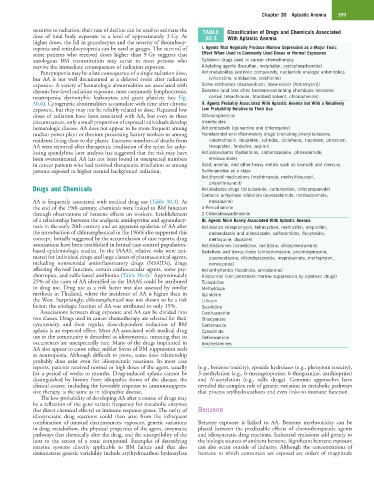
            sensitive to radiation, their rate of decline can be used to estimate the   TABLE   Classification of Drugs and Chemicals Associated
            dose  of  total  body  exposure  to  a  level  of  approximately  3 Gy.  At   30.3  With Aplastic Anemia
            higher doses, the fall in granulocytes and the severity of thrombocy-
            topenia and reticulocytopenia can be used as gauges. The survival of   I. Agents That Regularly Produce Marrow Depression as a Major Toxic
            some  patients  who  received  doses  higher  than  9 Gy  suggests  that   Effect When Used in Commonly Used Doses or Normal Exposures
            autologous  BM  reconstitution  may  occur  in  most  persons  who   Cytotoxic drugs used in cancer chemotherapy
            survive the immediate consequences of radiation exposure.  Alkylating agents (busulfan, melphalan, cyclophosphamide)
              Pancytopenia may be a late consequence of a single radiation dose,   Antimetabolites (antifolic compounds, nucleotide analogs) antimitotics
            but  AA  is  not  well  documented  as  a  delayed  event  after  radiation   (vincristine, vinblastine, colchicine)
            exposure. A variety of hematologic abnormalities are associated with   Some antibiotics (daunorubicin, doxorubicin [Adriamycin])
            chronic low-level radiation exposure, most commonly lymphocytosis,   Benzene (and less often benzene-containing chemicals: kerosene,
            neutropenia,  dysmorphic  leukocytes,  and  giant  platelets  (see  Fig.   carbon tetrachloride, Stoddard solvent, chlorophenols)
            30.6). Cytogenetic abnormalities accumulate with time after chronic   II. Agents Probably Associated With Aplastic Anemia but With a Relatively
            exposure, but they may not be reliably related to dose. Repeated low   Low Probability Relative to Their Use
            doses of radiation have been associated with AA, but even in these   Chloramphenicol
            circumstances, only a small proportion of exposed individuals develop   Insecticides
            hematologic disease. AA does not appear to be more frequent among   Antiprotozoals (quinacrine and chloroquine)
            nuclear power plant or thorium processing factory workers or among   Nonsteroidal antiinflammatory drugs (including phenylbutazone,
            residents living close to the plants. Excessive numbers of deaths from   indomethacin, ibuprofen, sulindac, diclofenac, naproxen, piroxicam,
            AA were reported after therapeutic irradiation of the spine for anky-  fenoprofen, fenbufen, aspirin)
            losing spondylitis; later analysis has suggested that the risk may have   Anticonvulsants (hydantoins, carbamazepine, phenacemide,
            been overestimated. AA has not been found in unexpected numbers   ethosuximide)
            in cancer patients who had received therapeutic irradiation or among   Gold, arsenic, and other heavy metals such as bismuth and mercury
            persons exposed to higher natural background radiation.  Sulfonamides as a class
                                                                   Antithyroid medications (methimazole, methylthiouracil,
                                                                     propylthiouracil)
            Drugs and Chemicals                                    Antidiabetes drugs (tolbutamide, carbutamide, chlorpropamide)
                                                                   Carbonic anhydrase inhibitors (acetazolamide, methazolamide,
            AA is frequently associated with medical drug use (Table 30.3). At   mesalazine)
            the end of the 19th century, chemicals were linked to BM function   D-Penicillamine
            through observations of benzene effects on workers. Establishment   2-Chlorodeoxyadenosine
            of a relationship between the analgesic amidopyrine and agranulocy-  III. Agents More Rarely Associated With Aplastic Anemia
            tosis in the early 20th century and an apparent epidemic of AA after   Antibiotics (streptomycin, tetracycline, methicillin, ampicillin,
            the introduction of chloramphenicol in the 1960s also supported this   mebendazole and albendazole, sulfonamides, flucytosine,
            concept. Initially suggested by the accumulation of case reports, drug   mefloquine, dapsone)
            associations have been established in formal case-control population-  Antihistamines (cimetidine, ranitidine, chlorpheniramine)
            based epidemiologic studies. In the IAAAS, relative risks were esti-  Sedatives and tranquilizers (chlorpromazine, prochlorperazine,
            mated for individual drugs and large classes of pharmaceutical agents,   piperacetazine, chlordiazepoxide, meprobamate, methyprylon,
            including  nonsteroidal  antiinflammatory  drugs  (NSAIDs),  drugs   remoxipride)
            affecting thyroid function, certain cardiovascular agents, some psy-  Antiarrhythmics (tocainide, amiodarone)
                                                  2
            chotropics, and sulfa-based antibiotics (Table 30.4).  Approximately   Allopurinol (can potentiate marrow suppression by cytotoxic drugs)
            25% of the cases of AA identified in the IAAAS could be attributed   Ticlopidine
            to drug use. Drug use as a risk factor was also assessed by similar   Methyldopa
            methods in Thailand, where the incidence of AA is higher than in   Quinidine
            the West. Surprisingly, chloramphenicol was not shown to be a risk   Lithium
            factor; the etiologic fraction of AA was attributed to only 15%.  Guanidine
              Associations between drug exposure and AA can be divided into   Canthaxanthin
            two classes. Drugs used in cancer chemotherapy are selected for their   Thiocyanate
            cytotoxicity,  and  their  regular,  dose-dependent  induction  of  BM   Carbimazole
            aplasia is an expected effect. Most AA associated with medical drug   Cyanamide
            use in the community is described as idiosyncratic, meaning that its   Deferoxamine
            occurrences are unexpectedly rare. Many of the drugs implicated in   Amphetamines
            AA also appear to cause other, milder forms of BM suppression such
            as neutropenia. Although difficult to prove, some dose relationship
            probably  does  exist  even  for  idiosyncratic  reactions.  In  most  case
            reports, patients received normal or high doses of the agent, usually   (e.g., benzene toxicity), epoxide hydrolases (e.g., phenytoin toxicity),
            for a period of weeks to months. Drug-induced aplasia cannot be   S-methylation (e.g., 6-mercaptopurine, 6-thioguanine, azathioprine)
            distinguished  by  history  from  idiopathic  forms  of  the  disease;  the   and  N-acetylation  (e.g.,  sulfa  drugs).  Genomic  approaches  have
            clinical course, including the favorable response to immunosuppres-  revealed the complex role of genetic variation in metabolic pathways
            sive therapy, is the same as in idiopathic disease.   that process arylhydrocarbons and even links to immune function.
              The low probability of developing AA after a course of drugs may
            be a reflection of the gene variant frequency for metabolic enzymes
            (for direct chemical effects) or immune response genes. The rarity of   Benzene
            idiosyncratic  drug  reactions  could  then  arise  from  the  infrequent
            combination of unusual circumstances: exposure, genetic variations   Benzene  exposure  is  linked  to  AA.  Benzene  myelotoxicity  can  be
            in drug metabolism, the physical properties of the agent, enzymatic   placed  between  the  predictable  effects  of  chemotherapeutic  agents
            pathways that chemically alter the drug, and the susceptibility of the   and idiosyncratic drug reactions. Industrial emissions add greatly to
            host  to  the  action  of  a  toxic  compound.  Examples  of  detoxifying   the biologic sources of ambient benzene. Significant benzene exposure
            enzyme  systems  directly  applicable  to  BM  failure  and  that  also   can also occur outside of industry. Although the concentrations of
            demonstrate genetic variability include arylhydrocarbon hydroxylase   benzene  to  which  consumers  are  exposed  are  orders  of  magnitude

