


Page 508 - Hematology_ Basic Principles and Practice ( PDFDrive )
P. 508
428    Part IV  Disorders of Hematopoietic Cell Development


        as a consequence of antibody formation against endogenous eryth-            Anemia
        ropoietin  or  while  receiving  treatment  with  recombinant  erythro-  Reticulocytopenia
        poietin. The latter condition has been referred to as epoetin-induced
        PRCA  or  EPO-PRCA  with  initial  cases  related  to  exposure  to
        epoetin alpha (Eprex; 92%) and epoetin beta (NeoRecormon; 8%).         Decreased or absent  No dysplasia
        There  are  reports  of  human  erythropoietin  (HuEPO)  neutralizing   Bone marrow exam  erythroid precursors  Normal cytogenetics
        antibody  PRCA  related  to  the  use  of  biosimilar  recombinant
        HuEPO in Thailand. There are several risk factors to the develop-  Rule out
        ment of EPO-PRCA, including subcutaneous route of administra-  drugs
        tion,  use  of  epoetin  alpha  stabilized  in  a  human  serum  albumin   systemic diseases
        (HSA)–free formulation, use of silicone oil as lubricant in prefilled   Flow cytometry  Absence of CLL, NK-LGL, or T-LGL
        Eprex syringes, and use in patients with chronic renal disease. This
        observation  has  led  to  modification  in  the  storage,  handling,  and
        administration of Eprex favoring IV administration, especially with
        Eprex  stabilized  with  HSA-free  formulation,  and  avoidance  of  the   B19 testing  Negative PCR, serology
        subcutaneous  (SC)  non–HSA  stabilized  Eprex.  Diagnostic  criteria
        have  also  been  proposed  incorporating  major  features  (treatment                     Idiopathic acquired
        with epoetin for at least 3 weeks, decrease in Hb by 0.1 g/dL/day   Family history  PRCA
        without  transfusions  or  transfusion  requirement  of  about  1  unit/
        week  to  keep  Hb  level  stable,  reticulocyte  count  less  than  10  ×                  Primary familial
          9
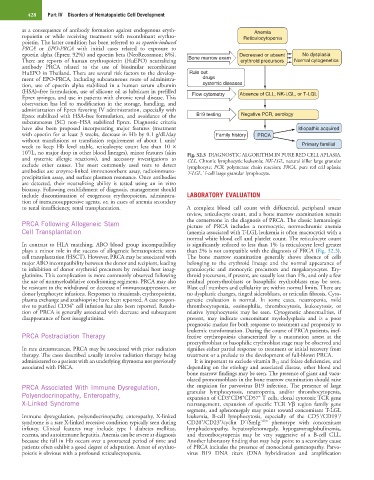
        10 /L, no major drop in other blood lineages), minor features (skin   Fig. 32.3  DIAGNOSTIC ALGORITHM IN PURE RED CELL APLASIA.
        and  systemic  allergic  reactions),  and  accessory  investigations  to   CLL, Chronic lymphocytic leukemia; NK-LGL, natural killer large granular
        exclude  other  causes.  The  most  commonly  used  tests  to  detect   lymphocyte; PCR, polymerase chain reaction; PRCA, pure red cell aplasia;
        antibodies are enzyme-linked immunosorbent assay, radioimmuno-  T-LGL, T-cell large granular lymphocyte.
        precipitation assay, and surface plasmon resonance. Once antibodies
        are  detected,  their  neutralizing  ability  is  tested  using  an  in  vitro
        bioassay. Following establishment of diagnosis, management should
        include  discontinuation  of  exogenous  erythropoietin,  administra-  LABORATORY EVALUATION
        tion of immunosuppressive agents, or, in cases of anemia secondary
        to renal insufficiency, renal transplantation.        A  complete  blood  cell  count  with  differential,  peripheral  smear
                                                              review, reticulocyte count, and a bone marrow examination remain
        PRCA Following Allogeneic Stem                        the cornerstone in the diagnosis of PRCA. The classic hematologic
                                                              picture  of  PRCA  includes  a  normocytic,  normochromic  anemia
        Cell Transplantation                                  (anemia associated with T-LGL leukemia is often macrocytic) with a
                                                              normal white blood cell and platelet count. The reticulocyte count
        In  contrast  to  HLA  matching,  ABO  blood  group  incompatibility   is significantly reduced to less than 1% (a reticulocyte level greater
        plays a minor role in the success of allogeneic hematopoietic stem   than 2% is not compatible with the diagnosis of PRCA (Fig. 32.3).
        cell transplantation (HSCT). However, PRCA may be associated with   The  bone  marrow  examination  generally  shows  absence  of  cells
        major ABO incompatibility between the donor and recipient, leading   belonging  to  the  erythroid  lineage  and  the  normal  appearance  of
        to inhibition of donor erythroid precursors by residual host isoag-  granulocytic  and  monocytic  precursors  and  megakaryocytes.  Ery-
        glutinins. This complication is more commonly observed following   throid precursors, if present, are usually less than 1%, and only a few
        the use of nonmyeloablative conditioning regimens. PRCA may also   residual  proerythroblasts  or  basophilic  erythroblasts  may  be  seen.
        be resistant to the withdrawal or decrease of immunosuppression, or   Blast cell numbers and cellularity are within normal limits. There are
        donor lymphocyte infusions. Responses to rituximab, erythropoietin,   no dysplastic changes, ringed sideroblasts, or reticulin fibrosis. Cyto-
        plasma exchange and azathioprine have been reported. A case respon-  genetic  evaluation  is  normal.  In  some  cases,  neutropenia,  mild
                         +
        sive to purified CD34  cell infusion has also been reported. Resolu-  thrombocytopenia,  eosinophilia,  thrombocytosis,  leukocytosis,  or
        tion of PRCA is generally associated with decrease and subsequent   relative  lymphocytosis  may  be  seen.  Cytogenetic  abnormalities,  if
        disappearance of host isoagglutinins.                 present,  may  indicate  concomitant  myelodysplasia  and  is  a  poor
                                                              prognostic marker for both response to treatment and propensity to
                                                              leukemic transformation. During the course of PRCA patients, inef-
        PRCA Postradiation Therapy                            fective  erythropoiesis  characterized  by  a  maturation  arrest  at  the
                                                              proerythroblast or basophilic erythroblast stage may be observed and
        In rare circumstances, PRCA may be associated with prior radiation   signifies either partial response to treatment or initial recovery from
        therapy. The cases described usually involve radiation therapy being   treatment or a prelude to the development of full-blown PRCA.
        administered to a patient with an underlying thymoma not previously   It is important to exclude vitamin B 12  and folate deficiencies, and
        associated with PRCA.                                 depending on the etiology and associated disease, other blood and
                                                              bone marrow findings may be seen. The presence of giant and vacu-
                                                              olated pronormoblasts in the bone marrow examination should raise
        PRCA Associated With Immune Dysregulation,            the  suspicion  for  parvovirus  B19  infection. The  presence  of  large
        Polyendocrinopathy, Enteropathy,                      granular  lymphocytosis,  neutropenia,  and/or  thrombocytopenia,
                                                                                      +
                                                                            +
                                                                                +
                                                              expansion of CD3 CD8 CD57  T cells, clonal cytotoxic TCR gene
        X-Linked Syndrome                                     rearrangement,  expansion  of  specific TCR  Vβ  region  family  gene
                                                              segment, and splenomegaly may point toward concomitant T-LGL
                                                                                                               +
                                                                                                         +
        Immune  dysregulation,  polyendocrinopathy,  enteropathy,  X-linked   leukemia,  B-cell  lymphocytosis,  especially  of  the  CD5 /CD19 /
                                                                         +
                                                                   +
                                                                                 −
        syndrome is a rare X-linked recessive condition typically seen during   CD20 /CD23 /cyclin  D /SmIg −dim   phenotype  with  concomitant
        infancy.  Clinical  features  may  include  type  1  diabetes  mellitus,   lymphadenopathy,  hepatosplenomegaly,  hypogammaglobulinemia,
        eczema, and autoimmune hepatitis. Anemia can be severe at diagnosis   and  thrombocytopenia  may  be  very  suggestive  of  a  B-cell  CLL.
        because the fall in Hb occurs over a protracted period of time and   Another laboratory finding that may help point to a secondary cause
        patients often exhibit a good degree of adaptation. Arrest of erythro-  of PRCA includes the presence of monoclonal gammopathy. Parvo-
        poiesis is obvious with a profound reticulocytopenia.  virus  B19  DNA  titers  (DNA  hybridization  and  amplification

