


Page 509 - Hematology_ Basic Principles and Practice ( PDFDrive )
P. 509
Chapter 32  Acquired Disorders of Red Cell, White Cell, and Platelet Production  429

                                                                  Medical
            techniques) may show high levels of the virus at 10 genome copies
                     118
            per milliliter,  but it is important to note that serologic (IgM and
            IgG) titers are usually absent. Erythropoietin antibodies, antinuclear   Supportive
            antibodies,  and/or  complement  consumption  may  point  toward  a
            specific  disease  mechanism.  A  radiographic  workup  may  also  be   Supportive care includes blood transfusions and iron chelation.
            useful in the clinical workup because chest x-ray examination or CT
            scan may show evidence of a thymoma.
                                                                  Immunosuppression
            DIFFERENTIAL DIAGNOSIS                                Prednisone  therapy  is  associated  with  significant  response  rates
                                                                  (approximately  40%)  and  should  constitute  the  initial  therapeutic
            PRCA  can  be  easily  differentiated  from  aplastic  anemia  and  other   approach. Initial responses are generally observed after 4 to 6 weeks.
            types of bone marrow failure syndromes. A distinction between MDS   A  slow  taper  of  prednisone  is  suggested  over  a  period  of  3  to  4
            with erythroid hypoplasia and idiopathic PRCA may be more diffi-  months. The disease may relapse, and the minimal maintenance dose
            cult. In childhood, TEC has to be distinguished from DBA, but a   of corticosteroids may need to be established to maintain the desired
            history of normal blood counts, late onset of manifestations, and a   Hb  levels.  Trials  of  prednisone  therapy  without  clinical  response
            transient disease course are characteristic of TEC.   longer than 8 weeks are not warranted.
                                                                    Alternative  therapies  may  include  cyclosporine,  oral  cyclophos-
                                                                  phamide,  azathioprine,  antithymocyte  globulin  (ATG),  rituximab,
            THERAPY                                               and alemtuzumab (see Table 32.3). Erythropoietin and darbepoietin
                                                                  are  usually  not  effective  as  a  sole  agent  but  may  hasten  recovery
            The distinction between primary and secondary forms of PRCA is   following  an  adequate  trial  of  cyclophosphamide.  No  randomized
            essential because many secondary types have specific and very effec-  trials  exist  to  favor  a  particular  treatment  based  on  efficacy.
            tive therapies (Table 32.3). All potentially offending drugs should be   The  choice  of  therapy  may  be  influenced  by  clinical  clues.  For
            discontinued, and drug-associated PRCA should remit within 3 to 4   example,  the  presence  of  LGLs  may  suggest  the  use  of  CsA,
            weeks. Nutritional deficiencies (B 12  and folic acid) should be excluded   hypogammaglobulinemia  may  be  corrected  with  IVIg,  whereas
            and treated if present. The therapy of primary and secondary forms   detection of hypergammaglobulinemia or monoclonal protein may
            of PRCA refractory to the treatment of an underlying disease may be   suggest  a  choice  of  rituximab.  Most  refractory  cases  may  require
            challenging and should include a sequential trial of various immuno-  administration  of  ATG. The  age  of  the  patient  may  influence  the
            suppressive agents until a response is achieved. Spontaneous remis-  choice  of  the  cytotoxic  agent,  which  may  pose  a  significant  risk
            sions have been reported.                             for  the  development  of  secondary  leukemias,  especially  with  a
                                                                  prolonged administration.
                                                                    Danazol is a synthetic attenuated androgen that has been used for
            Surgery or Radiation                                  many years for the treatment of a variety of hematologic disorders,
                                                                  mainly myelofibrosis.
            In cases associated with thymoma, thymectomy is the usual initial   IVIg is also effective in several types of PRCA. Higher doses of
            treatment  of  choice  before  immunosuppression  and  may  induce   usually 2 g/kg of IVIg for 5 days are necessary for the treatment of
            remission with return of erythropoiesis in 4 to 8 weeks in about 30%   parvovirus B19 virus–induced PRCA. In AIDS patients with parvo-
            to 40% of patients. Patients who fail to respond to surgery should be   virus  B19  virus–induced  PRCA,  a  regimen  consists  of  induction
            treated as patients with idiopathic PRCA. The removal of a thymoma   therapy with 1 g/kg daily for 1–2 days followed by 1 g/kg for 2 days.
            may improve responsiveness to immunosuppressive therapy. Thymec-  Azathioprine  is  an  imidazolyl  derivative  of  mercaptopurine
            tomy in the absence of a thymoma in other forms of PRCA is not   that  inhibits  DNA  synthesis  by  inhibition  of  purine  metabolism.
            recommended. In circumstances where surgical resection of thymoma   In  PRCA,  it  may  be  given  at  a  dose  of  2–3 mg/kg/day  IV  and
            is contraindicated, radiation therapy with or without chemotherapy   has  been  found  to  be  effective  in  patients  nonresponsive  to
            may be administered.                                  cyclophosphamide.


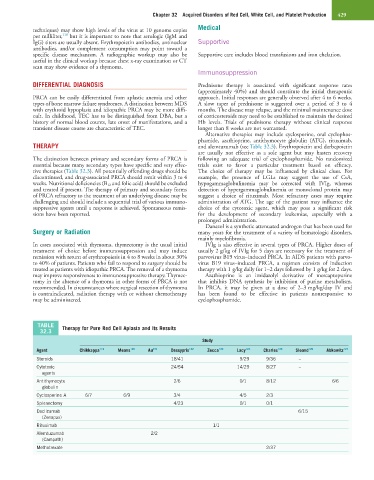
             TABLE   Therapy for Pure Red Cell Aplasia and Its Results
              32.3
                                                                   Study
             Agent         Chikkappa 119  Means 120  Au 121  Dessypris 122  Zecca 123  Lacy 124  Charles 125  Sloand 126  Abkowitz 127
             Steroids                                    18/41                 9/29     9/36       –
             Cytotoxic                                   24/54                 14/29    8/27       –
               agents
             Antithymocyte                                2/6                  0/1      8/12                  6/6
               globulin
             Cyclosporine A  6/7         6/9              3/4                  4/5      2/3
             Splenectomy                                  4/23                 0/1      0/1
             Daclizumab                                                                            6/15
               (Zenapax)
             Rituximab                                                 1/1
             Alemtuzumab                          2/2
               (Campath)
             Methotrexate                                                               2/37

