


Page 512 - Hematology_ Basic Principles and Practice ( PDFDrive )
P. 512
432    Part IV  Disorders of Hematopoietic Cell Development


        familial  forms  of  neutropenia.  The  etiology  of  this  condition  is   TABLE
        unknown,  but  the  pathogenesis  involves  ANAs,  detectable  in  the   32.6   Drugs Associated With Agranulocytosis
        majority  of  patients. The  antibodies  are  generally  directed  against
        similar antigens as seen in adult AIN, especially those involving NA,          Etiologic Fraction
        NB, and ND loci. In about 25% of cases, the antibody is against an     Agranulocytosis (%)  Aplastic Anemia (%)
        allele of neutrophil FcγRIII opsonin receptor called NA1. Immuno-
        suppressive  therapy  leads  frequently  to  responses  supporting  the   Overall  64           62
        immune pathogenesis of this disease. Although the neutrophil count   IAAAS  12                  27
        can  be  severely  depressed,  serious  infectious  complications  are   United States  72      17
        uncommon, and therefore treatment to raise the ANC is generally
        not indicated except if recurrent infections occur. Antibiotics are used   Thailand  70          2
        to treat infections, and granulocyte colony-stimulating factor (G-CSF)   Drugs associated with agranulocytosis (IAAAS and other drugs of interest)
        has been shown to be effective in elevating neutrophil counts.  Acetyldigoxin 172
                                                               ACE inhibitors 173,174
                                                                      175–177
        SECONDARY FORMS OF NEUTROPENIAS                        Allopurinol  178
                                                               Amodiaquine
        Clinical Associations                                  Benzafibrate 179
                                                                      172,180
                                                               β-Blockers
                                                               β-Lactam antibiotics 181
        Drug-Induced Neutropenia/Agranulocytosis               Carbamazepine 182
                                                               Cinepazide 183,184
                                                               Corticosteroids 185
        Drug-induced  neutropenia  is  common.  The  association  was  first   Cotrimoxazole, 186  other sulfonamides
        when agranulocytosis was observed in patients taking aminopyrine.   Dipyridamole 172
        The incidence in various studies is 1 to 3.4 cases per million per year.   Deferasirox (Exjade) 187
        Drugs may induce granulocytopenia by (1) direct toxicity leading to   Dypirone 171,188
        inhibition of myelopoiesis frequently observed in drugs like valproic   Histamine-2 receptor antagonist 189
        acid, carbamazepine, and β-lactam antibiotics; (2) immune mediated   Indomethacin 190
        (either antibody- or complement-mediated) as seen with penicillin   Isoniazid 191,192
        and  antithyroid  drugs  or  immune  complex–mediated  (quinidine)   Macrolides 193,194
        destruction of myeloid progenitors and mature neutrophils; and (3)   Mefloquine 195
        induction  of  CTL  responses  to  genetic  predisposition  because  of   Nifedipine 196
        polymorphisms in various genes coding for cytokine and cytokine   Phenytoin 197,198
        receptors as demonstrated for clozapine with tumor necrosis factor   Procainamide 199,200
        and HLA polymorphisms as well as variants of genes coding for a   Salicylates 201
        variety  of  metabolizing  enzymes. 169,170   Of  interest  are  drugs  that   Sulfasalazine 202,203
        directly antagonize important vitamin cofactors necessary in normal   Sulfonylureas 204,205
        bone marrow development. Neutropenia observed in patients treated   Tetracyclines 171
        with  trimethoprim-sulfamethoxazole  is  caused  by  the  inhibitory   Thenalidine
        effects  on  granulopoiesis  by  trimethoprim,  owing  to  its  antifolate   Thyrostatics 206–208
        action, which is reversed by folinic acid. A similar finding can be seen   Troxerutine 171
        with methotrexate owing to its antifolate action.
           Most  patients  present  with  either  asymptomatic  neutropenia   ACE, Angiotensin-converting enzyme; IAAAS, International Agranulocytosis and
                                                               Aplastic Anemia Study.
        discovered  on  routine  examination  or  symptomatic  neutropenia
        with  infectious  complications,  including  fever,  angular  stomatitis,
        or pneumonia. The reported mortality rates vary from 1% to 25%.
        Most patients recover with withdrawal of the offending drug without
        further complications. It has been estimated that drugs account for   hematopoiesis, granulocyte sequestration, margination, and periph-
        72% of cases of agranulocytosis. The usual time to development of   eral destruction. Neutropenia generally improves when the viremia
        overt  neutropenia  is  around  1–2  weeks,  and  neutropenia  resolves   resolves. Neutropenia has been associated with hepatitis A, B, and C
        upon discontinuation of the offending drug within a 2-week period,   viruses, EBV, influenza, measles, roseola, CMV, and parvovirus B19
        although  time  to  recovery  may  vary.  The  recovery  in  neutrophil   infections.  Neutropenia  is  also  frequently  encountered  in  patients
        counts is usually preceded by increases in peripheral blood monocytes   with AIDS, with approximately 70% of patients being neutropenic
        and immature granulocytes. The International Agranulocytosis and   during their illness. The mechanisms vary and may include antibody
        Aplastic Anemia Study has identified the most commonly associated   formation against neutrophils, direct viral inhibition of hematopoietic
        agents  and  the  relative  odds  ratios  for  developing  agranulocytosis   progenitor  cells,  abnormal  expression  of  growth  factors  and  other
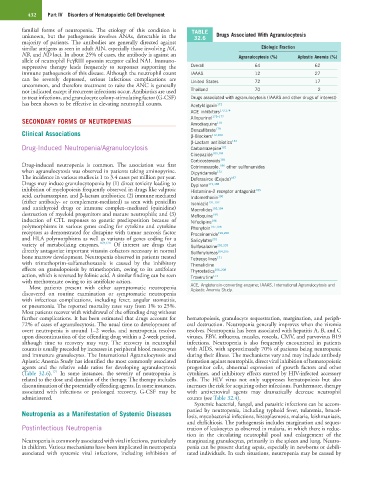
                  171
        (Table  32.6).   In  some  instances,  the  severity  of  neutropenia  is   cytokines, and inhibitory effects exerted by HIV-infected accessory
        related to the dose and duration of the therapy. The therapy includes   cells.  The  HIV  virus  not  only  suppresses  hematopoiesis  but  also
        discontinuation of the potentially offending agents. In some instances,   increases the risk for acquiring other infections. Furthermore, therapy
        associated  with  infections  or  prolonged  recovery,  G-CSF  may  be     with  antiretroviral  agents  may  dramatically  decrease  neutrophil
        administered.                                         counts (see Table 32.4).
                                                                 Systemic bacterial, fungal, and parasitic infections can be accom-
        Neutropenia as a Manifestation of Systemic Diseases   panied by neutropenia, including typhoid fever, tularemia, brucel-
                                                              losis, mycobacterial infections, histoplasmosis, malaria, leishmaniasis,
                                                              and ehrlichiosis. The pathogenesis includes margination and seques-
        Postinfectious Neutropenia                            tration of leukocytes as observed in malaria, in which there is reduc-
                                                              tion  in  the  circulating  neutrophil  pool  and  enlargement  of  the
        Neutropenia is commonly associated with viral infections, particularly   marginating granulocytes, primarily in the spleen and lung. Neutro-
        in children. Various mechanisms have been implicated in neutropenia   penia can be present during sepsis, especially in newborns or debili-
        associated  with  systemic  viral  infections,  including  inhibition  of   tated individuals. In such situations, neutropenia may be caused by

