


Page 511 - Hematology_ Basic Principles and Practice ( PDFDrive )
P. 511
Chapter 32  Acquired Disorders of Red Cell, White Cell, and Platelet Production  431


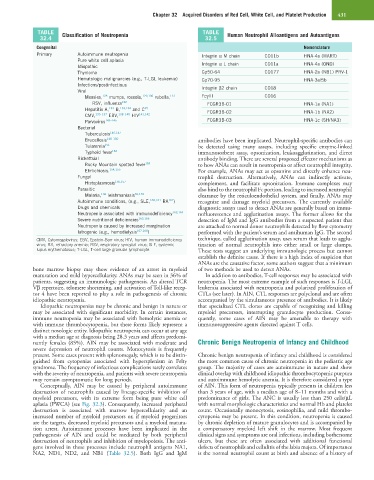
             TABLE   Classification of Neutropenia                 TABLE   Human Neutrophil Alloantigens and Autoantigens
              32.4                                                  32.5
             Congenital                                                                             Nomenclature
             Primary      Autoimmune neutropenia                   Integrin α M chain   CD11b       HNA-4a (MART)
                          Pure white cell aplasia
                          Idiopathic                               Integrin α L chain   CD11a       HNA-4a (OND)
                          Thymoma                                  Gp50-64              CD177       HNA-2a (NB1) PRV-1
                          Hematologic malignancies (e.g., T-LGL leukemia)  Gp70-95                  HNA-3a/5b
                          Infections/postinfectious                Integrin β2 chain    CD18
                          Viral
                             Measles, 128  mumps, roseola, 129,130  rubella, 131    FcγIII  CD16
                               RSV, influenza 132                    FCGR3B-01                      HNA-1a (NA1)
                             Hepatitis A, 133  B, 133,134  and C 35    FCGR3B-02                    HNA-1b (NA2)
                             CMV, 135–137  EBV, 138–140  HIV 141,142
                             Parvovirus 143–145                      FCGR3B-03                      HNA-1c (SH/NA3)
                          Bacterial
                             Tuberculosis 146,147
                             Brucellosis 148–150                  antibodies have been implicated. Neutrophil-specific antibodies can
                             Tularemia 151                        be  detected  using  many  assays,  including  specific  enzyme-linked
                             Typhoid fever 152                    immunosorbent assay, opsonization, leukoagglutination, and direct
                          Rickettsial                             antibody binding. There are several proposed effector mechanisms as
                             Rocky Mountain spotted fever 153     to how ANAs can result in neutropenia or affect neutrophil integrity.
                             Ehrlichiosis. 154,155                For example, ANAs may act as opsonins and directly enhance neu-
                          Fungal                                  trophil  destruction.  Alternatively,  ANAs  can  indirectly  activate,
                             Histoplasmosis 156,157               complement,  and  facilitate  opsonization.  Immune  complexes  may
                          Parasitic                               also bind to the neutrophil Fc portion, leading to increased neutrophil
                             Malaria, 158  leishmaniasis 36,159   clearance by the reticuloendothelial system, and finally, ANAs may
                          Autoimmune conditions, (e.g., SLE, 160,161  RA 162 )  recognize  and  damage  myeloid  precursors. The  currently  available
                          Drugs and chemicals                     diagnostic assays used to detect ANAs are generally based on immu-
                          Neutropenia associated with immunodeficiency 163,164  nofluorescence and agglutination assays. The former allows for the
                          Severe nutritional deficiencies 165,166  detection of IgM and IgG antibodies from a suspected patient that
                          Neutropenia caused by increased margination  are attached to normal donor neutrophils detected by flow cytometry
                          Iatrogenic (e.g., hemodialysis 167,168 )  performed with the patient’s serum and antihuman IgG. The second
             CMV, Cytomegalovirus; EBV, Epstein-Barr virus; HIV, human immunodeficiency   technique, called agglutination assay, uses serum that leads to agglu-
             virus; RA, refractory anemia; RSV, respiratory syncytial virus; SLE, systemic   tination  of  normal  neutrophils  into  either  small  or  large  clumps.
             lupus erythematosus; T-LGL, T-cell large granular lymphocyte.  These tests suggest an underlying immunologic process but cannot
                                                                  establish the definite cause. If there is a high index of suspicion that
                                                                  ANAs are the causative factor, some authors suggest that a minimum
            bone  marrow  biopsy  may  show  evidence  of  an  arrest  in  myeloid   of two methods be used to detect ANAs.
            maturation and mild hypercellularity. ANAs may be seen in 36% of   In addition to antibodies, T-cell responses may be associated with
            patients, suggesting an immunologic pathogenesis. An altered TCR   neutropenia. The most extreme example of such responses is T-LGL
            Vβ repertoire, telomere shortening, and activation of Toll-like recep-  leukemia associated with neutropenia and polarized proliferation of
            tor 4 have been reported to play a role in pathogenesis of chronic   CTLs (see later). In AIN, CTL responses are polyclonal and are often
            idiopathic neutropenia.                               accompanied by the simultaneous presence of antibodies. It is likely
              Idiopathic neutropenias may be chronic and benign in nature or   that specialized CTL clones are capable of recognizing and killing
            may  be  associated  with  significant  morbidity.  In  certain  instances,   myeloid  precursors,  interrupting  granulocyte  production.  Conse-
            immune neutropenia may be associated with hemolytic anemia or   quently,  some  cases  of  AIN  may  be  amenable  to  therapy  with
            with immune thrombocytopenia, but these forms likely represent a   immunosuppressive agents directed against T cells.
            distinct nosologic entity. Idiopathic neutropenia can occur at any age
            with a median age at diagnosis being 28.3 years and affects predomi-
            nantly  females  (85%).  AIN  may  be  associated  with  moderate  and   Chronic Benign Neutropenia of Infancy and Childhood
            severe  depression  of  neutrophil  counts.  Monocytosis  is  frequently
            present. Some cases present with splenomegaly, which is to be distin-  Chronic benign neutropenia of infancy and childhood is considered
            guished  from  cytopenias  associated  with  hypersplenism  in  Felty   the most common cause of chronic neutropenia in the pediatric age
            syndrome. The frequency of infectious complications rarely correlates   group. The majority of cases are autoimmune in nature and show
            with the severity of neutropenia, and patients with severe neutropenia   clinical overlap with childhood idiopathic thrombocytopenic purpura
            may remain asymptomatic for long periods.             and autoimmune hemolytic anemia. It is therefore considered a type
              Conceptually,  AIN  may  be  caused  by  peripheral  autoimmune   of AIN. This form of neutropenia typically presents in children less
            destruction  of  neutrophils  caused  by  lineage-specific  inhibition  of   than 3 years of age, with a median age of 8–11 months and with a
            myeloid  precursors,  with  its  extreme  form  being  pure  white  cell   predominance of girls. The ANC is usually less than 250 cells/µL
            aplasia (PWCA) (see Fig. 32.3). Consequently, increased peripheral   with normal morphologic characteristics and normal Hb and platelet
            destruction  is  associated  with  marrow  hypercellularity  and  an   count. Occasionally monocytosis, eosinophilia, and mild thrombo-
            increased number of myeloid precursors or, if myeloid progenitors   cytopenia may be present. In this condition, neutropenia is caused
            are the targets, decreased myeloid precursors and a myeloid matura-  by chronic depletion of mature granulocytes and is accompanied by
            tion  arrest.  Autoimmune  processes  have  been  implicated  in  the   a  compensatory  myeloid  left  shift  in  the  marrow.  Most  frequent
            pathogenesis  of  AIN  and  could  be  mediated  by  both  peripheral   clinical signs and symptoms are oral infections, including bothersome
            destruction of neutrophils and inhibition of myelopoiesis. The anti-  ulcers,  but  these  are  often  associated  with  additional  functional
            gens involved in these processes include neutrophil antigens NA1,   defects of neutrophils and cellulitis of the labia majora. Of importance
            NA2,  ND1,  ND2,  and  NB1  (Table  32.5).  Both  IgG  and  IgM   is the normal neutrophil count at birth and absence of a history of

