


Page 544 - Hematology_ Basic Principles and Practice ( PDFDrive )
P. 544
Chapter 34  Approach to Anemia in the Adult and Child  459


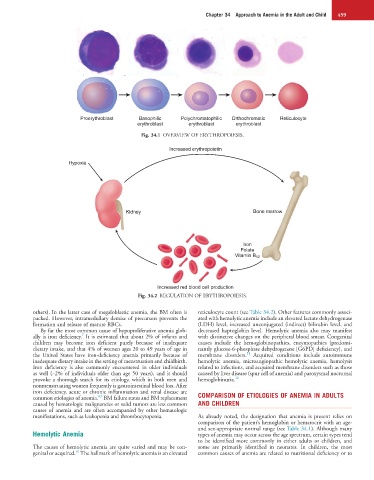
                           Proerythroblast    Basophilic    Polychromatophilic  Orthochromatic  Reticulocyte
                                              erythroblast     erythroblast   erythroblast
                                               Fig. 34.1  OVERVIEW OF ERYTHROPOIESIS.

                                                        Increased erythropoietin

                       Hypoxia


                                          Kidney                                    Bone marrow


                                                                                 Iron
                                                                                Folate
                                                                              Vitamin B 12


                                                     Increased red blood cell production
                                              Fig. 34.2  REGULATION OF ERYTHROPOIESIS.

            others). In the latter case of megaloblastic anemia, the BM often is   reticulocyte count (see Table 34.2). Other features commonly associ-
            packed. However, intramedullary demise of precursors prevents the   ated with hemolytic anemia include an elevated lactate dehydrogenase
            formation and release of mature RBCs.                 (LDH) level, increased unconjugated (indirect) bilirubin level, and
              By far the most common cause of hypoproliferative anemia glob-  decreased  haptoglobin  level.  Hemolytic  anemia  also  may  manifest
                            7
            ally is iron deficiency.  It is estimated that about 2% of infants and   with distinctive changes on the peripheral blood smear. Congenital
            children  may  become  iron  deficient  purely  because  of  inadequate   causes  include  the  hemoglobinopathies,  enzymopathies  (predomi-
            dietary intake, and that 4% of women ages 20 to 49 years of age in   nantly glucose-6-phosphate dehydrogenase [G6PD] deficiency), and
                                                                                  11
            the  United  States  have  iron-deficiency  anemia  primarily  because  of   membrane  disorders.   Acquired  conditions  include  autoimmune
            inadequate dietary intake in the setting of menstruation and childbirth.   hemolytic  anemia,  microangiopathic  hemolytic  anemia,  hemolysis
            Iron  deficiency  is  also  commonly  encountered  in  older  individuals   related to infections, and acquired membrane disorders such as those
            as well (~2% of individuals older than age 50 years), and it should   caused by liver disease (spur cell of anemia) and paroxysmal nocturnal
            provoke a thorough search for its etiology, which in both men and   hemoglobinuria. 12
            nonmenstruating women frequently is gastrointestinal blood loss. After
            iron deficiency, acute or chronic inflammation and renal disease are
                                 8,9
            common etiologies of anemia.  BM failure states and BM replacement   COMPARISON OF ETIOLOGIES OF ANEMIA IN ADULTS
            caused by hematologic malignancies or solid tumors are less common   AND CHILDREN
            causes  of  anemia  and  are  often  accompanied  by  other  hematologic
            manifestations, such as leukopenia and thrombocytopenia.  As  already  noted,  the  designation  that  anemia  is  present  relies  on
                                                                  comparison of the patient’s hemoglobin or hematocrit with an age-
                                                                  and sex-appropriate normal range (see Table 34.1). Although many
            Hemolytic Anemia                                      types of anemia may occur across the age spectrum, certain types tend
                                                                  to  be  identified  more  commonly  in  either  adults  or  children,  and
            The causes of hemolytic anemia are quite varied and may be con-  some  are  primarily  identified  in  neonates.  In  children,  the  most
                          10
            genital or acquired.  The hallmark of hemolytic anemia is an elevated   common causes of anemia are related to nutritional deficiency or to

