


Page 566 - Hematology_ Basic Principles and Practice ( PDFDrive )
P. 566
Chapter 36  Disorders of Iron Homeostasis  481


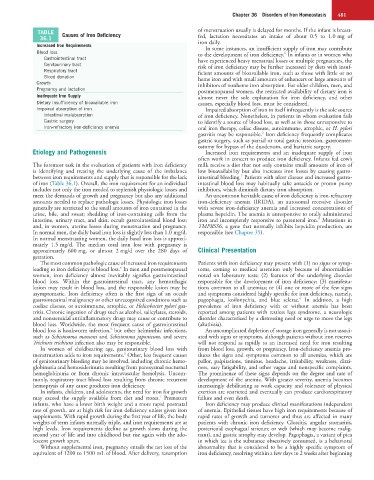
             TABLE   Causes of Iron Deficiency                    of menstruation usually is delayed for months. If the infant is breast-
              36.1                                                fed,  lactation  necessitates  an  intake  of  about  0.5  to  1.0 mg  of
             Increased Iron Requirements                          iron daily.
                                                                    In some instances, an insufficient supply of iron may contribute
             Blood loss                                           to the development of iron deficiency.  In infants or in women who
                                                                                              6
               Gastrointestinal tract                             have experienced heavy menstrual losses or multiple pregnancies, the
               Genitourinary tract                                risk of iron deficiency may be further increased by diets with insuf-
               Respiratory tract                                  ficient amounts of bioavailable iron, such as those with little or no
               Blood donation                                     heme iron and with small amounts of enhancers or large amounts of
             Growth                                               inhibitors of nonheme iron absorption. For older children, men, and
             Pregnancy and lactation                              postmenopausal women, the restricted availability of dietary iron is
             Inadequate Iron Supply                               almost  never  the  sole  explanation  for  iron  deficiency,  and  other
             Dietary insufficiency of bioavailable iron           causes, especially blood loss, must be considered.
             Impaired absorption of iron                            Impaired absorption of iron in itself infrequently is the sole source
               Intestinal malabsorption                           of iron deficiency. Nonetheless, in patients in whom evaluation fails
               Gastric surgery                                    to identify a source of blood loss, as well as in those unresponsive to
               Iron-refractory iron-deficiency anemia             oral iron therapy, celiac disease, autoimmune, atrophic, or H. pylori
                                                                                       6
                                                                  gastritis may be responsible.  Iron deficiency frequently complicates
                                                                  gastric surgery, such as partial or total gastric resection, gastroenter-
                                                                  ostomy for bypass of the duodenum, and bariatric surgery.
            Etiology and Pathogenesis                               Increased  iron  requirements  and  an  inadequate  supply  of  iron
                                                                  often work in concert to produce iron deficiency. Infants fed cow’s
            The foremost task in the evaluation of patients with iron deficiency   milk receive a diet that not only contains small amounts of iron of
            is  identifying  and  treating  the  underlying  cause  of  the  imbalance   low bioavailability but also increases iron losses by causing gastro-
                                                                                7
            between iron requirements and supply that is responsible for the lack   intestinal bleeding.  Patients with ulcer disease and increased gastro-
            of iron (Table 36.1). Overall, the iron requirement for an individual   intestinal blood loss may habitually take antacids or proton pump
            includes not only the iron needed to replenish physiologic losses and   inhibitors, which diminish dietary iron absorption.
            meet the demands of growth and pregnancy but also any additional   An uncommon heritable cause of iron deficiency is iron-refractory
            amounts needed to replace pathologic losses. Physiologic iron losses   iron-deficiency  anemia  (IRIDA),  an  autosomal  recessive  disorder
            generally are restricted to the small amounts of iron contained in the   with severe iron-deficiency anemia and increased concentrations of
            urine,  bile,  and  sweat;  shedding  of  iron-containing  cells  from  the   plasma hepcidin. The anemia is unresponsive to orally administered
                                                                                                         8
            intestine, urinary tract, and skin; occult gastrointestinal blood loss;   iron and incompletely responsive to parenteral iron.  Mutations in
            and, in women, uterine losses during menstruation and pregnancy.   TMPRSS6, a gene that normally inhibits hepcidin production, are
            In normal men, the daily basal iron loss is slightly less than 1.0 mg/d.   responsible (see Chapter 35).
            In normal menstruating women, the daily basal iron loss is approxi-
            mately  1.5 mg/d.  The  median  total  iron  loss  with  pregnancy  is
            approximately  600 mg,  or  almost  2 mg/d  over  the  280  days  of   Clinical Presentation
            gestation.
              The most common pathologic cause of increased iron requirements   Patients with iron deficiency may present with (1) no signs or symp-
                                        6
            leading to iron deficiency is blood loss.  In men and postmenopausal   toms,  coming  to  medical  attention  only  because  of  abnormalities
            women,  iron  deficiency  almost  inevitably  signifies  gastrointestinal   noted  on  laboratory  tests;  (2)  features  of  the  underlying  disorder
            blood  loss.  Within  the  gastrointestinal  tract,  any  hemorrhagic   responsible  for  the  development  of  iron  deficiency;  (3)  manifesta-
            lesion may result in blood loss, and the responsible lesion may be   tions common to all anemias; or (4) one or more of the few signs
            asymptomatic.  Iron  deficiency  often  is  the  first  sign  of  an  occult   and symptoms considered highly specific for iron deficiency, namely,
                                                                                                   6
            gastrointestinal malignancy or other unrecognized conditions such as   pagophagia,  koilonychia,  and  blue  sclerae.   In  addition,  a  high
            coeliac disease, or autoimmune, atrophic, or Helicobacter pylori gas-  prevalence  of  iron  deficiency  with  or  without  anemia  has  been
            tritis. Chronic ingestion of drugs such as alcohol, salicylates, steroids,   reported  among  patients  with  restless  legs  syndrome,  a  neurologic
            and nonsteroidal antiinflammatory drugs may cause or contribute to   disorder characterized by a distressing need or urge to move the legs
            blood loss. Worldwide, the most frequent cause of gastrointestinal   (akathisia).
                                     6
            blood loss is hookworm infection,  but other helminthic infections,   An uncomplicated depletion of storage iron generally is not associ-
            such as Schistosoma mansoni and Schistosoma japonicum, and severe   ated with signs or symptoms, although patients without iron reserves
            Trichuris trichiura infection also may be responsible.  will not respond as rapidly to an increased need for iron resulting
              In  women  of  childbearing  age,  genitourinary  blood  loss  with   from blood loss, growth, or pregnancy. Iron-deficiency anemia pro-
                                          6
            menstruation adds to iron requirements.  Other, less frequent causes   duces the signs and symptoms common to all anemias, which are
            of genitourinary bleeding may be involved, including chronic hemo-  pallor, palpitations, tinnitus, headache, irritability, weakness, dizzi-
            globinuria and hemosiderinuria resulting from paroxysmal nocturnal   ness, easy fatigability, and other vague and nonspecific complaints.
            hemoglobinuria  or  from  chronic  intravascular  hemolysis.  Uncom-  The prominence of these signs depends on the degree and rate of
            monly, respiratory tract blood loss resulting from chronic recurrent   development of the anemia. With greater severity, anemia becomes
            hemoptysis of any cause produces iron deficiency.     increasingly debilitating as work capacity and tolerance of physical
              In infants, children, and adolescents, the need for iron for growth   exertion are restricted and eventually can produce cardiorespiratory
                                                     7
            may  exceed  the  supply  available  from  diet  and  stores.   Premature   failure and even death.
            infants, who have a lower birth weight and a more rapid postnatal   Iron deficiency may produce clinical manifestations independent
            rate of growth, are at high risk for iron deficiency unless given iron   of anemia. Epithelial tissues have high iron requirements because of
            supplements. With rapid growth during the first year of life, the body   rapid rates of growth and turnover and thus are affected in many
            weights of term infants normally triple, and iron requirements are at   patients  with  chronic  iron  deficiency.  Glossitis,  angular  stomatitis,
            high  levels.  Iron  requirements  decline  as  growth  slows  during  the   postcricoid esophageal stricture or web (which may become malig-
            second year of life and into childhood but rise again with the ado-  nant), and gastric atrophy may develop. Pagophagia, a variant of pica
            lescent growth spurt.                                 in which ice is the substance obsessively consumed, is a behavioral
              Without supplemental iron, pregnancy entails the net loss of the   abnormality that is considered to be a highly specific symptom of
            equivalent of 1200 to 1500 mL of blood. After delivery, resumption   iron deficiency, resolving within a few days to 2 weeks after beginning

