


Page 561 - Hematology_ Basic Principles and Practice ( PDFDrive )
P. 561
476    Part V  Red Blood Cells


        iron-regulated BMP-SMAD pathway. Still other signal transduction   INTESTINAL IRON ABSORPTION
        pathways seem likely to be involved in regulating hepatic hepcidin
        production  in  response  to  increased  erythropoietic  requirements.   Because  humans  are  unable  to  excrete  excess  iron,  iron  balance  is
        Transferrin receptor 1 expression on erythroid precursors has been   physiologically maintained by the control of iron absorption in the
        proposed as a proximal mediator of erythropoietic control of hepcidin   proximal portion of the duodenum. Iron overload develops if regula-
        expression,  acting  through  a  yet  to  be  identified  soluble  regulator   tion of iron balance is bypassed by parenteral injections of iron or
        produced by the erythroid marrow. 27                  transfusion.  Normally,  only  about  1  to  1.5 mg  of  iron  of  the
                                                              10 to 20 mg in the adult diet is absorbed to balance obligatory losses.
        Inflammatory and Endoplasmic Reticulum                Both nonheme iron and heme iron enter through the microvillous
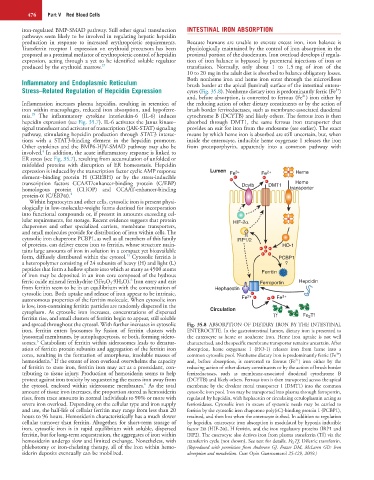
                                                              brush border at the apical (luminal) surface of the intestinal entero-
        Stress–Related Regulation of Hepcidin Expression      cytes (Fig. 35.8). Nonheme dietary iron is predominantly ferric (Fe )
                                                                                                               3+
                                                                                                    2+
                                                              and, before absorption, is converted to ferrous (Fe ) iron either by
        Inflammation  increases  plasma  hepcidin,  resulting  in  retention  of   the reducing action of other dietary constituents or by the action of
        iron within macrophages, reduced iron absorption, and hypoferre-  brush border ferrireductases, such as membrane-associated duodenal
           28
        mia.   The  inflammatory  cytokine  interleukin-6  (IL-6)  induces   cytochrome B (DCYTB) and likely others. The ferrous iron is then
        hepcidin expression (see Fig. 35.7). IL-6 activates the Janus kinase–  absorbed  through  DMT1,  the  same  ferrous  iron  transporter  that
        signal transducer and activator of transcription (JAK-STAT) signaling   provides an exit for iron from the endosome (see earlier). The exact
        pathway, stimulating hepcidin production through STAT3 interac-  means by which heme iron is absorbed are still uncertain, but, when
        tions  with  a  STAT3-binding  element  in  the  hepcidin  promoter.   inside the enterocyte, inducible heme oxygenase 1 releases the iron
        Other cytokines and the BMP6-HJV-SMAD pathway may also be   from  protoporphyrin,  apparently  into  a  common  pathway  with
               4
        involved.  In addition, the acute inflammatory response is linked to
        ER stress (see Fig. 35.7), resulting from accumulation of unfolded or
        misfolded  proteins  with  disruption  of  ER  homeostasis.  Hepcidin
        expression is induced by the transcription factor cyclic AMP response   Lumen  Fe 3+  Fe 2+  Heme
        element−binding  protein  H  (CREBH)  or  by  the  stress-inducible
        transcription  factors  CCAAT/enhancer-binding  protein  (C/EBP)        Dcytb    DMT1     Heme
        homologous  protein  (CHOP)  and  CCAAT-enhancer-binding                                transporter
        protein-α (C/EBPα). 4
           Within hepatocytes and other cells, cytosolic iron is present physi-
        ologically in low-molecular-weight forms destined for incorporation
        into functional compounds or, if present in amounts exceeding cel-
        lular requirements, for storage. Recent evidence suggests that protein   HIF-2α
        chaperones  and  other  specialized  carriers,  membrane  transporters,
        and small molecules provide for distribution of iron within cells. The
        cytosolic iron chaperone PCBP1, as well as all members of this family   IRP1/2
        of proteins, can deliver excess iron to ferritin, whose structure main-              HO-1
        tains large amounts of iron in solution in a compact yet bioavailable
                                          13
        form, diffusely distributed within the cytosol.  Cytosolic ferritin is              PCBP1
        a heteropolymer consisting of 24 subunits of heavy (H) and light (L)                  ?
        peptides that form a hollow sphere into which as many as 4500 atoms            Ferritin
        of iron may be deposited in an iron core composed of the hydrous
                                            6
        ferric oxide mineral ferrihydrite (5Fe 2 O 3 ⋅9H 2 O).  Iron entry and exit   Ferroportin  Hepcidin
        from ferritin seem to be in an equilibrium with the concentration of   Hephaestin
        cytosolic iron. Both uptake and release of iron appear to be intrinsic,   2+         3+
        autonomous properties of the ferritin molecule. When cytosolic iron     Fe         Fe
        is low, iron-containing ferritin particles are randomly dispersed in the   Circulation
        cytoplasm.  As  cytosolic  iron  increases,  concentrations  of  dispersed                  Fe 2 Tf
        ferritin rise, and small clusters of ferritin begin to appear, still soluble      Tf
        and spread throughout the cytosol. With further increases in cytosolic   Fig. 35.8  ABSORPTION OF DIETARY IRON BY THE INTESTINAL
        iron,  ferritin  enters  lysosomes  by  fusion  of  ferritin  clusters  with   ENTEROCYTE. In the gastrointestinal lumen, dietary iron is presented to
        lysosomal membranes, by autophagocytosis, or both, forming sidero-  the  enterocyte  as  heme  or  nonheme  iron.  Heme  iron  uptake  is  not  well
             6
        somes.  Catabolism of ferritin within siderosomes leads to denatur-  characterized, and the specific membrane transporter remains uncertain. After
        ation of ferritin protein subunits and aggregation of the ferritin iron   absorption,  heme  oxygenase  1  (HO-1)  releases  iron  from  heme  into  a
                                                                                                               3+
        cores, resulting in the formation of amorphous, insoluble masses of   common cytosolic pool. Nonheme dietary iron is predominantly ferric (Fe )
                  6
                                                                                                  2+
        hemosiderin.  If the extent of iron overload overwhelms the capacity   and,  before  absorption,  is  converted  to  ferrous  (Fe )  iron  either  by  the
        of ferritin to store iron, ferritin iron may act as a prooxidant, con-  reducing action of other dietary constituents or by the action of brush border
        tributing to tissue injury. Production of hemosiderin seems to help   ferrireductases,  such  as  membrane-associated  duodenal  cytochrome  B
        protect against iron toxicity by sequestering the excess iron away from   (DCYTB) and likely others. Ferrous iron is then transported across the apical
                                                6
        the  cytosol,  enclosed  within  siderosome  membranes.   As  the  total   membrane by the divalent metal transporter 1 (DMT1) into the common
        amount of tissue iron increases, the proportion stored as hemosiderin   cytosolic iron pool. Iron may be transported into plasma through ferroportin,
        rises, from trace amounts in normal individuals to 90% or more with   regulated by hepcidin, with hephaestin or circulating ceruloplasmin acting as
        severe iron overload. Depending on the cellular type and iron supply   ferrioxidases. Cytosolic iron in excess of systemic needs may be carried to
        and use, the half-life of cellular ferritin may range from less than 20   ferritin by the cytosolic iron chaperone poly(rC)-binding protein 1 (PCBP1),
        hours to 96 hours. Hemosiderin characteristically has a much slower   retained, and then lost when the enterocyte is shed. In addition to regulation
        cellular turnover than ferritin. Altogether, for short-term storage of   by hepcidin, enterocyte iron absorption is modulated by hypoxia inducible
        iron, cytosolic iron is in rapid equilibrium with soluble, dispersed   factor 2α (HIF-2α), H ferritin, and the iron regulatory proteins (IRP1 and
        ferritin, but for long-term sequestration, the aggregates of iron within   IRP2). The enterocyte also derives iron from plasma transferrin (Tf) via the
        hemosiderin undergo slow and limited exchange. Nonetheless, with   transferrin cycle (not shown). See text for details. Fe 2 Tf, Diferric transferrin.
        phlebotomy or iron-chelating therapy, all of the iron within hemo-  (Reproduced  with  permission  from  Anderson  GJ,  Frazer  DM,  McLaren  GD:  Iron
        siderin deposits eventually can be mobilized.         absorption and metabolism. Curr Opin Gastroenterol 25:129, 2009.)

