


Page 564 - Hematology_ Basic Principles and Practice ( PDFDrive )
P. 564
Chapter 36  Disorders of Iron Homeostasis  479


                                Hemochromatosis, Hemochromatosis,
                                  ferroportin  ferroportin  Transfusional
                                 associated  associated  Hereditary  iron overload                   Iron-refractory
                                 with impaired  with hepcidin hemochromatosis  with  Reduced  Iron  Iron-deficient Iron-deficiency iron-deficiency  Anemia of
                                 iron export  resistance  HFE-associated aplastic anemia  Normal  iron stores  depletion erythropoiesis  anemia  anemia  chronic disease


                        Threshold
                        for anemia

                    Plasma hepcidin (nM)  NI-↑  NI-↑  ↓    ↑↑      NI     NI     NI-↓    ↓      ↓↓     NI-↑   NI-↑
                      Marrow iron stores  4+  1–2+  1–2+   4+     2–3+    1+    0-Trace  0      0       0     2–4+
                     Plasma ferritin (µg/L)  >250  >250  >250  >250  100 ± 60  <25  <20  10     <10    <10*   >30
             Plasma transferrin receptor (mg/L)  5.5  5.5  5.5  5.5  5.5 ± 1.5  5.5  5.5  10    14     14    5.5 ± 1.5
                     Plasma iron (µg/dL) 115 ± 50  >150  >150  >150  115 ± 50  <115  <115  <60  <40    <40    <60
                    Transferrin IBC (µg/dL) 330 ± 30  <300  <300  <300  330 ± 30  330–360  360  390  410  410  <360
                  Transferrin saturation (%)  30 ± 10  >50  >50  >50  35 ± 15  30  <30  <15     <10    <10    <15
                 RBC ZnPP (µmol/mol heme)  <60  <60  <60   <60    <60     <60   60–80   >80     >80    >80    >60
                            MCV (fl)  90 ± 10  90 ± 10  90 ± 10  90 ± 10  90 ± 10  90 ± 10  90 ± 10  90 ± 10  <80  <65  75–90
                                     Macrophage storage iron
                                     Hepatocyte storage iron
                                     Erythroid iron

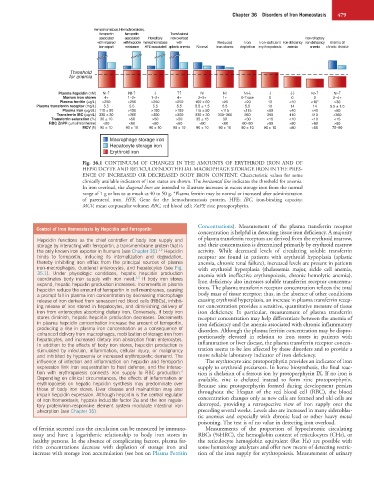
                            Fig.  36.1  CONTINUUM  OF  CHANGES  IN THE  AMOUNTS  OF  ERYTHROID  IRON  AND  OF
                            HEPATOCYTE AND RETICULOENDOTHELIAL MACROPHAGE STORAGE IRON IN THE PRES-
                            ENCE  OF  INCREASED  OR  DECREASED  BODY  IRON  CONTENT.  Characteristic  values  for  some
                            clinically available indicators of iron status are shown. The horizontal line indicates the threshold for anemia.
                            In iron overload, the diagonal lines are intended to illustrate increases in excess storage iron from the normal
                            range of 1 g or less to as much as 40 to 50 g. *Plasma ferritin may be normal or increased after administration
                            of  parenteral  iron.  HFE,  Gene  for  the  hemochromatosis  protein,  HFE;  IBC,  iron-binding  capacity;
                            MCV, mean corpuscular volume; RBC, red blood cell; ZnPP, zinc protoporphyrin.


                                                                  Concentrations).  Measurement  of  the  plasma  transferrin  receptor
             Control of Iron Homeostasis by Hepcidin and Ferroportin
                                                                  concentration is helpful in detecting tissue iron deficiency. A majority
             Hepcidin  functions  as  the  chief  controller  of  body  iron  supply  and   of plasma transferrin receptors are derived from the erythroid marrow,
             storage by interacting with ferroportin, a transmembrane protein that is   and their concentration is determined primarily by erythroid marrow
             the only known iron exporter in humans (see Chapter 35).  Hepcidin   activity.  While  decreased  levels  of  circulating  soluble  transferrin
                                                     1,2
             binds  to  ferroportin,  inducing  its  internalization  and  degradation,   receptor  are  found  in  patients  with  erythroid  hypoplasia  (aplastic
             thereby  inhibiting  iron  efflux  from  the  principal  sources  of  plasma   anemia, chronic renal failure), increased levels are present in patients
             iron-macrophages,  duodenal  enterocytes,  and  hepatocytes  (see  Fig.   with  erythroid  hyperplasia  (thalassemia  major,  sickle  cell  anemia,
             35.1).  Under  physiologic  conditions,  hepatic  hepcidin  production   anemia with ineffective erythropoiesis, chronic hemolytic anemia).
             coordinates  body  iron  supply  with  iron  need.   If  body  iron  stores   Iron deficiency also increases soluble transferrin receptor concentra-
                                             1,2
             expand, hepatic hepcidin production increases. Increments in plasma
             hepcidin reduce the amount of ferroportin in cell membranes, causing   tions. The plasma transferrin receptor concentration reflects the total
             a prompt fall in plasma iron concentration by decreasing macrophage   body mass of tissue receptor; thus, in the absence of other conditions
             release of iron derived from senescent red blood cells (RBCs), inhibit-  causing erythroid hyperplasia, an increase in plasma transferrin recep-
             ing release of iron stored in hepatocytes, and diminishing delivery of   tor concentration provides a sensitive, quantitative measure of tissue
             iron from enterocytes absorbing dietary iron. Conversely, if body iron   iron  deficiency.  In  particular,  measurement  of  plasma  transferrin
             stores diminish, hepatic hepcidin production decreases. Decrements   receptor concentration may help differentiate between the anemia of
             in plasma hepcidin concentration increase the amount of ferroportin,   iron deficiency and the anemia associated with chronic inflammatory
             producing  a  rise  in  plasma  iron  concentration  as  a  consequence  of   disorders. Although the plasma ferritin concentration may be dispro-
             enhanced delivery from macrophages, mobilization of storage iron from   portionately  elevated  in  relation  to  iron  stores  in  patients  with
             hepatocytes, and increased dietary iron absorption from enterocytes.
             In addition to the effects of body iron stores, hepcidin production is   inflammation or liver disease, the plasma transferrin receptor concen-
             stimulated  by  infection,  inflammation,  cellular  injury,  or  malignancy   tration seems to be less affected by these disorders and to provide a
             and inhibited by hypoxemia or increased erythropoietic demand. The   more reliable laboratory indicator of iron deficiency.
             influence  of  infection  and  inflammation  on  hepcidin  and  ferroportin   The erythrocyte zinc protoporphyrin provides an indicator of iron
             expression  link  iron  sequestration  to  host  defense,  and  the  interac-  supply to erythroid precursors. In heme biosynthesis, the final reac-
             tion  with  erythropoiesis  connects  iron  supply  to  RBC  production.    tion is chelation of a ferrous ion by protoporphyrin IX. If no iron is
                                                            3
             Depending  on  clinical  circumstances,  the  effects  of  inflammation  or   available,  zinc  is  chelated  instead  to  form  zinc  protoporphyrin.
             erythropoiesis  on  hepatic  hepcidin  synthesis  may  predominate  over   Because  zinc  protoporphyrin  formed  during  development  persists
             those  of  body  iron  stores.  Liver  disease  and  malnutrition  may  also   throughout  the  lifespan  of  the  red  blood  cell  (RBC),  the  blood
             impair hepcidin expression. Although hepcidin is the central regulator
             of iron homeostasis, hypoxia inducible factor 2α and the iron regula-  concentration changes only as new cells are formed and old cells are
             tory  protein/iron-responsive  element  system  modulate  intestinal  iron   destroyed,  providing  a  retrospective  view  of  iron  supply  over  the
             absorption (see Chapter 35).                         preceding several weeks. Levels also are increased in many sideroblas-
                                                                  tic  anemias  and  especially  with  chronic  lead  or  other  heavy  metal
                                                                  poisoning. The test is of no value in detecting iron overload.
            of ferritin secreted into the circulation can be measured by immuno-  Measurements  of  the  proportion  of  hypochromic  circulating
            assay  and  have  a  logarithmic  relationship  to  body  iron  stores  in   RBCs (%HRC), the hemoglobin content of reticulocytes (CHr), or
            healthy persons. In the absence of complicating factors, plasma fer-  the reticulocyte hemoglobin equivalent (Ret He) are possible with
            ritin  concentrations  decrease  with  depletion  of  storage  iron  and   some hematology analyzers and offer new means of detecting restric-
            increase with storage iron accumulation (see box on Plasma Ferritin   tion of the iron supply for erythropoiesis. Measurement of urinary

