


Page 565 - Hematology_ Basic Principles and Practice ( PDFDrive )
P. 565
480    Part V  Red Blood Cells


         A                            B                 C              D                   E

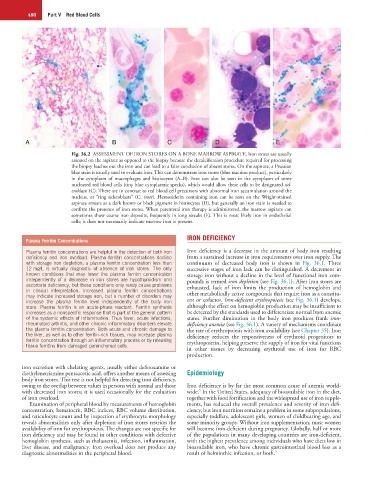
                        Fig. 36.2  ASSESSMENT OF IRON STORES ON A BONE MARROW ASPIRATE. Iron stores are usually
                        assessed on the aspirate as opposed to the biopsy because the decalcification procedure required for processing
                        the biopsy leaches out the iron and can lead to a false conclusion of absent stores. On the aspirate, a Prussian
                        blue stain is usually used to evaluate iron. This can demonstrate iron stores (blue reaction product), particularly
                        in  the  cytoplasm  of  macrophages  and  histiocytes  (A–B).  Iron  can  also  be  seen  in  the  cytoplasm  of  some
                        nucleated red blood cells (tiny blue cytoplasmic specks), which would allow these cells to be designated sid-
                        eroblasts (C). These are in contrast to red blood cell precursors with abnormal iron accumulation around the
                        nucleus, or “ring sideroblasts” (C, inset). Hemosiderin containing iron can be seen on the Wright-stained
                        aspirate smears as a dark brown or black pigment in histiocytes (D), but generally an iron stain is needed to
                        confirm the presence of iron stores. When parenteral iron therapy is administered, the marrow aspirate can
                        sometimes show coarse iron deposits, frequently in long streaks (E). This is most likely iron in endothelial
                        cells; it does not necessarily indicate marrow iron is present.

                                                              IRON DEFICIENCY
         Plasma Ferritin Concentrations
          Plasma ferritin concentrations are helpful in the detection of both iron   Iron deficiency is a decrease in the amount of body iron resulting
          deficiency  and  iron  overload.  Plasma  ferritin  concentrations  decline   from a sustained increase in iron requirements over iron supply. The
          with storage iron depletion; a plasma ferritin concentration less than   continuum  of  decreased  body  iron  is  shown  in  Fig.  36.1.  Three
          12 mg/L  is  virtually  diagnostic  of  absence  of  iron  stores.  The  only   successive stages of iron lack can be distinguished. A decrement in
          known  conditions  that  may  lower  the  plasma  ferritin  concentration   storage iron without a decline in the level of functional iron com-
          independently  of  a  decrease  in  iron  stores  are  hypothyroidism  and   pounds is termed iron depletion (see Fig. 36.1). After iron stores are
          ascorbate deficiency, but these conditions only rarely cause problems   exhausted,  lack  of  iron  limits  the  production  of  hemoglobin  and
          in  clinical  interpretation.  Increased  plasma  ferritin  concentrations
          may indicate increased storage iron, but a number of disorders may   other metabolically active compounds that require iron as a constitu-
          increase  the  plasma  ferritin  level  independently  of  the  body  iron   ent or cofactor. Iron-deficient erythropoiesis (see Fig. 36.1) develops,
          store.  Plasma  ferritin  is  an  acute-phase  reactant.  Ferritin  synthesis   although the effect on hemoglobin production may be insufficient to
          increases as a nonspecific response that is part of the general pattern   be detected by the standards used to differentiate normal from anemic
          of the systemic effects of inflammation. Thus fever, acute infections,   states.  Further  diminution  in  the  body  iron  produces  frank  iron-
          rheumatoid arthritis, and other chronic inflammatory disorders elevate   deficiency anemia (see Fig. 36.1). A variety of mechanisms coordinate
          the plasma ferritin concentration. Both acute and chronic damage to   the rate of erythropoiesis with iron availability (see Chapter 35). Iron
          the liver, as well as to other ferritin-rich tissues, may increase plasma   deficiency  reduces  the  responsiveness  of  erythroid  progenitors  to
          ferritin concentration through an inflammatory process or by releasing   erythropoietin, helping preserve the supply of iron for vital functions
          tissue ferritins from damaged parenchymal cells.
                                                              in  other  tissues  by  decreasing  erythroid  use  of  iron  for  RBC
                                                              production.
        iron excretion with chelating agents, usually either deferoxamine or
        diethylenetriamine pentaacetic acid, offers another means of assessing   Epidemiology
        body iron stores. This test is not helpful for detecting iron deficiency,
        owing to the overlap between values in persons with normal and those   Iron deficiency is by far the most common cause of anemia world-
                                                                  5
        with decreased iron stores; it is used occasionally for the evaluation   wide.  In the United States, adequacy of bioavailable iron in the diet,
        of iron overload.                                     together with food fortification and the widespread use of iron supple-
           Examination of peripheral blood by measurements of hemoglobin   ments, has reduced the overall prevalence and severity of iron defi-
        concentration, hematocrit, RBC indices, RBC volume distribution,   ciency, but iron nutrition remains a problem in some subpopulations,
        and reticulocyte count and by inspection of erythrocyte morphology   especially toddlers, adolescent girls, women of childbearing age, and
        reveals abnormalities only after depletion of iron stores restricts the   some minority groups. Without iron supplementation, most women
        availability of iron for erythropoiesis. The changes are not specific for   will become iron-deficient during pregnancy. Globally, half or more
        iron deficiency and may be found in other conditions with defective   of the populations in many developing countries are iron-deficient,
        hemoglobin synthesis, such as thalassemia, infection, inflammation,   with the highest prevalence among individuals who have diets low in
        liver disease, and malignancy. Iron overload does not produce any   bioavailable iron, who have chronic gastrointestinal blood loss as a
        diagnostic abnormalities in the peripheral blood.     result of helminthic infection, or both. 5

