


Page 583 - Hematology_ Basic Principles and Practice ( PDFDrive )
P. 583
498    Part V  Red Blood Cells


                                   ALA                        which is under the control of erythroid-specific promoters such as
                                              Plumboporphyria  GATA1, a globin transcription factor. Whether heme inhibits import
                              ALA        Porphobilinogen      of pre-ALAS2 into the mitochondrial matrix remains to be unequivo-
         X-linked hereditary                                  cally established. Heme may possibly also prevent the accumulation
         sideroblastic anemia                Acute intermittent  of  intracellular  iron  by  controlling  the  acquisition  of  iron  from
                             Glycine +                        transferrin  (see  Fig.  38.2B). In addition  to  transport  of  iron from
                           succinyl CoA         porphyria     plasma to the cytosol by the transferrin receptor, a second transport
                                         Hydroxymethylbilane  step is required for mitochondrial uptake of iron. This step is fulfilled
                                                                         22
                              Heme                            by mitoferrin,  a member of the solute carrier 25 family of proteins
          Erythropoietic                        Congenital    located in the inner mitochondrial membrane, which, to import iron
          protoporphyria                         porphyria    into the mitochondrion, must interact both with ferrochelatase and
                          Protoporphyrin IX                   with the adenosine triphosphate (ATP)-binding cassette transporter
                                                                     23
                                         Uroporphyrinogen III  ABCB10.   Levels  of  intracellular  iron  regulate  the  translation  of
         Variegate porphyria                                  ALAS2 mRNA. Cellular iron homeostasis is maintained through a
                         Protoporphyrinogen III  Porphyria cutanea  posttranscriptional regulatory mechanism, which is mediated by iron
                                                  tarda
                                                              regulatory proteins that bind to iron-responsive elements in mRNA
                                         Coproporphyrinogen III  of target genes to either increase or decrease translation. 24,25  The RNA
                                                              binding  activity  of  iron-responsive  proteins  (IRP)  is  regulated  by
                                Hereditary                    mitochondrial  iron-sulfur  cluster  synthesis  and  cytosolic  iron
                               coproporphyria                 levels. 26–28  When iron is available for heme synthesis, translation of
                                                              ALAS2 is allowed to proceed as a result of decreased IRP binding to
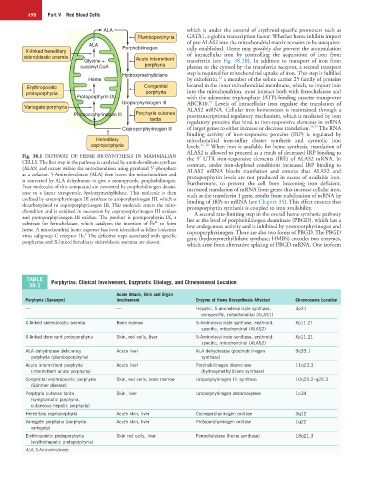
        Fig.  38.1  PATHWAY  OF  HEME  BIOSYNTHESIS  IN  MAMMALIAN   the 5′ UTR iron-responsive elements (IRE) of ALAS2 mRNA. In
        CELLS. The first step in the pathway is catalyzed by aminolevulinate synthase   contrast, under iron-depleted conditions increased IRP binding to
        (ALAS) and occurs within the mitochondrion using pyridoxal 5′-phosphate   ALAS2  mRNA  blocks  translation  and  ensures  that  ALAS2  and
        as a cofactor. 5-Aminolevulinate (ALA) then leaves the mitochondrion and   protoporphyrin levels are not produced in excess of available iron.
        is converted by ALA dehydratase to give a monopyrrole, porphobilinogen.   Furthermore,  to  prevent  the  cell  from  becoming  iron  deficient,
        Four molecules of this compound are converted by porphobilinogen deami-  increased translation of mRNA from genes that increase cellular iron,
        nase  to  a  linear  tetrapyrrole,  hydroxymethylbilane.  This  molecule  is  then   such as the transferrin 1 gene, results from stabilization of mRNA by
        cyclized by uroporphyrinogen III synthase to uroporphyrinogen III, which is   binding of IRPs to mRNA (see Chapter 35). This effect ensures that
        decarboxylated to coproporphyrinogen III. This molecule enters the mito-  protoporphyrin synthesis is coupled to iron availability.
        chondrion and is oxidized in succession by coproporphyrinogen III oxidase   A second rate-limiting step in the overall heme synthetic pathway
        and protoporphyrinogen III oxidase. The product is protoporphyrin IX, a   lies at the level of porphobilinogen deaminase (PBGD), which has a
                                                    2+
        substrate  for  ferrochelatase,  which  catalyzes  the  insertion  of  Fe   to  form   low endogenous activity and is inhibited by protoporphyrinogen and
        heme. A mitochondrial heme exporter has been identified as feline leukemia   coproporphyrinogen. There are also two forms of PBGD. The PBGD
                             6
        virus subgroup C receptor 1b.  The defective steps associated with specific   gene (hydroxymethylbilane synthase; HMBS) encodes two enzymes,
        porphyrias and X-linked hereditary sideroblastic anemias are shown.
                                                              which arise from alternative splicing of PBGD mRNA. One isoform


          TABLE   Porphyrias: Clinical Involvement, Enzymatic Etiology, and Chromosomal Location
          38.1
                                       Acute Attack, Skin and Organ
         Porphyria (Synonym)           Involvement               Enzyme of Heme Biosynthesis Affected  Chromosome Location
         —                             —                         Hepatic, 5-aminolevulinate synthase,   3p21
                                                                   nonspecific, mitochondrial (ALAS1)
         X-linked sideroblastic anemia  Bone marrow              5-Aminolevulinate synthase, erythroid-  Xp11.21
                                                                   specific, mitochondrial (ALAS2)
         X-linked dominant protoporphyria  Skin, red cells, liver  5-Aminolevulinate synthase, erythroid-  Xp11.21
                                                                   specific, mitochondrial (ALAS2)
         ALA dehydratase deficiency    Acute liver               ALA dehydratase (porphobilinogen   9q33.1
           porphyria (plumboporphyria)                             synthase)
         Acute intermittent porphyria   Acute liver              Porphobilinogen deaminase        11q23.3
           (intermittent acute porphyria)                          (hydroxymethylbilane synthase)
         Congenital erythropoietic porphyria   Skin, red cells, bone marrow  Uroporphyrinogen III synthase  10q25.2–q26.3
           (Günther disease)
         Porphyria cutanea tarda       Skin, liver               Uroporphyrinogen decarboxylase   1p34
           (symptomatic porphyria,
           cutaneous hepatic porphyria)
         Hereditary coproporphyria     Acute skin, liver         Coproporphyrinogen oxidase       3q12
         Variegate porphyria (porphyria   Acute skin, liver      Protoporphyrinogen oxidase       1q22
           variegata)
         Erythropoietic protoporphyria   Skin red cells, liver   Ferrochelatase (heme synthase)   18q21.3
           (erythrohepatic protoporphyria)
         ALA, 5-Aminolevulinate.

