


Page 587 - Hematology_ Basic Principles and Practice ( PDFDrive )
P. 587
502    Part V  Red Blood Cells


         Precipitating Factors in Acute Porphyria               TABLE   Precipitating Factors in Acute Porphyria
                                                                38.4
          Most patients who have inherited acute porphyria enjoy normal health
          and  go  through  life  without  any  knowledge  of  their  disorder  or  ever   Drugs    Other Stimuli
          experiencing  an  acute  attack.  All  porphyric  patients,  however,  are   Alcohol      Fasting or dieting
          at  risk  for  developing  an  attack  if  exposed  to  various  precipitating
          factors. Drugs are the most common precipitating agents. Other factors   Barbiturates     Hormones, stress
          that  may  trigger  attacks  include  alcohol  ingestion,  reduced  caloric   Angiotensin-converting enzyme (ACE) inhibitors  Smoking
          intake  (from  fasting  or  dieting),  and  infection.  Smoking  can  cause   Anticonvulsants
          more frequent attacks.
           Hormonal  status  is  also  important.  Attacks  are  more  common  in   Antidepressants
          females,  and  they  rarely  occur  before  puberty  or  after  menopause.   Calcium channel blockers
          Although generally uncomplicated, pregnancy in addition to oral con-
          traceptives may precipitate attacks.  Some women experience regular   Cephalosporins
                                 60
          attacks, commencing in the week before the onset of menstruation.   Ergot derivatives
          These  may  require  luteinizing  hormone–releasing  hormone  (LH-RH)
          antagonists for control (Table 38.4).                Erythromycin
          Drugs for Porphyria                                  Steroids or anabolic steroids
          Before prescribing any medication to a porphyric patient, advice must   Contraceptives, hormone replacement therapy
          be  sought  from  an  appropriate  specialist.  Full  drug  lists  are  avail-  Sulfonamides
          able on the Internet at www.porphyriafoundation.com (in the United
          States) and www.porphyria-europe.com (in European Union countries,   Sulfonylureas
          South  Africa,  and  Canada),  and  a  guide  for  drug  prescription  at
          www.drugs-porphyria.org. It should be borne in mind that such lists are
          far from encyclopedic, that new drugs are constantly being introduced
          to the pharmacopeia, and that any form of combined preparation must
          be  viewed  with  suspicion,  because  little  is  known  about  metabolic
                               61
          interactions  in  these  diseases.   More  details  of  such  use  and  side
          effects of drugs can be sought from the literature. 62


        Acute Intermittent Porphyria
        Clinical and Laboratory Manifestations

        Acute intermittent porphyria is the most severe of the acute porphyr-
        ias. During an attack, patients display abdominal and neuropsychiatric
        or  neurovisceral  disturbances.  Onset  occurs  in  puberty;  female
        patients exhibit a fourfold greater incidence of attacks than males.
        Attacks occur mainly in young adults and become less frequent after
                                                 57
        menopause. It is uncommon to see attacks in children.  Crises may
        vary in duration from several days to months. They are most com-
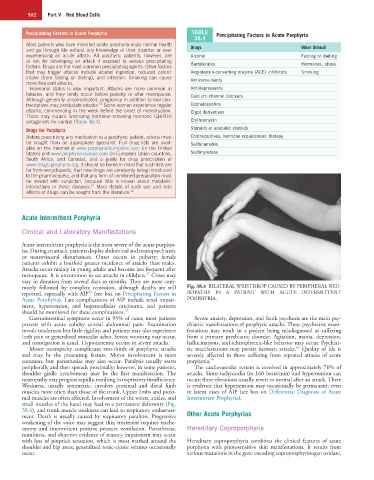
        monly  followed  by  complete  remission,  although  deaths  are  still   Fig. 38.4  BILATERAL WRISTDROP CAUSED BY PERIPHERAL NEU-
                              58
        reported, especially with AIP  (see box on Precipitating Factors in   ROPATHY  IN  A  PATIENT  WITH  ACUTE  INTERMITTENT
        Acute Porphyria). Late complications of AIP include renal impair-  PORPHYRIA.
        ment,  hypertension,  and  hepatocellular  carcinoma,  and  patients
        should be monitored for these complications. 59
           Gastrointestinal symptoms occur in 95% of cases; most patients   Severe anxiety, depression, and frank psychosis are the main psy-
        present  with  acute  colicky  central  abdominal  pain.  Examination   chiatric manifestations of porphyric attacks. These psychiatric mani-
        reveals tenderness but little rigidity, and patients may also experience   festations  may  result  in  a  patient  being  misdiagnosed  as  suffering
        limb pain or generalized muscular aches. Severe vomiting may occur,   from  a  primary  psychiatric  disorder.  Agitation,  mania,  depression,
        and constipation is usual. Hyponatremia occurs in severe attacks.  hallucinations, and schizophrenic-like behavior may occur. Psychiat-
                                                                                                  63
           Motor  neuropathy  complicates  two-thirds  of  porphyric  attacks   ric  manifestations  may  persist  between  attacks.   Quality  of  life  is
        and  may  be  the  presenting  feature.  Motor  involvement  is  most   severely  affected  in  those  suffering  from  repeated  attacks  of  acute
        common,  but  paresthesias  may  also  occur.  Paralysis  usually  starts   porphyria. 64
        peripherally and then spreads proximally; however, in some patients,   The cardiovascular system is involved in approximately 70% of
        shoulder  girdle  involvement  may  be  the  first  manifestation.  The   attacks. Sinus tachycardia (to 160 beats/min) and hypertension can
        neuropathy may progress rapidly, resulting in respiratory insufficiency.   occur; these elevations usually revert to normal after an attack. There
        Weakness,  usually  symmetric,  involves  proximal  and  distal  limb   is evidence that hypertension may occasionally be permanent, even
        muscles more often than those of the trunk. Upper limbs and proxi-  in latent cases of AIP (see box on Differential Diagnosis of Acute
        mal muscles are often affected. Involvement of the wrists, ankles, and   Intermittent Porphyria).
        small muscles of the hand may lead to a permanent deformity (Fig.
        38.4), and trunk muscle weakness can lead to respiratory embarrass-
        ment.  Death  is  usually  caused  by  respiratory  paralysis.  Progressive   Other Acute Porphyrias
        weakening of the voice may suggest this; treatment requires trache-
        otomy  and  intermittent  positive  pressure  ventilation.  Paresthesias,   Hereditary Coproporphyria
        numbness, and objective evidence of sensory impairment may occur
        with loss of pinprick sensation, which is most marked around the   Hereditary  coproporphyria  combines  the  clinical  features  of  acute
        shoulder and hip areas; generalized tonic-clonic seizures occasionally   porphyria  with  photosensitive  skin  manifestations.  It  results  from
        occur.                                                various mutations in the gene encoding coproporphyrinogen oxidase,

