


Page 584 - Hematology_ Basic Principles and Practice ( PDFDrive )
P. 584
Chapter 38  Heme Biosynthesis and Its Disorders  499


                                 pre-ALAS1                              pre-ALAS2
                                                   ALA                                     ALA
                         Translation                            Translation
                                              ALAS1                                   ALAS2
                                       -                                       -?
                                                 Glycine +                               Glycine +
                         pre−ALAS1              succinyl CoA     pre−ALAS2              succinyl CoA
                          mRNA                                    mRNA
                                                  Heme                      +             Heme
                                    +
                                               Fe 2+                          -       Fe 2+
                                              Protoporphyrin IX                       Protoporphyrin IX
                         Degradation
                                           mfrn                                    mfrn
                                     Iron                                   Iron
                         A          pool                          B         pool
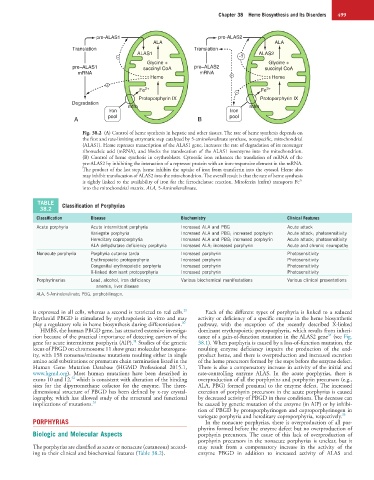
                            Fig. 38.2  (A) Control of heme synthesis in hepatic and other tissues. The rate of heme synthesis depends on
                            the first and rate-limiting enzymatic step catalyzed by 5-aminolevulinate synthase, nonspecific, mitochondrial
                            (ALAS1). Heme represses transcription of the ALAS1 gene, increases the rate of degradation of its messenger
                            ribonucleic acid (mRNA), and blocks the translocation of the ALAS1 isoenzyme into the mitochondrion.
                            (B)  Control  of  heme  synthesis  in  erythroblasts.  Cytosolic  iron  enhances  the  translation  of  mRNA  of  the
                            pre-ALAS2 by inhibiting the interaction of a repressor protein with an iron-responsive element in the mRNA.
                            The product of the last step, heme inhibits the uptake of iron from transferrin into the cytosol. Heme also
                            may inhibit translocation of ALAS2 into the mitochondrion. The overall result is that the rate of heme synthesis
                                                                                                   2+
                            is tightly linked to the availability of iron for the ferrochelatase reaction. Mitoferrin (mfrn) transports Fe
                            into the mitochondrial matrix. ALA, 5-Aminolevulinate.

             TABLE   Classification of Porphyrias
              38.2
             Classification    Disease                      Biochemistry                       Clinical Features
             Acute porphyria   Acute intermittent porphyria  Increased ALA and PBG             Acute attack
                               Variegate porphyria          Increased ALA and PBG; increased porphyrin  Acute attack; photosensitivity
                               Hereditary coproporphyria    Increased ALA and PBG; increased porphyrin  Acute attack; photosensitivity
                               ALA dehydratase deficiency porphyria  Increased ALA; increased porphyrin  Acute and chronic neuropathy
             Nonacute porphyria  Porphyria cutanea tarda    Increased porphyrin                Photosensitivity
                               Erythropoietic protoporphyria  Increased porphyrin              Photosensitivity
                               Congenital erythropoietic porphyria  Increased porphyrin        Photosensitivity
                               X-linked dominant protoporphyria  Increased porphyrin           Photosensitivity
             Porphyrinurias    Lead, alcohol, iron deficiency   Various biochemical manifestations  Various clinical presentations
                                 anemia, liver disease
             ALA, 5-Aminolevulinate; PBG, porphobilinogen.


                                                             29
            is expressed in all cells, whereas a second is restricted to red cells.    Each of the different types of porphyria is linked to a reduced
            Erythroid PBGD is stimulated by erythropoiesis in vitro and may   activity or deficiency of a specific enzyme in the heme biosynthetic
            play a regulatory role in heme biosynthesis during differentiation. 30  pathway,  with  the  exception  of  the  recently  described  X-linked
              HMBS, the human PBGD gene, has attracted extensive investiga-  dominant erythropoietic protoporphyria, which results from inheri-
                                                                                                            34
            tion because of the practical importance of detecting carriers of the   tance of a gain-of-function mutation in the ALAS2 gene  (see Fig.
                                             31
            gene for acute intermittent porphyria (AIP).  Studies of the genetic   38.1). When porphyria is caused by a loss-of-function mutation, the
            locus of PBGD on chromosome 11 show great molecular heterogene-  resulting  enzyme  deficiency  impairs  the  production  of  the  end-
            ity, with 158 nonsense/missense mutations resulting either in single   product heme, and there is overproduction and increased excretion
            amino acid substitutions or premature chain termination listed in the   of the heme precursors formed by the steps before the enzyme defect.
            Human  Gene  Mutation  Database  (HGMD  Professional  2015.1,   There is also a compensatory increase in activity of the initial and
            www.hgmd.org).  Most  human  mutations  have  been  described  in   rate-controlling  enzyme  ALAS.  In  the  acute  porphyrias,  there  is
                        32
            exons 10 and 12,  which is consistent with alteration of the binding   overproduction of all the porphyrins and porphyrin precursors (e.g.,
            sites  for  the  dipyrromethane  cofactor  for  the  enzyme.  The  three-  ALA, PBG) formed proximal to the enzyme defect. The increased
            dimensional structure of PBGD has been defined by x-ray crystal-  excretion of porphyrin precursors in the acute porphyrias is caused
            lography, which has allowed study of the structural and functional   by decreased activity of PBGD in these conditions. The decrease can
            implications of mutations. 33                         be caused by genetic mutation of the enzyme (in AIP) or by inhibi-
                                                                  tion of PBGD by protoporphyrinogen and coproporphyrinogen in
                                                                  variegate porphyria and hereditary coproporphyria, respectively. 35
            PORPHYRIAS                                              In the nonacute porphyrias, there is overproduction of all por-
                                                                  phyrins formed before the enzyme defect but no overproduction of
            Biologic and Molecular Aspects                        porphyrin  precursors. The  cause  of  this  lack  of  overproduction  of
                                                                  porphyrin precursors in the nonacute porphyrias is unclear, but it
            The porphyrias are classified as acute or nonacute (cutaneous) accord-  may  result  from  a  compensatory  increase  in  the  activity  of  the
            ing to their clinical and biochemical features (Table 38.2).  enzyme  PBGD  in  addition  to  increased  activity  of  ALAS  and

