


Page 585 - Hematology_ Basic Principles and Practice ( PDFDrive )
P. 585
500    Part V  Red Blood Cells


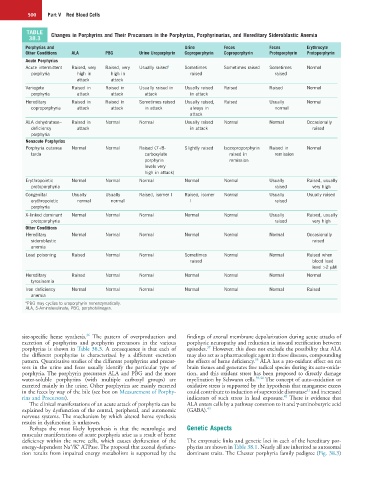
          TABLE   Changes in Porphyrins and Their Precursors in the Porphyrias, Porphyrinurias, and Hereditary Sideroblastic Anemia
          38.3
         Porphyrias and                                      Urine        Feces          Feces       Erythrocyte
         Other Conditions  ALA      PBG        Urine Uroporphyrin  Coproporphyrin  Coproporphyrin  Protoporphyrin  Protoporphyrin
         Acute Porphyrias
         Acute intermittent   Raised, very   Raised, very   Usually raised a  Sometimes   Sometimes raised  Sometimes   Normal
           porphyria      high in    high in                   raised                      raised
                          attack     attack
         Variegate      Raised in   Raised in   Usually raised in   Usually raised   Raised  Raised  Normal
           porphyria      attack     attack     attack         in attack
         Hereditary     Raised in   Raised in   Sometimes raised   Usually raised,   Raised  Usually   Normal
           coproporphyria  attack    attack     in attack      always in                   normal
                                                               attack
         ALA dehydratase–  Raised in   Normal  Normal        Usually raised   Normal     Normal      Occasionally
           deficiency     attack                               in attack                               raised
           porphyria
         Nonacute Porphyrias
         Porphyria cutanea   Normal  Normal    Raised (7-/8-   Slightly raised  Isocoproporphyrin   Raised in   Normal
           tarda                                carboxylate                 raised in      remission
                                                porphyrin                   remission
                                                levels very
                                                high in attack)
         Erythropoietic   Normal    Normal     Normal        Normal       Normal         Usually     Raised, usually
           protoporphyria                                                                  raised      very high
         Congenital     Usually     Usually    Raised, isomer I  Raised, isomer   Normal  Usually    Usually raised
           erythropoietic   normal   normal                    I                           raised
           porphyria
         X-linked dominant   Normal  Normal    Normal        Normal       Normal         Usually     Raised, usually
           protoporphyria                                                                  raised      very high
         Other Conditions
         Hereditary     Normal      Normal     Normal        Normal       Normal         Normal      Occasionally
           sideroblastic                                                                               raised
           anemia
         Lead poisoning  Raised     Normal     Normal        Sometimes    Normal         Normal      Raised when
                                                               raised                                  blood lead
                                                                                                       level >2 µM
         Hereditary     Raised      Normal     Normal        Normal       Normal         Normal      Normal
           tyrosinemia
         Iron deficiency   Normal   Normal     Normal        Normal       Normal         Normal      Raised
           anemia
         a PBG may cyclize to uroporphyrin nonenzymatically.
         ALA, 5-Aminolevulinate; PBG, porphobilinogen.


                             36
        site-specific  heme  synthesis.   The  pattern  of  overproduction  and   findings of axonal membrane depolarization during acute attacks of
        excretion  of  porphyrins  and  porphyrin  precursors  in  the  various   porphyric neuropathy and reduction in inward rectification between
                                                                     37
        porphyrias  is  shown  in Table  38.3.  A  consequence  is  that  each  of   episodes.  However, this does not exclude the possibility that ALA
        the  different  porphyrias  is  characterized  by  a  different  excretion   may also act as a pharmacologic agent in these diseases, compounding
                                                                                    38
        pattern. Quantitative studies of the different porphyrins and precur-  the effects of heme deficiency.  ALA has a pro-oxidant effect on rat
        sors  in  the  urine  and  feces  usually  identify  the  particular  type  of   brain tissues and generates free radical species during its auto-oxida-
        porphyria. The porphyrin precursors ALA and PBG and the more   tion, and this oxidant stress has been proposed to directly damage
        water-soluble  porphyrins  (with  multiple  carboxyl  groups)  are   myelination by Schwann cells. 39,40  The concept of auto-oxidation or
        excreted mainly in the urine. Other porphyrins are mainly excreted   oxidative stress is supported by the hypothesis that manganese excess
                                                                                                     41
        in the feces by way of the bile (see box on Measurement of Porphy-  could contribute to induction of superoxide dismutase  and increased
                                                                                              42
        rins and Precursors).                                 indicators of such stress in lead exposure.  There is evidence that
           The clinical manifestations of an acute attack of porphyria can be   ALA enters cells by a pathway common to it and γ-aminobutyric acid
        explained by dysfunction of the central, peripheral, and autonomic   (GABA). 43
        nervous systems. The mechanism by which altered heme synthesis
        results in dysfunction is unknown.
           Perhaps  the  most  likely  hypothesis  is  that  the  neurologic  and   Genetic Aspects
        muscular manifestations of acute porphyria arise as a result of heme
        deficiency  within  the  nerve  cells,  which  causes  dysfunction  of  the   The enzymatic links and genetic loci in each of the hereditary por-
                          +
                        +
        energy-dependent Na /K  ATPase. The proposal that axonal dysfunc-  phyrias are shown in Table 38.1. Nearly all are inherited as autosomal
        tion results from impaired energy metabolism is supported by the   dominant traits. The Chester porphyria family pedigree (Fig. 38.3)

