


Page 588 - Hematology_ Basic Principles and Practice ( PDFDrive )
P. 588
Chapter 38  Heme Biosynthesis and Its Disorders  503


             Differential Diagnosis of Acute Intermittent Porphyria  Management of Acute Porphyria
             Attacks of acute porphyria must be distinguished from other causes of   Treatment of Acute Attack
             acute abdominal pain or peripheral neuropathy sometimes associated   A  carbohydrate  intake  of  1500–2000 kcal/24  hours  should  be
             with  psychosis.   Heavy  metal  poisoning  (i.e.,  lead  or  arsenic)  and   maintained throughout the attack to reduce porphyrin synthesis; give
                        65
             Guillain-Barré syndrome must be considered, as well as paroxysmal   this  orally  or,  for  more  severe  attacks,  through  a  fine-bore  Teflon
             nocturnal hemoglobinuria with its characteristic early morning hemo-  nasogastric tube. If this cannot be tolerated, intravenous dextrose (e.g.,
             globinuria and abdominal pain. 65                     20% solution, 2 L/day) should be given. If early in the attack (2–4 days
              During an attack, all patients excrete a massive excess of the porphy-  from onset), give intravenous hematin as heme arginate (Normosang,
             rin precursors, 5-aminolevulinate (ALA) and porphobilinogen (PBG), in   Orphan Europe, Normosang, Medunik Canada) at 2–4 mg/kg over 30
             their urine. Urine, when first voided, is clear and darkens on exposure   minutes once or twice each day to further reduce the overproduction
             to light as the hexa-hydroporphyrins, the porphyrinogens, are oxidized   of porphyrin and precursors. 81,82  Hematin (Panhematin, Recordati Rare
             to porphyrins.                                        Diseases, Lebanon, NJ) in similar doses may also be used, although it
              A rapid screening test during an acute attack is to mix equal volumes   should be reconstituted in human albumin solution to avoid phlebitis
             of urine and Ehrlich aldehyde reagent and observe for the pink color of   and mild transient prolongation of coagulation times. No renal compli-
             porphobilinogen; alternatively, the urine can be left standing in sunlight   cations have occurred with the standard recommended dosages, and
             to observe darkening in color. The differential diagnosis of porphyrias   even patients with renal insufficiency tolerate hematin well, although
             uses  qualitative  and  quantitative  measurement  of  porphyrins  and   the dosage should be reduced slightly. Severe hepatic toxicity has been
             precursors, with subsequent use of enzymatic assay and identification   associated with rapid infusion of higher doses of heme arginate.  The
                                                                                                               83
             of familial genetic alterations. 66                   action of heme therapy may be extended by heme oxygenase blockers
                                                                                      82
                                                                   such as tin protoporphyrin.  Liver transplantation may be an effective
                                                                   treatment for life-threatening acute intermittent porphyria that fails to
                                                                   respond to medical therapy. 84
                                                                   Prophylaxis
                                                                   Many drugs are contraindicated, and the patient must be warned to
                                                                   avoid precipitating factors. Alcohol should be restricted and smoking
                                                                   discouraged.  Dieting  (<800 kcal/day)  must  be  avoided.  Pregnancy
                                                                   should also be  avoided if  the disease is active. If a  patient  requires
                                                                   an  anesthetic,  nitrous  oxide,  ether,  and  cyclopropane  are  safe,  and
                                                                   suxamethonium appears to be a safe muscle relaxant. The opiates and
                                                                   belladonna derivatives can be used for premedication and propofol for
                                                                   maintenance  of  anesthesia.  Infection  can  precipitate  an  attack  and
                                                                   should  therefore  be  sought  and  treated.  Blood  relatives  of  patients
                                                                   should be screened to see if they carry the gene.
                                                                    Luteinizing  hormone-releasing  hormone  (LH-RH)  antagonists  that
                                                                   suppress ovulation are a valuable form of prophylaxis in menstrually
                                                                             85
                                                                   related attacks.  Estrogens and progestogens such as those in the con-
                                                                   traceptive pill must be avoided in acute porphyria. The same applies to
                                                                   most steroids and receptor antagonists such as mifepristone. 86

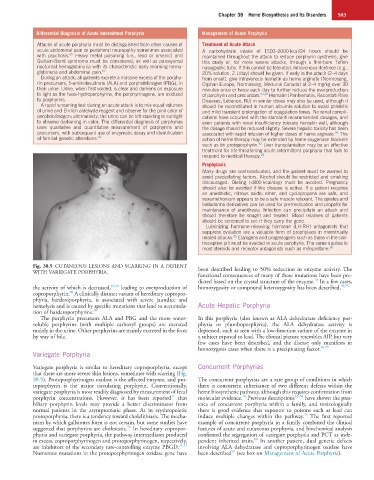
            Fig. 38.5  CUTANEOUS LESIONS AND SCARRING IN A PATIENT   been  described  leading  to  50%  reduction  in  enzyme  activity. The
            WITH VARIEGATE PORPHYRIA.
                                                                  functional consequences of many of these mutations have been pre-
                                                                                                        74
                                                                  dicted based on the crystal structure of the enzyme.  In a few cases,
            the activity of which is decreased, 67,68  leading to overproduction of   homozygosity or compound heterozygosity has been described. 49,75
                        69
            coproporphyrin.  A clinically distinct variant of hereditary copropor-
            phyria,  harderoporphyria,  is  associated  with  severe  jaundice  and
            hemolysis and is caused by specific mutations that lead to accumula-  Acute Hepatic Porphyria
            tion of harderoporphyrins. 70
              The  porphyrin  precursors  ALA  and  PBG  and  the  more  water-  In this porphyria (also known as ALA dehydratase deficiency por-
            soluble  porphyrins  (with  multiple  carboxyl  groups)  are  excreted   phyria  or  plumboporphyria),  the  ALA  dehydratase  activity  is
            mainly in the urine. Other porphyrins are mainly excreted in the feces   depressed, such as seen with a low-function variant of the enzyme in
            by way of bile.                                       a subject exposed to lead. The clinical picture resembles AIP, but very
                                                                  few  cases  have  been  described,  and  the  disease  only  manifests  in
                                                                  homozygous cases when there is a precipitating factor. 76,77
            Variegate Porphyria

            Variegate porphyria is similar to hereditary coproporphyria, except   Concurrent Porphyrias
            that there are more severe skin lesions, sometimes with scarring (Fig.
            38.5). Protoporphyrinogen oxidase is the affected enzyme, and pro-  The concurrent porphyrias are a rare group of conditions in which
            toporphyrin  is  the  major  circulating  porphyrin.  Conventionally,   there  is  concurrent  inheritance  of  two  different  defects  within  the
            variegate porphyria is most readily diagnosed by measurement of fecal   heme biosynthetic pathway, although this requires confirmation from
                                                                                78
                                                         71
            porphyrin  concentrations.  However,  it  has  been  reported   that   molecular evidence.  Previous descriptions 52–54  have shown the pres-
            biliary  porphyrin  levels  may  provide  a  better  discriminator  from   ence  of  concurrent  porphyria  within  a  family,  and  toxicologically
            normal  patients  in  the  asymptomatic  phase.  As  in  erythropoietic   there  is  good  evidence  that  exposure  to  poisons  such  as  lead  can
                                                                                                     79
            protoporphyria, there is a tendency toward cholelithiasis. The mecha-  induce  multiple  changes  within  the  pathway.   The  first  reported
            nism by which gallstones form is not certain, but some studies have   example of concurrent porphyria in a family combined the clinical
                                           72
            suggested that porphyrins are cholestatic.  In hereditary copropor-  features of acute and cutaneous porphyria, and biochemical analysis
            phyria and variegate porphyria, the pathway intermediates produced   confirmed the segregation of variegate porphyria and PCT as inde-
                                                                                    80
            in excess, coproporphyrinogen and protoporphyrinogen, respectively,   pendent  inherited  traits.   In  another  patient,  dual  genetic  defects
            are inhibitors of the secondary rate-controlling enzyme PBGD. 35,73    involving  ALA  dehydratase  and  coproporphyrinogen  oxidase  have
                                                                             52
            Numerous mutations in the protoporphyrinogen oxidase gene have   been described  (see box on Management of Acute Porphyria).

