


Page 586 - Hematology_ Basic Principles and Practice ( PDFDrive )
P. 586
Chapter 38  Heme Biosynthesis and Its Disorders  501


                                                            4   3  2
                                                         5            1
                                                     6                   5
                                                  1
                                                2                           4
                                               3              6
                                             1                       5         3
                                             2         7                         2
                                                          Married 1888
                                                                                 1
                                            3         8                4
                                                                                 1
                                             1                        3         8
                                             2         9            2           7
                                              3           10   1               6
                                               4                              5
                                                 5                          4
                                                   6                      3
                                                     1                  2
                                                       2             1
                                                           3  4  5  6
                                                                                       Key
                                                                               Porphyria biochemistry positive
                                                                               Porphyria biochemistry negative
                                                                               Obligatory porphyria
                                                                               Porphyria positive (history only)
                                                                               Not tested
                                                                               Unknown sex
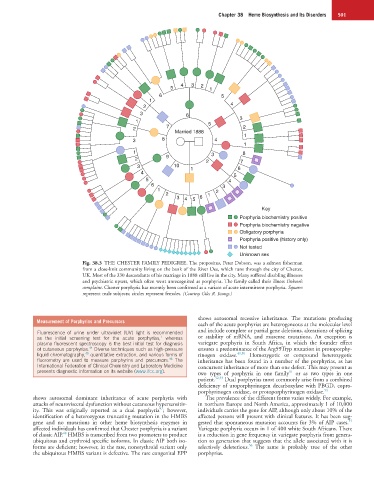
                            Fig. 38.3  THE CHESTER FAMILY PEDIGREE. The propositus, Peter Dobson, was a salmon fisherman
                            from a close-knit community living on the bank of the River Dee, which runs through the city of Chester,
                            UK. Most of the 330 descendants of his marriage in 1888 still live in the city. Many suffered disabling illnesses
                            and psychiatric upsets, which often went unrecognized as porphyria. The family called their illness Dobson’s
                            complaint. Chester porphyria has recently been confirmed as a variant of acute intermittent porphyria. Squares
                            represent male subjects; circles represent females. (Courtesy Giles R. Youngs.)


                                                                  shows  autosomal  recessive  inheritance.  The  mutations  producing
             Measurement of Porphyrins and Precursors
                                                                  each of the acute porphyrias are heterogeneous at the molecular level
             Fluorescence  of  urine  under  ultraviolet  (UV)  light  is  recommended   and include complete or partial gene deletions, alterations of splicing
             as  the  initial  screening  test  for  the  acute  porphyrias,   whereas   or  stability  of  mRNA,  and  missense  mutations.  An  exception  is
                                                      7
             plasma  fluorescent  spectroscopy  is  the  best  initial  test  for  diagnosis   variegate  porphyria  in  South  Africa,  in  which  the  founder  effect
             of cutaneous porphyrias.  Diverse techniques such as high-pressure   ensures a predominance of the Arg59Tryp mutation in protoporphy-
                              44
             liquid chromatography,  quantitative extraction, and various forms of   rinogen  oxidase. 49,50   Homozygotic  or  compound  heterozygotic
                             45
             fluorometry  are  used  to  measure  porphyrins  and  precursors.   The   inheritance has been found in a number of the porphyrias, as has
                                                        46
             International Federation of Clinical Chemistry and Laboratory Medicine   concurrent inheritance of more than one defect. This may present as
             presents diagnostic information on its website (www.ifcc.org).  two  types  of  porphyria  in  one  family   or  as  two  types  in  one
                                                                                                51
                                                                  patient. 52,53  Dual porphyrias most commonly arise from a combined
                                                                  deficiency of uroporphyrinogen decarboxylase with PBGD, copro-
                                                                  porphyrinogen oxidase, or protoporphyrinogen oxidase. 54
            shows  autosomal  dominant  inheritance  of  acute  porphyria  with   The prevalence of the different forms varies widely. For example,
            attacks of neurovisceral dysfunction without cutaneous hypersensitiv-  in northern Europe and North America, approximately 1 of 10,000
                                                     47
            ity.  This  was  originally  reported  as  a  dual  porphyria ;  however,   individuals carries the gene for AIP, although only about 10% of the
            identification of a heterozygous truncating mutation in the HMBS   affected persons will present with clinical features. It has been sug-
                                                                                                                   55
            gene  and  no  mutations  in  other  heme  biosynthesis  enzymes  in   gested that spontaneous mutation accounts for 3% of AIP cases.
            affected individuals has confirmed that Chester porphyria is a variant   Variegate porphyria occurs in 1 of 400 white South Africans. There
                      48
            of classic AIP.  HMBS is transcribed from two promoters to produce   is a reduction in gene frequency in variegate porphyria from genera-
            ubiquitous and erythroid specific isoforms. In classic AIP both iso-  tion to generation that suggests that the allele associated with it is
                                                                                  56
            forms are deficient; however, in the rare, nonerythroid variant only   selectively  deleterious.   The  same  is  probably  true  of  the  other
            the ubiquitous HMBS variant is defective. The rare congenital EPP   porphyrias.

