


Page 606 - Hematology_ Basic Principles and Practice ( PDFDrive )
P. 606
Chapter 39  Megaloblastic Anemias  515


                                Structure of cobalamin              Food  cobalamin  is  stable  to  high-temperature  cooking  but  is
                             (components and substitutions)       readily converted to inactive cobalamin analogues by ascorbic acid.
                                                                  Cobalamin  is  exceptionally  well  stored  in  tissues  in  its  coenzyme
                                      N    NH 2                   forms. Of the total-body content of 2 to 5 mg in adults, about 1 mg
                                                                  is in the liver. There is an obligatory loss of 0.1% per day (1.3 µg)
                                     N     N     5′-deoxyadenosyl-  regardless of total-body cobalamin content. It takes about 3 to 4 years
                                 O     N         methyl-          to  deplete  cobalamin  stores  when  dietary  cobalamin  is  abruptly
                          CH 2                   hydroxo-         malabsorbed, but it may take longer to develop nutritional cobalamin
                                                 cyano-
                               OH  OH                             deficiency,  because  of  an  efficient  enterohepatic  circulation,  which
                                                                                                          15
                                                                  accounts for turnover of 5 to 10 µg/day of cobalamin.
                            B
                       C    N   C C
                    A  N  Co +  N                                 Absorption
                         N        C              Cobamide
                        D      C                                  Cobalamin in food is usually in coenzyme form (5′-deoxyadenosyl-
                           N                                      cobalamin [adenosylcobalamin] and methylcobalamin), nonspecifi-
            CH
              2  CH                                               cally  bound  to  proteins  (see  Fig.  39.2).  In  the  stomach,  peptic
            CH    2                                               digestion at low pH is a prerequisite for cobalamin release from food
              2            N                                      protein.   Once  released  by  proteolysis,  cobalamin  preferentially
                                                                        15
            CO                                                    binds a high-affinity, 150-kDa, cobalamin-binding protein called R
                  CH                             5:6-dimethyl-    protein (a haptocorrin) from gastric juice and saliva that has higher
            NH      3   -          C
                       O       O                 benziminazole    affinity  for  cobalamin  than  gastric  intrinsic  factor  (IF).  The
            CH 2        P                                         cobalamin–R  protein  (holo-R  protein)  complex,  along  with  excess
            CH     O     O                                        unbound (apo)-R protein and IF, pass through into the second part
                                                                  of  the  duodenum,  where  pancreatic  proteases  degrade  holo-R  and
            CH 2                                                  apo-R proteins (but not IF). This results in the transfer of cobalamin
                                                                  to IF, a 45-kDa glycoprotein with high-affinity binding (K a  = 1.5 ×
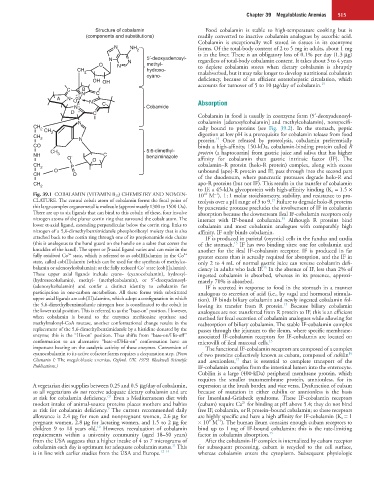
            Fig. 39.1  COBALAMIN (VITAMIN B 12) CHEMISTRY AND NOMEN-  10  M ), 1 : 1 molar stoichiometry, stability, and resistance to pro-
                                                                    10
                                                                       −1
            CLATURE. The central cobalt atom of cobalamin forms the focal point of   teolysis over a pH range of 3 to 9.  Failure to degrade holo-R proteins
                                                                                          15
            this large complex organometallic molecule (approximately 1300 to 1500 Da).   by pancreatic protease precludes the involvement of IF in cobalamin
            There are up to six ligands that can bind to this cobalt; of these, four involve   absorption because the downstream ileal IF-cobalamin receptors only
            nitrogen atoms of the planar corrin ring that surround the cobalt atom. The   interact  with  IF-bound  cobalamin.   Although  R  proteins  bind
                                                                                             15
            lower α-axial ligand, extending perpendicular below the corrin ring, links to   cobalamin  and  most  cobalamin  analogues  with  comparably  high
            nitrogen of a 5,6-dimethylbenzimidazole phosphoribosyl moiety that is also   affinity, IF only binds cobalamin.
            attached back to the corrin ring through one of its propionamide side chains   IF is produced in parietal (oxyntic) cells in the fundus and cardia
            (this is analogous to the hand guard on the handle on a sabre that covers the   of the stomach.  IF has two binding sites: one for cobalamin and
                                                                              15
            knuckles of the hand). The upper or β-axial ligand varies and can exist in the   another  for  the  ileal  IF-cobalamin  receptor.  IF  is  produced  in  far
                       3+
                                                             2+
            fully oxidized Co  state, which is referred to as cob(III)alamin; in the Co    greater excess than is actually required for absorption, and the IF in
            state, called cob(II)alamin (which can be used for the synthesis of methylco-  only 2 to 4 mL of normal gastric juice can reverse cobalamin defi-
                                                +
            balamin or adenosylcobalamin); or the fully reduced Co  state (cob[I]alamin).   ciency in adults who lack IF.  In the absence of IF, less than 2% of
                                                                                       15
            These  upper  axial  ligands  include  cyano-  (cyanocobalamin),  hydroxyl-   ingested  cobalamin  is  absorbed,  whereas  in  its  presence,  approxi-
            (hydroxocobalamin),  methyl-  (methylcobalamin),  or  5′-deoxyadenosyl-   mately 70% is absorbed.
            (adenosylcobalamin)  and  confer  a  distinct  identity  to  cobalamin  for   IF is secreted in response to food in the stomach in a manner
            participation  in  one-carbon  metabolism.  All  these  forms  with  substituted   analogous to secretion of acid (i.e., by vagal and hormonal stimula-
            upper axial ligands are cob(III)alamins, which adopt a configuration in which   tion). IF binds biliary cobalamin and newly ingested cobalamin fol-
            the 5,6-dimethylbenzimidazole nitrogen base is coordinated to the cobalt in   lowing  its  transfer  from  R  protein.   Because  biliary  cobalamin
                                                                                              15
            the lower axial position. This is referred to as the “base-on” position. However,   analogues are not transferred from R protein to IF, this is an efficient
            when  cobalamin  is  bound  to  the  enzymes  methionine  synthase  and   method for fecal excretion of cobalamin analogues while allowing for
            methylmalonyl-CoA mutase, another conformational change results in the   reabsorption of biliary cobalamin. The stable IF-cobalamin complex
            replacement of the 5,6-dimethylbenzimidazole by a histidine donated by the   passes through the jejunum to the ileum, where specific membrane-
            enzyme;  this  is  the  “His-on”  position. Thus  shifts  from  “base-on/His-off”   associated  IF-cobalamin  receptors  for  IF-cobalamin  are  located  on
            conformation  to  an  alternative  “base-off/His-on”  conformation  have  an   microvilli of ileal mucosal cells. 15
            important bearing on the catalytic activity of these enzymes. Conversion of   The functional IF-cobalamin receptors are composed of a complex
            cyanocobalamin to its active cofactor forms requires a decyanation step. (From   of two proteins collectively known as cubam, composed of cubilin
                                                                                                                   16
                                                                              17
            Chanarin I: The megaloblastic anemias, Oxford, UK, 1979, Blackwell Scientific   and  amnionless,   that  is  essential  to  complete  transport  of  the
            Publications.)                                        IF-cobalamin complex from the intestinal lumen into the enterocyte.
                                                                  Cubilin  is  a  large (400-kDa)  peripheral membrane protein, which
                                                                  requires  the  smaller  transmembrane  protein,  amnionless,  for  its
            A vegetarian diet supplies between 0.25 and 0.5 µg/day of cobalamin,   expression at the brush border, and vice versa. Dysfunction of cubam
            so all vegetarians do not receive adequate dietary cobalamin and are   because  of  mutation  in  either  cubilin  or  amnionless  is  the  basis
                                    7,8
            at risk for cobalamin deficiency.  Even a Mediterranean diet with   for  Imerslund-Gräsbeck  syndrome.  These  IF-cobalamin  receptors
                                                                                2+
            modest intake of animal-source proteins places mothers and babies   (cubam) require Ca  for binding at pH above 5.4; they do not bind
                                    9
            at  risk  for  cobalamin  deficiency.  The  current  recommended  daily   free IF, cobalamin, or R protein–bound cobalamin; so these receptors
            allowance  is  2.4 µg  for  men  and  nonpregnant  women,  2.6 µg  for   are highly specific and have a high affinity for IF-cobalamin (K a  = 1
                                                                     9
                                                                        −1
            pregnant women, 2.8 µg for lactating women, and 1.5 to 2 µg for   × 10  M ). The human ileum contains enough cubam receptors to
                                 10
            children  9  to  18  years  old.   However,  reevaluation  of  cobalamin   bind  up  to  1 mg  of  IF-bound  cobalamin;  this  is  the  rate-limiting
            requirements  within  a  university  community  (aged  18–50  years)   factor in cobalamin absorption. 15
            from the USA suggests that a higher intake of 4 to 7 micrograms of   After the cobalamin-IF complex is internalized by cubam receptor
                                                         11
            cobalamin each day is optimum for adequate cobalamin status.  This   for  subsequent  processing,  cubam  is  recycled  to  the  cell  surface,
            is in line with earlier studies from the USA and Europe. 12–14  whereas  cobalamin  enters  the  cytoplasm.  Subsequent  physiologic

