


Page 608 - Hematology_ Basic Principles and Practice ( PDFDrive )
P. 608
Chapter 39  Megaloblastic Anemias  517


                                                                                           Via intermediates of
                                                                                         one-carbon metabolism
                                                              Cytoplasm
                                                                                                m    Polyglutamation
                                                                                                e  s
                                                                                                 t
                                                                                    5-CH H PteGlu h  y  H PteGlu
              Plasma                                                                   3 4       i n  4
            membrane                                                                            o t
                                          TC II degradation
                                                                                                n  h
                                                                                   Cob(I)alamin  i    MeCbI  G
                             TCII                                             E                 n  a
                     TC II  receptor
                                       TC II    F             C,D                     SAH       e s
            Cob(III)alamin                        Cob(III)alamin    Cob(II)alamin                 e
                                    Cob(III)alamin  J       Reductase          SAM
                                                                                      Methionine    Homocysteine
                                    Lysosome
                            Receptor-
                            mediated                               Cob(II)alamin
                           endocytosis
                                                                    Reductase  A
                                          Mitochondria
                                                                   Cob(I)alamin

                                                                 Adenosyltransferase B

                                                                     AdoCbl
                                                 Methylmalonyl CoA                Succinyl CoA
                                                                 5-CH -H PteGlu,
                                                                       4
                                                                     3
                                                                    5-methyl-
                                                                  tetrahydrofolate;
                                                                    MMCoA
                                                                     mutase


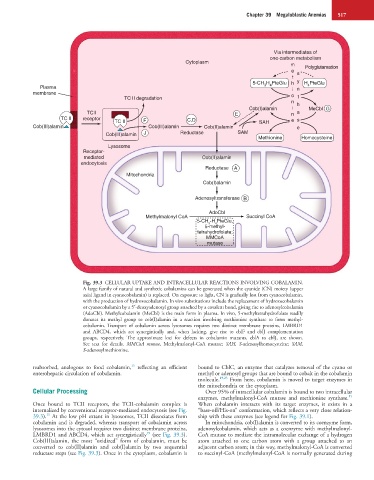
                            Fig. 39.3  CELLULAR UPTAKE AND INTRACELLULAR REACTIONS INVOLVING COBALAMIN.
                            A large family of natural and synthetic cobalamins can be generated when the cyanide (CN) moiety (upper
                            axial ligand in cyanocobalamin) is replaced. On exposure to light, CN is gradually lost from cyanocobalamin,
                            with the production of hydroxocobalamin. In vivo substitutions include the replacement of hydroxocobalamin
                            or cyanocobalamin by a 5′-deoxyadenosyl group attached by a covalent bond, giving rise to adenosylcobalamin
                            (AdoCbl). Methylcobalamin (MeCbl) is the main form in plasma. In vivo, 5-methyltetrahydrofolate readily
                            donates  its  methyl  group  to  cob(I)alamin  in  a  reaction  involving  methionine  synthase  to  form  methyl-
                            cobalamin. Transport  of  cobalamin  across  lysosomes  requires  two  distinct  membrane  proteins,  LMBRD1
                            and  ABCD4,  which  act  synergistically  and,  when  lacking,  give  rise  to  cblF  and  cblJ  complementation
                            groups,  respectively.  The  approximate  loci  for  defects  in  cobalamin  mutants,  cblA  to  cblJ,  are  shown.
                            See  text  for  details.  MMCoA  mutase,  Methylmalonyl-CoA  mutase;  SAH,  S-adenosylhomocysteine;  SAM,
                            S-adenosylmethionine.

                                            15
            reabsorbed,  analogous  to  food  cobalamin,   reflecting  an  efficient   bound to CblC, an enzyme that catalyzes removal of the cyano or
            enterohepatic circulation of cobalamin.               methyl or adenosyl groups that are bound to cobalt in the cobalamin
                                                                  molecule. 19,23  From here, cobalamin is moved to target enzymes in
                                                                  the mitochondria or the cytoplasm.
            Cellular Processing                                     Over 95% of intracellular cobalamin is bound to two intracellular
                                                                                                                   15
                                                                  enzymes,  methylmalonyl-CoA  mutase  and  methionine  synthase.
            Once  bound  to  TCII  receptors,  the  TCII-cobalamin  complex  is   When  cobalamin  interacts  with  its  target  enzymes,  it  exists  in  a
            internalized by conventional receptor-mediated endocytosis (see Fig.   “base-off/His-on” conformation, which reflects a very close relation-
                15
            39.3).  At the low pH extant in lysosomes, TCII dissociates from   ship with these enzymes (see legend for Fig. 39.1).
            cobalamin and is degraded, whereas transport of cobalamin across   In mitochondria, cob(I)alamin is converted to its coenzyme form,
            lysosomes into the cytosol requires two distinct membrane proteins,   adenosylcobalamin,  which  acts  as  a  coenzyme  with  methylmalonyl-
                                                 19
            LMBRD1 and ABCD4, which act synergistically  (see Fig. 39.3).   CoA mutase to mediate the intramolecular exchange of a hydrogen
            Cob(III)alamin,  the  most  “oxidized”  form  of  cobalamin,  must  be   atom  attached  to  one  carbon  atom  with  a  group  attached  to  an
            converted  to  cob(II)alamin  and  cob(I)alamin  by  two  sequential   adjacent carbon atom; in this way, methylmalonyl-CoA is converted
            reductase steps (see Fig. 39.3). Once in the cytoplasm, cobalamin is   to succinyl-CoA (methylmalonyl-CoA is normally generated during

