


Page 611 - Hematology_ Basic Principles and Practice ( PDFDrive )
P. 611
520    Part V  Red Blood Cells
                                                                              1.  Dihydrofolate reductase
                                                     Extracellular space      2.  Folylpolyglutamate synthetase

                       2         3         4                                  3.  Serine hydroxymethyltransferase
             1                                        5                       4.  Methylenetetrahydrofolate reductase
                                H +       H +
                                           H +                                5.  Methionine synthetase
                                 H +    H +                                   6.  6/6a. Formimino transferase-cyclodeaminase
                                                                              7.  Formyltransferase
                                                                              8.  Formyl-tetrahydrofolate synthetase
             Caveolae     Cytoplasm
                                                                              9.  8-amino-4-imidazole carboxamide
                                                                                    ribonucleotide (AICAR) transformylase
             Receptor                                               PteGlu   10.  Formyl-tetrahydrofolate dehydrogenase

             Folate                                                          11.  Glycinamide ribonucleotide (GAR)
             Folate polyglutamate                              NADPH   1  DHFR          transformylase
             Channel                                           NADP
          H Proton                                                 H PteGlu  12.  Methylenetetrahydrofolate dehydrogenase
           +
                                                                    2
                                           Polyglutamation                   13.  Thymidylate synthetase
                                        2                      NADPH   1  DHFR
                                            Homocysteine Methionine          14.  Methenyltetrahydrofolate synthetase
              DNA   dTMP                             5         NADP          15.  Methenyltetrahydrofolate cyclohydorolase
                           13  TS  5–CH H PteGlu n                 H PteGlu n
                                         4
                                       3
                                                                    4
                       dUMP           methyl           MS        ATP
                                                     MeCbl        glu  2  glu
                               FAD                              ADP
                              NADP
                                        4                         H PteGlu
                                FADH          Serine                4    n           FAICAR
                                NADPH              3                                     9    NADPH
                                          Glycine                           Formate        AICAR      10
                                                         FiGIu    formylGIu                       NADP
                                                             6           7        ATP
                                                        Glu         Glu                8
                                                                                       ADP
                    5,10–CH –H PteGlu               5–CH=NHH PteGlu   5–CHOH PteGIu       Pi    10–CHOH PteGIu n
                                                                                                        4
                                                                            4
                          2  4    n                          4    n               n                  formyl
                        methylene                       formimino         formyl
                                                                       ATP
                                                                             14
                                                                6a  ADP         H O
                                                          NH          Pi         2
                                              NADP           3                          15      de novo biosynthesis
                                                    12                                           of the purine ring
                                                    NADPH                                         GAR    FGAR
                                                              5,10–CH=H PteGlu n
                                                                       4
                                                                  methenyl                             11
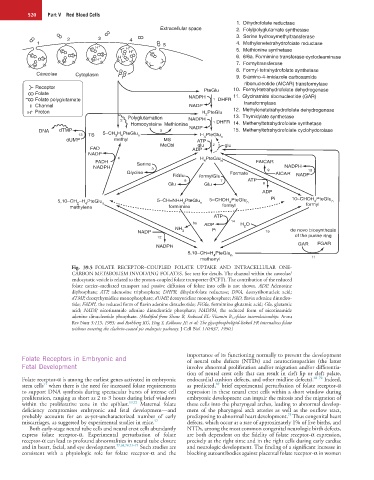
                        Fig.  39.5  FOLATE  RECEPTOR–COUPLED  FOLATE  UPTAKE  AND  INTRACELLULAR  ONE-
                        CARBON METABOLISM INVOLVING FOLATES. See text for details. The channel within the caveolae/
                        endocytotic vesicle is related to the proton-coupled folate transporter (PCFT). The contribution of the reduced
                        folate  carrier–mediated  transport  and  passive  diffusion  of  folate  into  cells  is  not  shown.  ADP,  Adenosine
                        diphosphate;  ATP,  adenosine  triphosphate;  DHFR,  dihydrofolate  reductase;  DNA,  deoxyribonucleic  acid;
                        dTMP, deoxythymidine monophosphate; dUMP, deoxyuridine monophosphate; FAD, flavin adenine dinucleo-
                        tide; FADH, the reduced form of flavin adenine dinucleotide; FiGlu, formimino glutamic acid; Glu, glutamic
                        acid;  NADP,  nicotinamide  adenine  dinucleotide  phosphate;  NADPH,  the  reduced  form  of  nicotinamide
                        adenine dinucleotide phosphate. (Modified from Shane B, Stokstad EL: Vitamin B 12 -folate interrelationships. Annu
                        Rev Nutr 5:115, 1985; and Rothberg KG, Ying Y, Kolhouse JF, et al: The glycophospholipid-linked FR internalizes folate
                        without entering the clathrin-coated pit endocytic pathway. J Cell Biol 110:637, 1990.)
        Folate Receptors in Embryonic and                     importance of its functioning normally to prevent the development
                                                              of  neural  tube  defects  (NTDs)  and  neurocristopathies  (the  latter
        Fetal Development                                     involve abnormal proliferation and/or migration and/or differentia-
                                                              tion of neural crest cells that can result in cleft lip or cleft palate,
        Folate receptor-α is among the earliest genes activated in embryonic   endocardial cushion defects, and other midline defects). 68–70  Indeed,
                                                                        69
               71
        stem cells  when there is the need for increased folate requirements   as predicted,  brief experimental perturbation of folate receptor-α
        to support DNA synthesis during spectacular bursts of intense cell   expression in these neural crest cells within a short window during
        proliferation, ranging as short as 2 to 3 hours during brief windows   embryonic development can impair the mitosis and the migration of
        within  the  proliferative  zone  in  the  epiblast. 69,72   Maternal  folate   these cells into the pharyngeal arches, leading to abnormal develop-
        deficiency  compromises  embryonic  and  fetal  development—and   ment  of  the  pharyngeal  arch  arteries  as  well  as  the  outflow  tract,
                                                                                               75
        probably  accounts  for  an  as-yet-uncharacterized  number  of  early   predisposing to abnormal heart development.  Thus congenital heart
        miscarriages, as suggested by experimental studies in mice. 57  defects, which occur at a rate of approximately 1% of live births, and
           Both early-stage neural tube cells and neural crest cells abundantly   NTDs, among the most common congenital neurologic birth defects,
        express  folate  receptor-α.  Experimental  perturbation  of  folate   are both dependent on the fidelity of folate receptor-α expression,
        receptor-α can lead to profound abnormalities in neural tube closure   precisely at the right time and in the right cells during early cardiac
        and in heart, facial, and eye development. 57,68,70,73–75  Such studies are   and neurologic development. The finding of a significant increase in
        consistent  with  a  physiologic  role  for  folate  receptor-α  and  the   blocking autoantibodies against placental folate receptor-α in women

