


Page 609 - Hematology_ Basic Principles and Practice ( PDFDrive )
P. 609
518    Part V  Red Blood Cells


        the catabolism of branched-chain amino acids, odd-chain fatty acids,   Substitutions
        and  cholesterol).  When  formed,  succinyl-CoA  can  then  enter  the   N  position only  N  position only
                                                                             10
                                                               5
        Krebs tricarboxylic acid cycle.
           In the cytoplasm, cobalamin, as methylcobalamin, functions as   Formyl–CHO  Formyl–CHO
        a  coenzyme  for  methionine  synthase,  a  critical  enzyme  for  which   Methyl–CH 3  Hydroxymethyl–CH OH
                                                                                           2
        both  folates  and  cobalamin  are  required  for  normal  one-carbon   Formimino–CH=NH
                                                                           5
        metabolism (see Fig. 39.3). Methionine synthase is a modular protein   Bridged between N and N 10
        with  four  distinct  and  separate  regions  for  binding  homocysteine,   Methylene–CH  -
        5-methyl-tetrahydrofolate (5-methyl-THF; 5-methyl-H 4PteGlu), the   Methenyl–CH= 2    COOH
                                                      22
        cobalamin prosthetic group, and S-adenosylmethionine (SAM).  The   C  H
        reaction proceeds by methyl transfer from 5-methyl-tetrahydrofolate   OH  H  N  CO NH CH
        to methionine synthase–bound cob(I)alamin to form methylcobala-  N  9 CH 2 10         CH
        min, followed by transfer of this methyl group to homocysteine to   N 3  4  5  6  H     2
        form methionine and regeneration of cob(I)alamin. In this process,   2 1  8  7  p-aminobenzoic  CH 2  COOH
        5-methyl-tetrahydrofolate is converted to tetrahydrofolate 5-methyl-  NH 2  N  N  acid residue  CO NH CH
        tetrahydrofolate is converted to tetrahydrofolate that is subsequently   H  H  (PABA)
        polyglutamylated by folyl  polyglutamate  synthase;  this  addition  of            L-Glutamic  CH 2
        multiple glutamic acid moieties to tetrahydrofolate facilitates both its   Substituted pteridine  acid  COOH
        retention within cells and participation in one-carbon metabolism.   moiety         residue  CH 2
        During this reaction, spontaneous oxidation of cob(I)alamin (which                           CO NH CH
        has no axial ligand) to the catalytically inactive cob(II)alamin form   (tetrahydro)pteroyl moiety  CH
        requires reduction back to cob(I)alamin before it can accept a methyl                                 2
        group.  There  is  a  specific  redox  regulator  known  as  methionine                             CH 2
        synthase reductase that restores enzyme activity in the presence of   5, 6, 7, 8 tetrahydropteroyl diglutamic acid
                       24
        SAM and NADPH ; this enzyme is mutated in patients with cblE                                        COOH
        mutations.                                                                                   Multiple glutamic
           The physiologic importance of the key cofactor roles of the two                           acid moieties can
        forms of cobalamin (i.e., adenosylcobalamin and methylcobalamin)                                be added
        in methylmalonyl-CoA mutase and methionine synthase, respectively,
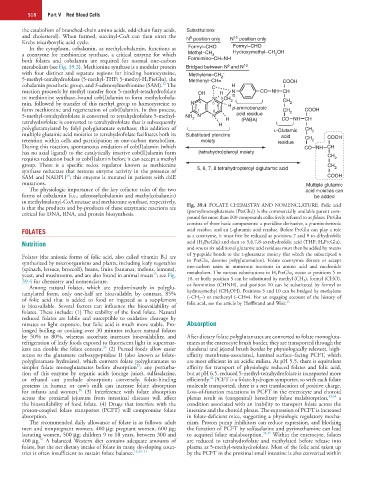
        is that the products and by-products of these enzymatic reactions are   Fig. 39.4  FOLATE CHEMISTRY AND NOMENCLATURE. Folic acid
        critical for DNA, RNA, and protein biosynthesis.      (pteroylmonoglutamate [PteGlu]) is the commercially available parent com-
                                                              pound for more than 100 compounds collectively referred to as folates. PteGlu
                                                              consists of three basic components: a pteridine derivative, a p-aminobenzoic
        FOLATES                                               acid residue, and an L-glutamic acid residue. Before PteGlu can play a role
                                                              as a coenzyme, it must first be reduced at positions 7 and 8 to dihydrofolic
        Nutrition                                             acid (H 2PteGlu) and then to 5,6,7,8-tetrahydrofolic acid (THF; H 4PteGlu),
                                                              and one to six additional glutamic acid residues must then be added by means
                                                              of γ-peptide bonds to the L-glutamate moiety (for which the subscripted n
        Folates (the anionic forms of folic acid, also called vitamin B 9 ) are
        synthesized by microorganisms and plants, including leafy vegetables   in  PteGlu n   denotes  polyglutamation).  Folate  coenzymes  donate  or  accept
        (spinach, lettuce, broccoli), beans, fruits (bananas, melons, lemons),   one-carbon  units  in  numerous  reactions  in  amino  acid  and  nucleotide
                                                   15
        yeast, and mushrooms, and are also found in animal meats ; see Fig.   metabolism. The various substitutions in H 4PteGlu n  occur at positions 5 or
        39.4 for chemistry and nomenclature.                  10, or both; position 5 can be substituted by methyl (CH 3 ), formyl (CHO),
           Among  natural  folates,  which  are  predominantly  in  polyglu-  or formimino (CHNH), and position 10 can be substituted by formyl or
        tamylated  form,  only  one-half  are  bioavailable;  by  contrast,  85%   hydroxymethyl (CH 2OH). Positions 5 and 10 can be bridged by methylene
        of  folic  acid  that  is  added  to  food  or  ingested  as  a  supplement   (–CH 2–) or methenyl (–CH=). For an engaging account of the history of
                                                                                               25
        is  bioavailable.  Several  factors  can  influence  the  bioavailability  of   folic acid, see the article by Hoffbrand and Weir.
        folates. These include: (1) The stability of the food folate. Natural
        reduced  folates  are  labile  and  susceptible  to  oxidative  cleavage  by
        nitrates or light exposure, but folic acid is much more stable. Pro-  Absorption
        longed boiling or cooking over 30 minutes reduces natural folates
        by  50%  to  80%,  whereas  ascorbate  increases  bioavailability,  and   After dietary folate polyglutamates are converted to folate monogluta-
        refrigeration of leafy foods exposed to fluorescent light in supermar-  mates at the enterocyte brush border, they are transported through the
                                   26
        kets can double the folate content.  (2) Pureed foods allow easier   duodenal and jejunal brush border by physiologically relevant, high-
        access to the glutamate carboxypeptidase II (also known as folate-  affinity membrane-associated, luminal surface–facing PCFT, which
        polyglutamate  hydrolase),  which  converts  folate  polyglutamates  to   are most efficient in an acidic milieu. At pH 5.5, there is equivalent
                                              27
        simpler  folate  monoglutamates  before  absorption ;  any  perturba-  affinity for transport of physiologic reduced folates and folic acid,
        tion  of  this  enzyme  by  organic  acids  (orange  juice),  sulfasalazine,   but at pH 6.5, reduced 5-methyl-tetrahydrofolate is transported more
                                                                      32
        or  ethanol  can  preclude  absorption;  conversely,  folate-binding   efficiently.  PCFT is a folate-hydrogen symporter, so with each folate
        proteins  in  human  or  cow’s  milk  can  increase  folate  absorption   molecule transported, there is a net translocation of positive charge.
                           28
        for  infants  and  women.   (3)  Interference  with  folate  absorption   Loss-of-function mutations in PCFT in the enterocyte and choroid
        across  the  proximal  jejunum  from  intestinal  diseases  will  affect   plexus  result  in  (congenital)  hereditary  folate  malabsorption, 33,34   a
        the bioavailability of food folate. (4) Drugs that interfere with the   condition associated with an inability to transport folate across the
        proton-coupled  folate  transporter  (PCFT)  will  compromise  folate    intestine and the choroid plexus. The expression of PCFT is increased
        absorption.                                           in folate-deficient mice, suggesting a physiologic regulatory mecha-
           The recommended daily allowance of folate is as follows: adult   nism. Proton pump inhibitors can reduce expression, and blocking
        men and nonpregnant women, 400 µg; pregnant women, 600 µg;   the function of PCFT by sulfasalazine and pyrimethamine can lead
        lactating women, 500 µg; children 9 to 18 years, between 300 and   to acquired folate malabsorption. 34,35  Within the enterocyte, folates
              10
        400 µg.   A  balanced  Western  diet  contains  adequate  amounts  of   are  reduced  to  tetrahydrofolate  and  methylated  before  release  into
        folate, but the net dietary intake of folate in many developing coun-  plasma as 5-methyl-tetrahydrofolate. Most of the folic acid taken up
        tries is often insufficient to sustain folate balance. 15,29–31  by the PCFT in the proximal small intestine is also converted within

