


Page 607 - Hematology_ Basic Principles and Practice ( PDFDrive )
P. 607
516    Part V  Red Blood Cells


                                                  Cbl-food protein
                                                  salivary R protein
                                                                                               Potential loci
                                                                                             for pathophysiology
                            Absorption of                    R-protein
                               Cbl                       CbI-food protein                 A.   Nutritional: insufficient
                                      Blood                                                     CbI intake.
                                                               CbI dissociated
                                                                from food by
                         Enterohepatic                   HCI   acid proteolysis
                        circulation of CbI              pepsin      IF                    B.   Abnormal intragastric
                                    Biliary CbI and                 HCI    Gastric              events: poor dissociation
                                    CbI analogues           R-CbI   Pepsin  secretion           of food-CbI.
                                      excreted            IF
                                                       CbI preferentially
                                    R protein binds     binds R protein                   C.   Deficient or defective IF.
                                    biliary CbI and             R-CbI
                                    CbI analogues
                      R-CbI                       Excess unbound
                  R-CbI analogues                    IF present
                       IF                                              Food and biliary   D.   Abnormal events in
                                                         IF                                     small bowel: Inadequate
                            R-CbI       Pancreatic protease secreted    CbI absorbed            pancreatic protease.
                                                                                                Usurping of luminal CbI
                                                       IF CbI complex                           by bacteria or D. latum
                                       IF-CbI           resistant to  TCII-CbI complex
           Pancreatic protease  IF-CbI  CbI analogues   proteolysis     To portal blood and
           selectively degrades                                         systemic circulation
              R proteins             Degraded R protein      IF receptors
                                                                                          E.   Disordered mucosa and/or
           Released CbI binds                                                                   IF receptors and/or
           IF within 10 minutes                 Ileum                TCII-CbI                   transenterocytic transport.
                                             IF receptors  IF-CbI     TCII-CbI
          CbI analogues unbound       IF-CbI                  IF-CbI  TCII-CbI  TCII binds CbI within enterocyte
                                                              IF-CbI           IF
                                       IF-CbI binds          Ca 2+         receptor              TCII  CbI
                                       IF receptors        pH>5.4   TCII     IF-CbI    IF   TCII

                                                     CbI analogues and                   CbI
                                                    degraded R proteins                          Enterocyte
                                                       are excreted
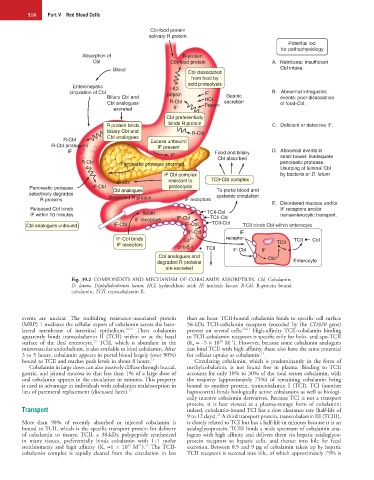
                        Fig. 39.2  COMPONENTS AND MECHANISM OF COBALAMIN ABSORPTION. Cbl, Cobalamin;
                        D.  latum,  Diphyllobothrium  latum;  HCl,  hydrochloric  acid;  IF,  intrinsic  factor;  R-Cbl,  R-protein  bound
                        cobalamin; TCII, transcobalamin II.


        events  are  unclear.  The  multidrug  resistance–associated  protein   than an hour. TCII-bound cobalamin binds to specific cell surface
        (MRP) 1 mediates the cellular export of cobalamin across the baso-  58-kDa  TCII-cobalamin  receptors  (encoded  by  the  CD320  gene)
        lateral  membrane  of  intestinal  epithelium. 18,19   Then  cobalamin   present  on  several  cells. 20,21   High-affinity TCII-cobalamin  binding
        apparently  binds  transcobalamin  II  (TCII)  within  or  at  the  basal   to TCII-cobalamin receptors is specific only for holo- and apo-TCII
                                                                         10
                                15
                                                                            −1
        surface  of  the  ileal  enterocyte.   TCII,  which  is  abundant  in  the   (K a  = ~5 × 10  M ). However, because some cobalamin analogues
        microvascular endothelium, is also available to bind cobalamin. After   can bind TCII with high affinity, these also have the same potential
        3 to 5 hours, cobalamin appears in portal blood largely (over 90%)   for cellular uptake as cobalamin. 15
        bound to TCII and reaches peak levels in about 8 hours. 15  Circulating  cobalamin,  which  is  predominantly  in  the  form  of
           Cobalamin in large doses can also passively diffuse through buccal,   methylcobalamin,  is  not  found  free  in  plasma.  Binding  to  TCII
        gastric, and jejunal mucosa so that less than 1% of a large dose of   accounts for only 10% to 30% of the total serum cobalamin, with
        oral cobalamin appears in the circulation in minutes. This property   the  majority  (approximately  75%)  of  remaining  cobalamin  being
        is used to advantage in individuals with cobalamin malabsorption in   bound  to  another  protein,  transcobalamin  I  (TCI). TCI  (another
        lieu of parenteral replacement (discussed later). 15  haptocorrin) binds biologically active cobalamins as well as biologi-
                                                              cally inactive cobalamin derivatives. Because TCI is not a transport
                                                              protein,  it  is  best  viewed  as  a  plasma-storage  form  of  cobalamin;
        Transport                                             indeed, cobalamin-bound TCI has a slow clearance rate (half-life of
                                                                        22
                                                              9 to 12 days).  A third transport protein, transcobalamin III (TCIII),
        More  than  90%  of  recently  absorbed  or  injected  cobalamin  is   is closely related to TCI but has a half-life in minutes because it is an
        bound to TCII, which is the specific transport protein for delivery   asialoglycoprotein. TCIII binds a wide spectrum of cobalamin ana-
        of  cobalamin  to  tissues.  TCII,  a  38-kDa  polypeptide  synthesized   logues with high affinity and delivers them via hepatic asialoglyco-
        in  many  tissues,  preferentially  binds  cobalamin  with  1 : 1  molar   protein  receptors  to  hepatic  cells,  and  thence  into  bile  for  fecal
                                           11
                                              −1 15
        stoichiometry  and  high  affinity  (K a   =1  ×  10  M ).   The  TCII-  excretion. Between 0.5 and 9 µg of cobalamin taken up by hepatic
        cobalamin  complex  is  rapidly  cleared  from  the  circulation  in  less   TCII receptors is secreted into bile, of which approximately 75% is

