


Page 612 - Hematology_ Basic Principles and Practice ( PDFDrive )
P. 612
Chapter 39  Megaloblastic Anemias  521

                                                                                                         76
                                    5′-UTR    Folate receptor     with  pregnancy  complicated  by  neural  tube  defects   is  a  striking
                                                                                                                   74
                                                                  human correlate of experimental studies in mice using antibodies.
                                                 mRNA             Folate receptor-α also provides folate during neuronal regeneration
                                  cis-element                                                                     77
                                                                  and repair after injury where DNA methylation is also involved.
                         Stimulates      No effect on interaction  Folate Receptors and PCFT in Cerebral Folate
                         interaction                              Transport Across the Choroid Plexus

                                                                  A new pathway of folate receptor-α dependent basolateral-to-apical
                                  trans-factor                    transcytosis within vesicles across the choroid plexus cells followed
                  Homocysteine    (hnRNP E1)     Methionine       by  exosome-mediated  folate  delivery  across  the  cerebrospinal  fluid
                                                                                                             45
                                                                  (CSF)  into  the  brain  parenchyma  has  been  discovered.   Briefly,
                                Methylcobalamin                   5-methyl-THF  is  bound  by  glycosyl-phosphatidyl  inositol  (GPI)-
                                                                  anchored  folate  receptor-α  on  the  basolateral  surface  of  choroid
                               Methionine synthase                plexus  cells.  Following  endocytosis  there  is  sequential  transfer  of
                                                                  folate receptor-α-bound folate from an early- to a later-endosomal
                                                                  compartment called multivesicular bodies. The inward budding of
               5-Methyl-tetrahydrofolate       Tetrahydrofolate
              (concentration dependent on    one-carbon metabolism  the limiting membrane of multivesicular bodies leads to formation of
            A  cellular delivery of folate)                       several intraluminal vesicles that now contain outward-facing folate
                                                                  receptor-α. Following transcytosis of multivesicular bodies (contain-
                                                                  ing their cargo of intraluminal vesicles) and eventual fusion with the
                           Cysteine  S  S  Cysteine               apical membrane, there is discharge of these intraluminal vesicles as
                                                                  40 to 100 nm exosomes into the cerebrospinal fluid. These exosomes
                                    mRNA                          (containing outward oriented folate receptor-α-bound folates) then
                                                                                                                 45
                                   binding site                   cross the ependymal cell layer and enter the brain parenchyma.
                                                                    Some of the endocytosed folate receptor-α-bound folate is trans-
                                                                  ported out of acidified endosomal compartments via proton-coupled
                                                                                                                   45
                                                                  folate transporters (PCFT) into the choroid plexus cell cytoplasm.
                                                                  However,  more  information  on  the  cooperative  function  of  folate
                                                                  receptor-α  and  PCFT  in  folate  transport  to  the  brain  is  required,
                Homocysteine                      Homocysteine    because  loss  of  PCFT-mediated  function  in  hereditary  folate  mal-
                                                                  absorption  profoundly  compromises  choroid  plexus  transport  of
                           S                    S                 folates. 33,78
                             S                 S
                           Cysteine       Cysteine                Renal Retention of Folates (and Cobalamin)

                                    mRNA                          After glomerular filtration, luminal folate binds folate receptor-α in
                                   binding site                   the brush border membranes of proximal renal tubular cells and is
            B                                                     internalized  rapidly  by  folate  receptor-α–mediated  endocytosis;  in
                                                                  the  low  pH  of  endocytotic  vesicles,  there  is  dissociation  of  folates
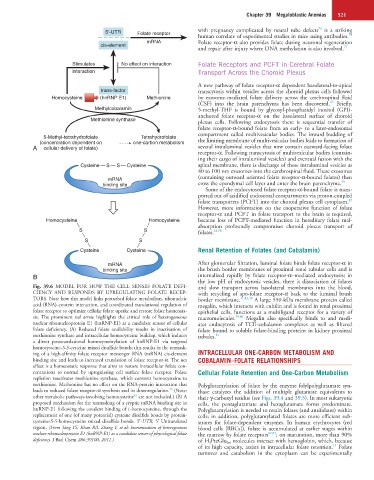
            Fig.  39.6  MODEL  FOR  HOW  THE  CELL  SENSES  FOLATE  DEFI-  and  slow  transport  across  basolateral  membranes  into  the  blood,
            CIENCY  AND  RESPONDS  BY  UPREGULATING  FOLATE  RECEP-  with  recycling  of  apo-folate  receptor-α  back  to  the  luminal  brush
            TORS. Note how this model links perturbed folate metabolism, ribonucleic   border membrane. 41,42,48  A large 550-kDa membrane protein called
            acid (RNA)–protein interaction, and coordinated translational regulation of   megalin, which interacts with cubilin and is found in renal proximal
            folate receptor to optimize cellular folate uptake and restore folate homeosta-  epithelial cells, functions as a multiligand receptor for a variety of
            sis. The  prominent  red  arrow  highlights  the  critical  role  of  heterogeneous   macromolecules. 79,80   Megalin  also  specifically  binds  to  and  medi-
            nuclear ribonucleoprotein E1 (hnRNP-E1) as a candidate sensor of cellular   ates  endocytosis  of  TCII-cobalamin  complexes  as  well  as  filtered
            folate  deficiency.  (A)  Reduced  folate  availability  results  in  inactivation  of   folate bound to soluble folate-binding proteins in kidney proximal
            methionine synthase and intracellular homocysteine buildup, which induces   tubules. 81
            a  direct  posttranslational  homocysteinylation  of  hnRNP-E1  via  targeted
            homocysteine-S-S-cysteine mixed disulfide bonds; this results in the unmask-
            ing of a high-affinity folate receptor messenger RNA (mRNA) cis-element   INTRACELLULAR ONE-CARBON METABOLISM AND
            binding site and leads to increased translation of folate receptor-α. The net   COBALAMIN–FOLATE RELATIONSHIPS
            effect is a homeostatic response that aims to restore intracellular folate con-
            centrations  to  normal  by  upregulating  cell  surface  folate  receptor.  Folate   Cellular Folate Retention and One-Carbon Metabolism
            repletion reactivates methionine synthase, which converts homocysteine to
            methionine. Methionine has no effect on the RNA-protein interaction that   Polyglutamylation of folate by the enzyme folylpolyglutamate syn-
                                                        56
            leads to reduced folate receptor-α synthesis and its downregulation.  (Note:   thase  catalyzes  the  addition  of  multiple  glutamate  equivalents  to
                                             61
            other metabolic pathways involving homocysteine  are not included.) (B) A   their γ-carboxyl residue (see Figs. 39.4 and 39.5). In most eukaryotic
            proposed mechanism for the unmasking of a cryptic mRNA binding site in   cells,  the  pentaglutamate  and  hexaglutamate  forms  predominate.
            hnRNP-E1 following the covalent binding of L-homocysteine, through the   Polyglutamylation is needed to retain folates (and antifolates) within
            replacement of one (of many potential) cysteine disulfide bonds by protein-  cells;  in  addition,  polyglutamylated  folates  are  more  efficient  sub-
            cysteine-S-S-homocysteine mixed disulfide bonds. 5′-UTR, 5′ Untranslated   strates  for  folate-dependent  enzymes.  In  human  erythrocytes  (red
            region. (From Tang YS, Khan RA, Zhang Y, et al: Incrimination of heterogeneous   blood  cells  [RBCs]),  folate  is  accumulated  at  earlier  stages  within
            nuclear ribonucleoprotein E1 (hnRNP-E1) as a candidate sensor of physiological folate   the marrow by folate receptors 82,83 ; on maturation, more than 90%
            deficiency. J Biol Chem 286:39100, 2011.)             of H 4PteGlu (n)  molecules interact with hemoglobin, which, because
                                                                                                              15
                                                                  of its high capacity, assists in intracellular folate retention.  Folate
                                                                  turnover  and  catabolism  in  the  cytoplasm  can  be  experimentally

