


Page 616 - Hematology_ Basic Principles and Practice ( PDFDrive )
P. 616
Chapter 39  Megaloblastic Anemias  525


             Clues for Distinguishing Cobalamin and Folate Deficiencies  Etiopathophysiologic Classification of Cobalamin Deficiency
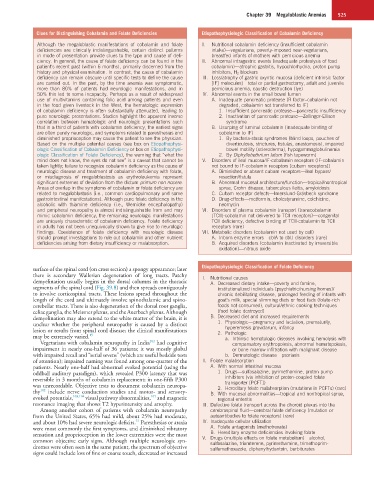
             Although  the  megaloblastic  manifestations  of  cobalamin  and  folate    I.   Nutritional cobalamin deficiency (insufficient cobalamin
             deficiencies  are  clinically  indistinguishable,  certain  distinct  patterns   intake)—vegetarians, poverty-imposed near-vegetarians,
             in mode of presentation provide clues to the type and cause of defi-  breastfed infants of mothers with pernicious anemia
             ciency. In general, the cause of folate deficiency can be found in the    II.  Abnormal intragastric events (inadequate proteolysis of food
             patient’s recent past (within 6 months), primarily discerned from the   cobalamin)—atrophic gastritis, hypochlorhydria, proton pump
             history and physical examination. In contrast, the cause of cobalamin   inhibitors, H 2  blockers
             deficiency can remain obscure until specific tests to define the cause    III.  Loss/atrophy of gastric oxyntic mucosa (deficient intrinsic factor
             are  carried  out.  In  the  past,  by  the  time  anemia  was  symptomatic,   [IF] molecules)—total or partial gastrectomy, adult and juvenile
             more  than  80%  of  patients  had  neurologic  manifestations,  and  in   pernicious anemia, caustic destruction (lye)
             50% this led to some incapacity. Perhaps as a result of widespread    IV.  Abnormal events in the small bowel lumen
             use  of  multivitamins  containing  folic  acid  among  patients  and  even    A.  Inadequate pancreatic protease (R factor–cobalamin not
             in  the  food  given  livestock  in  the  West,  the  hematologic  expression   degraded, cobalamin not transferred to IF)
             of  cobalamin  deficiency  is  often  substantially  attenuated,  leading  to   1.  Insufficient pancreatic protease—pancreatic insufficiency
             pure neurologic presentations. Studies highlight the apparent inverse   2.  Inactivation of pancreatic protease—Zollinger-Ellison
             correlation  between  hematologic  and  neurologic  presentations  such   syndrome
             that in a third of patients with cobalamin deficiency, the earliest signs    B.  Usurping of luminal cobalamin (inadequate binding of
             are often purely neurologic, and symptoms related to paresthesias and   cobalamin to IF)
             diminished proprioception may cause the patient to see the physician.   1.  By bacteria-stasis syndromes (blind loops, pouches of
             Based  on  the  multiple  potential  causes  (see  box  on  Etiopathophysi-  diverticulosis, strictures, fistulas, anastomosis), impaired
             ologic Classification of Cobalamin Deficiency or box on Etiopathophysi-  bowel motility (scleroderma), hypogammaglobulinemia
             ologic Classification of Folate Deficiency), the warning that “what the   2.  By Diphyllobothrium latum (fish tapeworm)
             mind does not know, the eyes do not see” is a caveat that cannot be    V.  Disorders of ileal mucosa/IF-cobalamin receptors (IF-cobalamin
             taken lightly; failure to recognize cobalamin deficiency as the cause of   not bound to IF-cobalamin receptors [cubam receptors])
             neurologic disease and treatment of cobalamin deficiency with folate,    A.  Diminished or absent cubam receptors—ileal bypass/
             or  misdiagnosis  of  megaloblastosis  as  erythroleukemia  represent   resection/fistula
             significant extremes of deviation from the dictum primum non nocere.    B.  Abnormal mucosal architecture/function—tropical/nontropical
             Areas of overlap in the symptoms of cobalamin or folate deficiency are   sprue, Crohn disease, tuberculous ileitis, amyloidosis
             related to megaloblastosis (i.e., common cardiopulmonary and some    C.  Cubam receptor defects—Imerslund-Gräsbeck syndrome
             gastrointestinal manifestations). Although pure folate deficiency in the    D.  Drug-effects—metformin, cholestyramine, colchicine,
             alcoholic  with  thiamine  deficiency  (i.e.,  Wernicke  encephalopathy)   neomycin
             and peripheral neuropathy is almost indistinguishable from and may    VI.  Disorders of plasma cobalamin transport (transcobalamin
             mimic cobalamin deficiency, the remaining neurologic manifestations   [TCII]-cobalamin not delivered to TCII receptors)—congenital
             are uniquely characteristic of cobalamin deficiency. Folate deficiency   TCII deficiency, defective binding of TCII-cobalamin to TCII
             in adults has not been unequivocally shown to give rise to neurologic   receptors (rare)
             findings.  Coexistence  of  folate  deficiency  with  neurologic  disease    VII.  Metabolic disorders (cobalamin not used by cell)
             should prompt investigations to rule out cobalamin and other nutrient    A.  Inborn enzyme errors—cblA to cblJ disorders (rare)
             deficiencies arising from dietary insufficiency or malabsorption.   B.  Acquired disorders (cobalamin inactivated by irreversible
                                                                         oxidation)—nitrous oxide


            surface of the spinal cord (on cross section) a spongy appearance; later   Etiopathophysiologic Classification of Folate Deficiency
            there  is  secondary  Wallerian  degeneration  of  long  tracts.  Patchy    I.  Nutritional causes
            demyelination usually begins in the dorsal columns in the thoracic    A.  Decreased dietary intake—poverty and famine,
            segments of the spinal cord (Fig. 39.8) and then spreads contiguously   institutionalized individuals (psychiatric/nursing homes)/
            to involve corticospinal tracts. These lesions spread throughout the   chronic debilitating disease, prolonged feeding of infants with
            length of the cord and ultimately involve spinothalamic and spino-  goat’s milk, special slimming diets or food fads (folate-rich
            cerebellar tracts. There is also degeneration of the dorsal root ganglia,   foods not consumed), cultural/ethnic cooking techniques
            celiac ganglia, the Meissner plexus, and the Auerbach plexus. Although   (food folate destroyed)
            demyelination may also extend to the white matter of the brain, it is    B.  Decreased diet and increased requirements
            unclear  whether  the  peripheral  neuropathy  is  caused  by  a  distinct   1.  Physiologic—pregnancy and lactation, prematurity,
                                                                           hyperemesis gravidarum, infancy
            lesion or results from spinal cord disease; the clinical manifestations   2.  Pathologic
            may be extremely varied. 15                                     a.  Intrinsic hematologic diseases involving hemolysis with
                                                  102
              Vegetarians with cobalamin neuropathy in India  had cognitive   compensatory erythropoiesis, abnormal hematopoiesis,
            impairment in nearly one-half of 36 patients; it was mostly global   or bone marrow infiltration with malignant disease
            with impaired recall and “serial sevens” (which are useful bedside tests    b.  Dermatologic disease—psoriasis
            of attention); impaired naming was found among one-quarter of the    II.  Folate malabsorption
            patients. Nearly one-half had abnormal evoked potential (using the    A.  With normal intestinal mucosa
            oddball auditory paradigm), which revealed P300 latency that was   1.  Drugs—sulfasalazine, pyrimethamine, proton pump
            reversible in 3 months of cobalamin replacement; in one-fifth P300   inhibitors (via inhibition of proton-coupled folate
                                                                           transporter [PCFT])
            was unrecordable. Objective tests to document cobalamin neuropa-  2.  Hereditary folate malabsorption (mutations in PCFTs) (rare)
              102
            thy   include  nerve  conduction  studies  and  motor-  and  sensory-   B.  With mucosal abnormalities—tropical and nontropical sprue,
                                                  105
            evoked potentials, 103,104  visual pathway abnormalities,  and magnetic   regional enteritis
            resonance imaging that shows T2 hyperintensity and atrophy.   III.  Defective folate transport across the choroid plexus into the
              Among  another  cohort  of  patients  with  cobalamin  neuropathy   cerebrospinal fluid—cerebral folate deficiency (mutation or
            from the United States, 65% had mild, about 25% had moderate,   autoantibodies to folate receptors) (rare)
                                             22
            and about 10% had severe neurologic deficits.  Paresthesias or ataxia    IV.  Inadequate cellular utilization
            were most commonly the first symptoms, and diminished vibratory    A.  Folate antagonists (methotrexate)
                                                                       B.  Hereditary enzyme deficiencies involving folate
            sensation and proprioception in the lower extremities were the most    V.  Drugs (multiple effects on folate metabolism)—alcohol,
            common  objective  early  signs.  Although  multiple  neurologic  syn-  sulfasalazine, triamterene, pyrimethamine, trimethoprim-
            dromes were often seen in the same patient, the spectrum of objective   sulfamethoxazole, diphenylhydantoin, barbiturates
            signs could include loss of fine or coarse touch, decreased or increased

