


Page 661 - Hematology_ Basic Principles and Practice ( PDFDrive )
P. 661
Chapter 40  Thalassemia Syndromes  563


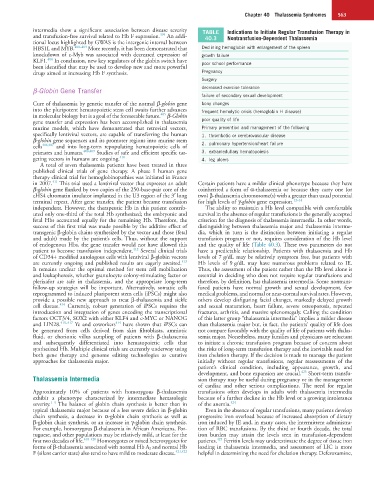
            intermedia  show  a  significant  association  between  disease  severity   TABLE   Indications to Initiate Regular Transfusion Therapy in
                                                     399
            and transfusion-free survival related to Hb F expression.  An addi-  40.3  Nontransfusion-Dependent Thalassemia
            tional locus highlighted by GWAS is the intergenic interval between
            HBS1L and MYB. 400–403  More recently, it has been demonstrated that   Declining hemoglobin with enlargement of the spleen
            knockdown  of  c-Myb  was  associated  with  decreased  expression  of   growth failure
                 404
            KLF1.  In conclusion, new key regulators of the globin switch have   poor school performance
            been identified that may be used to develop new and more powerful
            drugs aimed at increasing Hb F synthesis.              Pregnancy
                                                                   Surgery
            β-Globin Gene Transfer                                 decreased exercise tolerance
                                                                   failure of secondary sexual development
            Cure of thalassemia by genetic transfer of the normal β-globin gene   bony changes
            into the pluripotent hematopoietic stem cell awaits further advances   frequent hemolytic crisis (hemoglobin H disease)
                                                      405
            in molecular biology but is a goal of the foreseeable future.  β-Globin
            gene transfer and expression has been accomplished in thalassemia   poor quality of life
            murine  models,  which  have  demonstrated  that  retroviral  vectors,   Primary prevention and management of the following
            specifically lentiviral vectors, are capable of transferring the human   1.  thrombotic or cerebrovascular disease
            β-globin gene sequences and its promoter regions into murine stem
            cells 406,407   and  into  long-term  repopulating  hematopoietic  cells  of   2.  pulmonary hypertension/heart failure
            primates and humans. 408,409  Studies of safe and efficient specific tar-  3.  extramedullary hematopoiesis
            geting vectors in humans are ongoing. 410              4.  leg ulcers
              A total of seven thalassemia patients have been treated in three
            published  clinical  trials  of  gene  therapy.  A  phase  I  human  gene
            therapy clinical trial for hemoglobinopathies was initiated in France
                  411
            in 2007.  This trial used a lentiviral vector that expresses an adult   Certain patients have a milder clinical phenotype because they have
            β-globin gene flanked by two copies of the 250-base-pair core of the   coinherited a form of α-thalassemia or because they carry one (or
            cHS4 chromatin insulator implanted in the U3 region of the 3′ long   two) β-thalassemia chromosome(s) with a greater than usual potential
            terminal repeat. After gene transfer, the patient became transfusion   for high levels of γ-globin gene expression. 12–14
            independent. However, the therapeutic Hb in this patient contrib-  The ability to maintain a Hb level compatible with comfortable
            uted only one-third of the total Hb synthesized; the embryonic and   survival in the absence of regular transfusions is the generally accepted
            fetal Hbs accounted equally for the remaining Hb. Therefore, the   criterion for the diagnosis of thalassemia intermedia. In other words,
            success of this first trial was made possible by the additive effect of   distinguishing between thalassemia major and thalassemia interme-
            transgenic β-globin chains synthesized by the vector and those (fetal   dia,  which  in  turn  is  the  distinction  between  initiating  a  regular
            and  adult)  made  by  the  patient’s  cells. Thus,  without  the  support   transfusion program or not, requires consideration of the Hb level
            of endogenous Hbs, the gene transfer would not have allowed this   and the quality of life (Table 40.3). These two parameters do not
                                             412
            patient to become transfusion independent.  Several clinical trials   have  a  predictable  relationship.  Patients  with  thalassemia  and  Hb
            of CD34+ modified autologous cells with lentiviral β-globin vectors   levels of 7 g/dL may be relatively symptom free, but patients with
                                                            413
            are  currently  ongoing  and  published  results  are  eagerly  awaited.    Hb  levels  of  9 g/dL  may  have  numerous  problems  related  to  IE.
            It  remains  unclear  the  optimal  method  for  stem  cell  mobilization   Thus, the assessment of the patient rather than the Hb level alone is
            and leukapheresis, whether granulocyte colony-stimulating factor or   essential in deciding who does not require regular transfusions and
            plerixafor  are  safe  in  thalassemia,  and  the  appropriate  long-term   therefore, by definition, has thalassemia intermedia. Some nontrans-
            follow-up  strategies  will  be  important.  Alternatively,  somatic  cells   fused  patients  have  normal  growth  and  sexual  development,  few
            reprogrammed to induced pluripotent stem cells (iPSCs) might also   medical problems, and normal or near-normal survival rates. However,
            provide  a  possible  new  approach  to  treat  β-thalassemia  and  sickle   others develop disfiguring facial changes, markedly delayed growth
                     414
            cell  disease.   Currently,  robust  generation  of  iPSCs  requires  the   and  sexual  maturation,  heart  failure,  severe  osteoporosis,  repeated
            introduction and integration of genes encoding the transcriptional   fractures, arthritis, and massive splenomegaly. Calling the condition
            factors OCT3/4, SOX2 with either KLF4 and c-MYC or NANOG   of this latter group “thalassemia intermedia” implies a milder disease
                                       414
            and LIN28. 415–417  Ye and coworkers  have shown that iPSCs can   than thalassemia major but, in fact, the patients’ quality of life does
            be  generated  from  cells  derived  from  skin  fibroblasts,  amniotic   not compare favorably with the quality of life of patients with thalas-
            fluid,  or  chorionic  villus  sampling  of  patients  with  β-thalassemia   semia major. Nonetheless, many families and physicians are reluctant
            and  subsequently  differentiated  into  hematopoietic  cells  that     to initiate a chronic transfusion program because of concern about
            synthesized Hb. Multiple clinical trials are currently underway using   the risks of long-term transfusion therapy and the inevitable need for
            both  gene  therapy  and  genome  editing  technologies  as  curative   iron chelation therapy. If the decision is made to manage the patient
            approaches for thalassemia major.                     initially  without  regular  transfusions,  regular  reassessments  of  the
                                                                  patient’s  clinical  condition,  including  appearance,  growth,  and
                                                                                                    423
                                                                  development, and bone expansion are crucial.  Short-term transfu-
            Thalassemia Intermedia                                sion therapy may be useful during pregnancy or in the management
                                                                  of  cardiac  and  other  serious  complications.  The  need  for  regular
            Approximately  10%  of  patients  with  homozygous  β-thalassemia   transfusions  often  develops  in  adults  with  thalassemia  intermedia
            exhibit  a  phenotype  characterized  by  intermediate  hematologic   because of a further decline in the Hb level or a growing intolerance
                  1–4
            severity.  The  balance  of  globin  chain  synthesis  is  better  than  in   of the anemia. 424
            typical thalassemia major because of a less severe defect in β-globin   Even in the absence of regular transfusions, many patients develop
            chain  synthesis,  a  decrease  in  α-globin  chain  synthesis  as  well  as   progressive iron overload because of increased absorption of dietary
            β-globin chain synthesis, or an increase in γ-globin chain synthesis.   iron induced by IE and, in many cases, the intermittent administra-
            For example, homozygous β-thalassemia in African Americans, Por-  tion of RBC transfusions. By the third or fourth decade, the total
            tuguese, and other populations may be relatively mild, at least for the   iron  burden  may  attain  the  levels  seen  in  transfusion-dependent
                                                                        425
            first two decades of life. 418–420  Homozygotes or mixed heterozygotes for   patients.  Ferritin levels may underestimate the degree of tissue iron
            forms of β-thalassemia associated with normal Hb A 2 and normal Hb   loading  in  thalassemia  intermedia,  and  assessment of  LIC is  more
            F (silent carrier state) also tend to have mild to moderate disease. 421,422    helpful in determining the need for chelation therapy. Deferoxamine,

