


Page 693 - Hematology_ Basic Principles and Practice ( PDFDrive )
P. 693
Chapter 42  Sickle Cell Disease  585


                                                                                                      D


             A                                       B                 C                              E

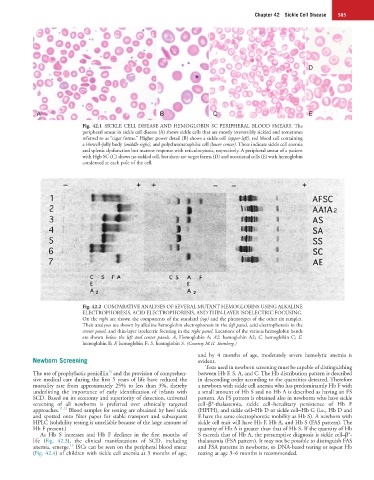
                            Fig. 42.1  SICKLE CELL DISEASE AND HEMOGLOBIN SC PERIPHERAL BLOOD SMEARS. The
                            peripheral smear in sickle cell disease (A) shows sickle cells that are mostly irreversibly sickled and sometimes
                            referred to as “cigar forms.” Higher power detail (B) shows a sickle cell (upper left), red blood cell containing
                            a Howell-Jolly body (middle right), and polychromatophilic cell (lower center). These indicate sickle cell anemia
                            and splenic dysfunction but marrow response with reticulocytosis, respectively. A peripheral smear of a patient
                            with Hgb SC (C) shows no sickled cell, but there are target forms (D) and occasional cells (E) with hemoglobin
                            condensed at each pole of the cell.


                            Fig. 42.2  COMPARATIVE ANALYSES OF SEVERAL MUTANT HEMOGLOBINS USING ALKALINE
                            ELECTROPHORESIS, ACID ELECTROPHORESIS, AND THIN-LAYER ISOELECTRIC FOCUSING.
                            On the right are shown the components of the standard (top) and the phenotypes of the other six samples.
                            Their analyses are shown by alkaline hemoglobin electrophoresis in the left panel, acid electrophoresis in the
                            center panel, and thin-layer isoelectric focusing in the right panel. Locations of the various hemoglobin bands
                            are  shown  below  the  left  and  center  panels.  A,  Hemoglobin  A;  A2,  hemoglobin  A2;  C,  hemoglobin  C;  E,
                            hemoglobin E; F, hemoglobin F; S, hemoglobin S. (Courtesy M.H. Steinberg.)
                                                                  and  by  4  months  of  age,  moderately  severe  hemolytic  anemia  is
            Newborn Screening                                     evident.
                                                                    Tests used in newborn screening must be capable of distinguishing
                                    10
            The use of prophylactic penicillin  and the provision of comprehen-  between Hb F, S, A, and C. The Hb distribution pattern is described
            sive  medical  care  during  the  first  5  years  of  life  have  reduced  the   in descending order according to the quantities detected. Therefore
            mortality  rate  from  approximately  25%  to  less  than  3%,  thereby   a newborn with sickle cell anemia who has predominantly Hb F with
            underlining  the  importance  of  early  identification  of  infants  with   a small amount of Hb S and no Hb A is described as having an FS
            SCD. Based on its economy and superiority of detection, universal   pattern. An FS pattern is obtained also in newborns who have sickle
            screening  of  all  newborns  is  preferred  over  ethnically  targeted   cell–β°-thalassemia,  sickle  cell–hereditary  persistence  of  Hb  F
            approaches. 11,12  Blood samples for testing are obtained by heel stick   (HPFH), and sickle cell–Hb D or sickle cell–Hb G (i.e., Hb D and
            and  spotted  onto  filter  paper  for  stable  transport  and  subsequent   E have the same electrophoretic mobility as Hb S). A newborn with
            HPLC (solubility testing is unreliable because of the large amount of   sickle cell trait will have Hb F, Hb A, and Hb S (FAS pattern). The
            Hb F present.)                                        quantity of Hb A is greater than that of Hb S. If the quantity of Hb
                                                                                                                   +
              As  Hb  S  increases  and  Hb  F  declines  in  the  first  months  of   S exceeds that of Hb A, the presumptive diagnosis is sickle cell–β -
            life  (Fig.  42.3),  the  clinical  manifestations  of  SCD,  including   thalassemia (FSA pattern). It may not be possible to distinguish FAS
                        13
            anemia, emerge.  ISCs can be seen on the peripheral blood smear   and FSA patterns in newborns, so DNA-based testing or repeat Hb
            (Fig. 42.4) of children with sickle cell anemia at 3 months of age,   testing at age 3–6 months is recommended.

