


Page 694 - Hematology_ Basic Principles and Practice ( PDFDrive )
P. 694
586    Part V  Red Blood Cells


           100


           80


           60
          Hb F (%)

           40                              Sickle cell disease


           20
                Normal

            0
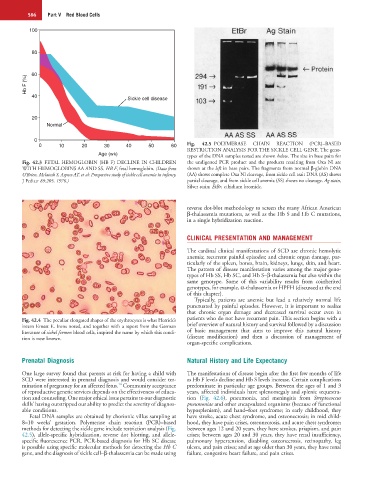
              0     10      20     30     40      50     60   Fig.   42.5  POLYMERASE   CHAIN   REACTION   (PCR)–BASED
                                                              RESTRICTION ANALYSIS FOR THE SICKLE CELL GENE. The geno-
                                 Age (wk)                     types of the DNA samples tested are shown below. The size in base pairs for
        Fig. 42.3  FETAL HEMOGLOBIN (HB F) DECLINE IN CHILDREN   the undigested PCR product and the products resulting from Oxa Nl are
        WITH HEMOGLOBINS AA AND SS. HB F, fetal hemoglobin. (Data from   shown at the left in base pairs. The fragments from normal β-globin DNA
        O’Brien, Mclatosh S, Aspnes AT, et al: Prospective study of sickle cell anemia in infancy.   (AA) shows complete Oxa Nl cleavage, from sickle cell trait DNA (AS) shows
        J Pediatr 89:205, 1976.)                              partial cleavage, and from sickle cell anemia (SS) shows no cleavage. Ag stain,
                                                              Silver stain; EtBr, ethidium bromide.


                                                              reverse dot-blot methodology to screen the many African American
                                                              β-thalassemia mutations, as well as the Hb S and Hb C mutations,
                                                              in a single hybridization reaction.


                                                              CLINICAL PRESENTATION AND MANAGEMENT
                                                              The cardinal clinical manifestations of SCD are chronic hemolytic
                                                              anemia; recurrent painful episodes; and chronic organ damage, par-
                                                              ticularly of the spleen, bones, brain, kidneys, lungs, skin, and heart.
                                                              The pattern of disease manifestation varies among the major geno-
                                                              types of Hb SS, Hb SC, and Hb S–β-thalassemia but also within the
                                                              same  genotype.  Some  of  this  variability  results  from  coinherited
                                                              genotypes, for example, α-thalassemia or HPFH (discussed at the end
                                                              of this chapter).
                                                                 Typically,  patients  are  anemic  but  lead  a  relatively  normal  life
                                                              punctuated by painful episodes. However, it is important to realize
                                                              that  chronic  organ  damage  and  decreased  survival  occur  even  in
        Fig. 42.4  The peculiar elongated shapes of the erythrocytes is what Herrick’s   patients who do not have recurrent pain. This section begins with a
        intern Ernest E. Irons noted, and together with a report from the German   brief overview of natural history and survival followed by a discussion
        literature of sichel formen blood cells, inspired the name by which this condi-  of  basic  management  that  aims  to  improve  this  natural  history
        tion is now known.                                    (disease  modification)  and  then  a  discussion  of  management  of
                                                              organ-specific complications.


        Prenatal Diagnosis                                    Natural History and Life Expectancy

        One large survey found that parents at risk for having a child with   The manifestations of disease begin after the first few months of life
        SCD were interested in prenatal diagnosis and would consider ter-  as Hb F levels decline and Hb S levels increase. Certain complications
                                        14
        mination of pregnancy for an affected fetus.  Community acceptance   predominate in particular age groups. Between the ages of 1 and 3
        of reproductive genetic services depends on the effectiveness of educa-  years, affected individuals have splenomegaly and splenic sequestra-
        tion and counseling. One major ethical issue pertains to our diagnostic   tion  (Fig.  42.6),  pneumonia,  and  meningitis  from  Streptococcus
        skills’ having outstripped our ability to predict the severity of diagnos-  pneumoniae and other encapsulated organisms (because of functional
        able conditions.                                      hyposplenism), and hand–foot syndrome; in early childhood, they
           Fetal DNA samples are obtained by chorionic villus sampling at   have stroke, acute chest syndrome, and osteonecrosis; in mid child-
        8–10  weeks’  gestation.  Polymerase  chain  reaction  (PCR)–based   hood, they have pain crises, osteonecrosis, and acute chest syndrome;
        methods for detecting the sickle gene include restriction analysis (Fig.   between ages 12 and 20 years, they have strokes, priapism, and pain
        42.5),  allele-specific  hybridization,  reverse  dot  blotting,  and  allele-  crises; between ages 20 and 30 years, they have renal insufficiency,
        specific fluorescence PCR. PCR-based diagnosis for Hb SC disease   pulmonary  hypertension,  disabling  osteonecrosis,  retinopathy,  leg
        is possible using specific molecular methods for detecting the Hb C   ulcers, and pain crises; and at age older than 30 years, they have renal
        gene, and the diagnosis of sickle cell–β-thalassemia can be made using   failure, congestive heart failure, and pain crises.

