


Page 697 - Hematology_ Basic Principles and Practice ( PDFDrive )
P. 697
Chapter 42  Sickle Cell Disease  589


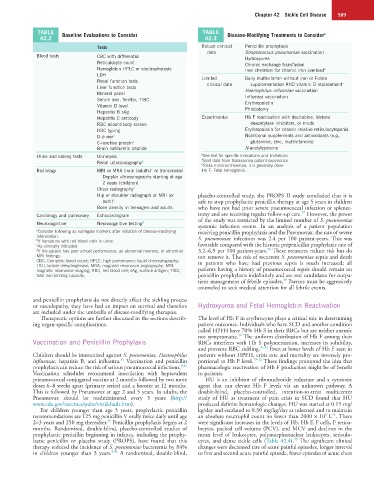
             TABLE   Baseline Evaluations to Consider              TABLE   Disease-Modifying Treatments to Consider a
              42.2                                                  42.3
                                 Tests                             Robust clinical   Penicillin prophylaxis
                                                                     data        Streptococcus pneumoniae vaccination
             Blood tests         CBC with differential                           Hydroxyurea
                                 Reticulocyte count                              Chronic exchange transfusion
                                 Hemoglobin HPLC or electrophoresis              Iron chelation for chronic iron overload b
                                 LDH                               Limited       Daily multivitamin without iron or Folate
                                 Renal function tests                clinical data  supplementation AND vitamin D replacement c
                                 Liver function tests                            Haemophilus influenzae vaccination
                                 Mineral panel                                   Influenza vaccination
                                 Serum iron, ferritin, TIBC                      Erythropoietin
                                 Vitamin D level                                 Phlebotomy
                                 Hepatitis B sAg
                                 Hepatitis C antibody              Experimental  Hb F reactivation with decitabine, histone
                                 RBC alloantibody screen                           deacetylase inhibitors, or imids
                                 RBC typing                                      Erythropoietin for chronic relative reticulocytopenia
                                 D-dimer a                                       Nutritional supplements and antioxidants (e.g.,
                                 C-reactive protein a                              glutamine, zinc, multivitamins)
                                 Brain natriuretic peptide                       N-acetylcysteine
             Urine and kidney tests  Urinalysis                    a b See text for specific indications and limitations.
                                 Renal ultrasonography b           c Best data from thalassemia patient experience.
                                                                   Risks minimal therefore, it is generally done.
                                                  c
             Radiology           MRI or MRA brain (adults)  or transcranial   Hb F, Fetal hemoglobin.
                                   Doppler ultrasonography starting at age
                                   2 years (children)
                                 Chest radiography d
                                 Hip or shoulder radiograph or MRI (or   placebo-controlled study, the PROPS II study concluded that it is
                                   both) c                        safe to stop prophylactic penicillin therapy at age 5 years in children
                                 Bone density in teenagers and adults  who have not had prior severe pneumococcal infection or splenec-
                                                                                                    37
             Cardiology and pulmonary  Echocardiogram             tomy and are receiving regular follow-up care.  However, the power
                                                                  of the study was restricted by the limited number of S. pneumoniae
             Neurocognitive      Neurocognitive testing d
                                                                  systemic  infection  events.  In  an  analysis  of  a  patient  population
             a Consider following as surrogate markers after initiation of disease-modifying   receiving penicillin prophylaxis and the Pneumovax, the rate of severe
             intervention.                                        S.  pneumoniae  infections  was  2.4  per  100  patient-years. This  was
             b If hematuria with red blood cells in urine.
             c As clinically indicated.                           favorable compared with the historic prepenicillin prophylaxis rate of
                                                                                        38
             d If the patient has poor school performance, an abnormal memory, or abnormal   3.2–6.9 per 100 patient-years.  These measures reduce risk but do
             MRI findings.                                        not remove it. The risk of recurrent S. pneumoniae sepsis and death
             CBC, Complete blood count; HPLC, high performance liquid chromatography;   in  patients  who  have  had  previous  sepsis  is  much  increased;  all
             LDH, lactate dehydrogenase; MRA, magnetic resonance angiography; MRI,
             magnetic resonance imaging; RBC, red blood cell; sAg, surface antigen; TIBC,   patients having a history of pneumococcal sepsis should remain on
             total iron-binding capacity.                         penicillin prophylaxis indefinitely and are not candidates for outpa-
                                                                                              39
                                                                  tient management of febrile episodes.  Parents must be aggressively
                                                                  counseled to seek medical attention for all febrile events.
            and penicillin prophylaxis do not directly affect the sickling process
            or vasculopathy, they have had an impact on survival and therefore   Hydroxyurea and Fetal Hemoglobin Reactivation
            are included under the umbrella of disease-modifying therapies.
              Therapeutic options are further discussed in the sections describ-  The level of Hb F in erythrocytes plays a critical role in determining
            ing organ-specific complications.                     patient outcomes. Individuals who have SCD and another condition
                                                                  called HPFH have 70% Hb S in their RBCs but are neither anemic
                                                                               40
                                                                  nor symptomatic.  The uniform distribution of Hb F among their
            Vaccination and Penicillin Prophylaxis                RBCs interferes with Hb S polymerization, increases its solubility,
                                                                  and prevents RBC sickling. 41,42  Even at lower levels of Hb F seen in
            Children should be immunized against S. pneumoniae, Haemophilus   patients without HPFH, crisis rate and mortality are inversely pro-
                                        35
            influenzae,  hepatitis  B,  and  influenza.   Vaccination  and  penicillin   portional to Hb F level. 19–22  These findings prompted the idea that
            prophylaxis can reduce the risk of serious pneumococcal infections. 9,36    pharmacologic reactivation of Hb F production might be of benefit
            Vaccination  schedules  recommend  inoculation  with  heptavalent   to patients.
            pneumococcal conjugated vaccine at 2 months followed by two more   HU is an inhibitor of ribonucleotide reductase and a cytotoxic
            doses 6–8 weeks apart (primary series) and a booster at 12 months.   agent  that  can  elevate  Hb  F  levels  via  an  unknown  pathway.  A
            This is followed by Pneumovax at age 2 and 5 years. In adults, the   double-blind,  placebo-controlled,  intention-to-treat  multicenter
            Pneumovax  should  be  readministered  every  5  years  (http://  study  of  HU  as  treatment  of  pain  crisis  in  SCD  found  that  HU
            www.cdc.gov/vaccines/pubs/vis/default.htm).           produced definite hematologic changes. HU was started at 0.15 mg/
              For  children  younger  than  age  5  years,  prophylactic  penicillin   kg/day and escalated to 0.30 mg/kg/day as tolerated and to maintain
                                                                                                           9
                                                                                                              −1
            recommendations are 125 mg penicillin V orally twice daily until age   an absolute neutrophil count no lower than 2000 × 10  L . There
                                    35
            2–3 years and 250 mg thereafter.  Penicillin prophylaxis begins at 2   were significant increases in the levels of Hb, Hb F, F cells, F reticu-
            months.  Randomized,  double-blind,  placebo-controlled  studies  of   locytes, packed cell volume (PCV), and MCV and declines in the
            prophylactic penicillin beginning in infancy, including the prophy-  mean  level  of  leukocytes,  polymorphonuclear  leukocytes,  reticulo-
                                                                                                 43
            lactic  penicillin  or  placebo  study  (PROPS),  have  found  that  this   cytes, and dense sickle cells (Table 42.4).  The significant clinical
            therapy reduced the incidence of S. pneumoniae bacteremia by 84%   changes were decreased rate of acute painful episodes, longer interval
            in  children  younger  than  3  years. 9,36   A  randomized,  double-blind,   to first and second acute painful episode, fewer episodes of acute chest

