


Page 698 - Hematology_ Basic Principles and Practice ( PDFDrive )
P. 698
590    Part V  Red Blood Cells


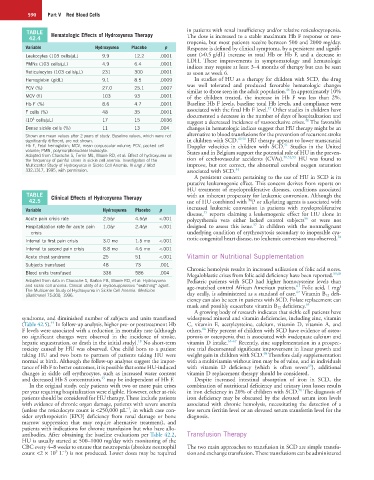
          TABLE   Hematologic Effects of Hydroxyurea Therapy  in patients with renal insufficiency and/or relative reticulocytopenia.
          42.4                                                The dose is increased to a stable maximum Hb F response or neu-
                                                              tropenia, but most patients receive between 500 and 2000 mg/day.
         Variable               Hydroxyurea  Placebo   p      Response is defined by clinical symptoms, by a persistent and signifi-
         Leukocytes (103 cells/µL)  9.9      12.2    .0001    cant  (>0.5 g/dL)  increase  in  total  Hb  or  Hb  F,  and  a  decrease  in
                                                              LDH.  These  improvements  in  symptomatology  and  hematologic
         PMNs (103 cells/µL)      4.9        6.4     .0001
                                                              indices may require at least 3–4 months of therapy but can be seen
         Reticulocytes (103 cells/µL)  231   300     .0001    as soon as week 6.
         Hemoglobin (g/dL)        9.1        8.5     .0009       In studies of HU as a therapy for children with SCD, the drug
                                                              was  well  tolerated  and  produced  favorable  hematologic  changes
         PCV (%)                  27.0       25.1    .0007                                     46
                                                              similar to those seen in the adult population.  In approximately 10%
         MCV (fl)                 103        93      .0001    of  the  children  treated,  the  increase  in  Hb  F  was  less  than  2%.
         Hb F (%)                 8.6        4.7     .0001    Baseline Hb F levels, baseline total Hb levels, and compliance were
                                                                                         47
         F cells (%)              48         35      .0001    associated with the final Hb F level.  Other studies in children have
                                                              documented a decrease in the number of days of hospitalization and
         (10  cells/µL)           17         15      .0036    suggest a decreased incidence of vasoocclusive crises.  The favorable
            3
                                                                                                     48
         Dense sickle cells (%)   11         13      .004     changes in hematologic indices suggest that HU therapy might be an
         Shown are mean values after 2 years of study. Baseline values, which were not   alternative to blood transfusions for the prevention of recurrent stroke
                                                                               49,50
         significantly different, are not shown.              in children with SCD.   HU therapy appears to lower transcranial
                                                                                              51
         Hb F, Fetal hemoglobin; MCV, mean corpuscular volume; PCV, packed cell   Doppler  velocities  in  children  with  SCD.   Studies  in  the  United
         volume; PMN, polymorphonuclear leukocyte.            States and in Belgium support the potential role of HU in the preven-
         Adapted from Charache S, Terrin ML, Moore RD, et al: Effect of hydroxyurea on        50,52,53
         the frequency of painful crises in sickle cell anemia. Investigators of the   tion  of  cerebrovascular  accidents  (CVAs).    HU  was  found  to
         Multicenter Study of Hydroxyurea in Sickle Cell Anemia. N Engl J Med   improve, but not correct, the abnormal cerebral oxygen saturation
         332:1317, 1995, with permission.                     associated with SCD. 54
                                                                 A persistent concern pertaining to the use of HU in SCD is its
                                                              putative leukemogenic effect. This concern derives from reports on
                                                              HU  treatment  of  myeloproliferative  diseases,  conditions  associated
          TABLE   Clinical Effects of Hydroxyurea Therapy     with an inherent propensity for leukemic conversion. Although the
          42.5                                                use of HU combined with  P or alkylating agents is associated with
                                                                                  36
         Variable                  Hydroxyurea  Placebo  p    increased  leukemic  conversion  in  patients  with  myeloproliferative
                                                                    55
                                                              disease,   reports  claiming  a  leukemogenic  effect  for  HU  alone  in
         Acute pain crisis rate    2.5/yr    4.5/yr  <.001    polycythemia  vera  either  lacked  control  subjects   or  were  not
                                                                                                     56
                                                                                    57
         Hospitalization rate for acute pain   1.0/yr  2.4/yr  <.001  designed  to  assess  this  issue.   In  children  with  the  nonmalignant
           crisis                                             underlying condition of erythrocytosis secondary to inoperable cya-
                                                                                                               58
         Interval to first pain crisis  3.0 mo  1.5 mo  <.001  notic congenital heart disease, no leukemic conversion was observed.
         Interval to second pain crisis  8.8 mo  4.6 mo  <.001
         Acute chest syndrome      25        51      <.001    Vitamin or Nutritional Supplementation
         Subjects transfused       48        73      .001
         Blood units transfused    336       586     .004     Chronic hemolysis results in increased utilization of folic acid stores.
                                                                                                              59,60
                                                              Megaloblastic crises from folic acid deficiency have been reported.
         Adapted from data in Charache S, Barton FB, Moore RD, et al: Hydroxyurea   Pediatric  patients  with  SCD  had  higher  homocysteine  levels  than
         and sickle cell anemia. Clinical utility of a myelosuppressive “switching” agent.   age-matched control African American patients.  Folic acid, 1 mg/
                                                                                                  61
         The Multicenter Study of Hydroxyurea in Sickle Cell Anemia. Medicine                     62
         (Baltimore) 75:300, 1996.                            day orally, is administered as a standard of care.  Vitamin B 12  defi-
                                                              ciency can also be seen in patients with SCD. Folate replacement can
                                                              mask and possibly exacerbate vitamin B 12  deficiency. 63
                                                                 A growing body of research indicates that sickle cell patients have
        syndrome, and diminished number of subjects and units transfused   widespread mineral and vitamin deficiencies, including zinc, vitamin
                  44
        (Table 42.5).  In follow-up analysis, higher pre- or posttreatment Hb   C,  vitamin  E,  acetylcysteine,  calcium,  vitamin  D,  vitamin  A,  and
                                                                   64
        F levels were associated with a reduction in mortality rate (although   others.  Fifty percent of children with SCD have evidence of osteo-
        no  significant  changes  were  observed  in  the  incidence  of  stroke,   porosis or osteopenia that is associated with inadequate calcium and
                                              18
        hepatic sequestration, or death in the initial study).  No short-term   vitamin D intake. 65–67  Recently, zinc supplementation in a prospec-
        toxicity caused by HU was observed. One child born to a patient   tive trial documented significant improvement in linear growth and
                                                                                       68
        taking HU and two born to partners of patients taking HU were   weight gain in children with SCD.  Therefore daily supplementation
        normal at birth. Although the follow-up analyses suggest the impor-  with a multivitamin without iron may be of value, and in individuals
                                                                                                      69
        tance of Hb F to better outcomes, it is possible that some HU-induced   with  vitamin  D  deficiency  (which  is  often  severe ),  additional
        changes in sickle cell erythrocytes, such as increased water content   vitamin D replacement therapy should be considered.
                                  45
        and decreased Hb S concentration,  may be independent of Hb F.  Despite  increased  intestinal  absorption  of  iron  in  SCD,  the
           In the original study, only patients with two or more pain crises   combination of nutritional deficiency and urinary iron losses results
                                                                                                   70
        per year requiring hospitalization were eligible. However, other at-risk   in iron deficiency in 20% of children with SCD.  The diagnosis of
        patients should be considered for HU therapy. These include patients   iron deficiency may be obscured by the elevated serum iron levels
        with evidence of chronic organ damage, patients with severe anemia   associated  with  chronic hemolysis,  necessitating the  detection of a
                                          −1
        (unless the reticulocyte count is <250,000 µL , in which case con-  low serum ferritin level or an elevated serum transferrin level for the
        sider  erythropoietin  [EPO]  deficiency  from  renal  damage  or  bone   diagnosis.
        marrow  suppression  that  may  require  alternative  treatment),  and
        patients with indications for chronic transfusion but who have allo-
        antibodies. After obtaining the baseline evaluations per Table 42.2,   Transfusion Therapy
        HU is usually started at 500–1000 mg/day with monitoring of the
        CBC every 4–8 weeks to ensure that neutropenia (absolute neutrophil   The two main approaches to transfusion in SCD are simple transfu-
                     −1
                   9
        count <2 × 10  L ) is not produced. Lower doses may be required   sion and exchange transfusion. These transfusions can be administered

