


Page 699 - Hematology_ Basic Principles and Practice ( PDFDrive )
P. 699
Chapter 42  Sickle Cell Disease  591


            in an episodic fashion or in a chronic fashion. Therefore transfusion   for patients with SCD, even those who do not have high risk char-
            therapy in SCD is of the following types: episodic simple, episodic   acteristics at the time of surgery, and preoperative transfusion should
            partial  exchange,  or  chronic  partial  exchange.  In  both  simple  and   be considered. A caveat is that extended phenotyping of transfused
            exchange transfusion, the target Hb level is 10–11 g/dL (hematocrit,   red cells, should be performed, as discussed further subsequently.
            30%). 71,72  Transfusing to a higher Hb or hematocrit level is avoided   Chronic partial-exchange transfusion is indicated in primary and
            because  a  hematocrit  level  greater  than  30%  is  associated  with   secondary  prevention  of  cerebral  thrombosis  as  discussed  in  the
            hyperviscosity  if  there  is  a  substantial  proportion  of  Hb  S  in  the   section on neurologic complications.
            blood. In exchange transfusion, an additional objective is to achieve   Transfusion  complications  include  alloimmunization,  delayed
            an  Hb  S  percentage  of  less  than  30%  (or  sometimes  <50%).  In   hemolytic  transfusion  reactions  (discussed  in  Exacerbations  of
            partial-exchange transfusion,  a  proportion  of  the patient’s  diseased   Anemia), iron overload, and transmission of viral illness. The inci-
            RBCs are removed before transfusion of normal donor RBCs; this   dence  of  alloimmunization  is  between  19%  and  30%  and  usually
                                                                                              76
            can be done manually through phlebotomy followed by transfusion   occurs with fewer than 15 transfusions.  Some patients seem to toler-
            or  concurrently  using  an  automated  device.  In  patients  who  need   ate  multiple  transfusions  without  developing  alloantibodies,  but
            chronic transfusions, partial exchange is recommended because of the   others are readily allosensitized. The high rate of alloimmunization
            reduced iron burden of this approach. Partial exchange is also indi-  in transfused sickle cell patients is partly attributable to minor blood
            cated if the baseline Hb level is more than 10 g/dL. Simple transfu-  group incompatibilities between the recipient and donor pool, which
            sion in this instance risks exacerbating the clinical condition through   often differ in ethnicity. 76,77  Antibodies against the C and E antigens
            increased  viscosity.  For  critical  illness,  exchange  transfusion  is  also   of the Rh group, Kell (K) and Lewis, Duffy (Fya, Fyb), and Kidd
                                                                                76
            preferred. Although the target Hb S level should be less than 30% in   (Jk)  are  common.   In  the  Stroke  Prevention  Trial  in  Sickle  Cell
            exchange transfusion, decreasing Hb S levels to less than 50% may   Anemia, the routine use of WBC-reduced RBCs matched for E, C,
            suffice depending on the severity of the complication being treated.  and Kell decreased the allosensitization rate compared with historical
              The volumes required for simple and exchange transfusions (Table   data from 3% to 0.5% per unit transfused and decreased the rate of
                                                                                                 78
            42.6) are particularly important for transfusing children. For normal-  hemolytic  transfusion  reactions  by  90%.   Therefore  the  recom-
            size adults, the general rule is that each unit of RBCs infused increases   mended approach to preventing alloimmunization is to reduce leu-
            the Hb level approximately 1 g/dL. 73                 kocytes  and  perform  limited  phenotype  matching  for  all  patients
              Episodic  simple  transfusion  should  be  considered  for  blood   (ABO,  C,  D,  E,  and  Kell)  and  extended  phenotype  matching  for
                                                                                       72
            volume replacement in aplastic crisis and splenic sequestration crises   patients with alloantibodies.  The management of a delayed hemo-
            and for protection when there is a more than 20% decrease in Hb   lytic transfusion reaction and transfusional iron overload are discussed
            from baseline from severe illness such as septicemia or severe vasooc-  under Exacerbations of Anemia, later.
            clusive  crisis  or  hyperhemolysis  or  Hb  levels  of  less  than  5 g/dL.   Transmission of human immunodeficiency virus, hepatitis B and
            Episodic  simple  or  exchange  transfusion  should  be  considered  for   C,  and  human T-cell  leukemia/lymphoma  virus-1  has  diminished
            acute chest syndrome, priapism, and preoperatively. The choice of   with improved screening of banked units but remains an issue. In
            simple versus exchange transfusion is determined by the pretransfu-  addition to better screening programs, the use of leukocyte-depleted
            sion total Hb level and the severity of the illness.  RBC transfusions can reduce this hazard. 79
              In  the  preoperative  setting,  there  is  good  randomized  data  to
            support the use of preoperative transfusion to decrease the risk of
            complications,  including  severe  complications  such  as  acute  chest   Stem Cell Transplantation
            syndrome. 74,75  Preoperative transfusions can be categorized as follows.
            (1) Top-up transfusions to a target Hb level of 10 g/dL. This is an   At this time, allogeneic stem cell transplantation remains the only
            appropriate  intervention  for  patients  with  baseline  Hb  between   curative  option  for  SCD,  and  improvements  in  conditioning
            6.5–9 g/dL undergoing low or medium risk surgeries (e.g., cholecys-  approaches suggest both pediatric and adult populations are eligible.
            tectomy,  joint  replacement).  (2)  Partial  exchange  transfusion  to   The  largest  series  to  date  has  been  in  a  pediatric  population  with
            achieve a target Hb level of 10 g/dL with an estimated Hb S percent-  severely symptomatic SCD failing to respond to HU. Using myeloab-
            age of <60%. This is an appropriate intervention for patients with   lative conditioning and human leukocyte antigen (HLA)–matched
            baseline  Hb  levels  of  >9.5 g/dL  undergoing  low-  or  medium-risk   or one-mismatch (two cases) sibling donors, with bone marrow as
            surgeries as per above. (3) Exchange transfusion to achieve a target   the source of stem cells in the majority, there was a 10% mortality
            Hb level of 10 g/dL with an estimated Hb S percentage of <30%.   rate  with  90%  overall  survival  and  82%  event-free  survival  at  a
                                                                                         80
            This procedure should be considered for patients with SCD undergo-  median follow-up of 54 months.  Similar results were obtained when
            ing high-risk surgeries (e.g., cardiothoracic surgery). In short, surgery,   related, HLA-matched umbilical cord blood was used as the source
                                                                            81
            even low- or medium-risk surgery, is a substantial physiologic stressor   of stem cells.  According to these results, stem cell transplant is a
                                                                  therapeutic option for the severely symptomatic child with an HLA-
                                                                  matched sibling donor.
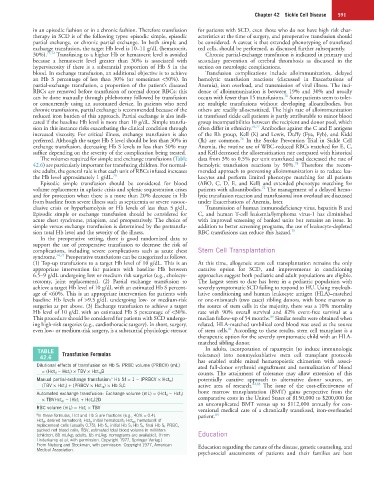
             TABLE   Transfusion Formulas                           In  adults,  incorporation  of  rapamycin  (to  induce  immunologic
              42.6                                                tolerance)  into  nonmyeloablative  stem  cell  transplant  protocols
             Dilutional effects of transfusion on Hb S: PRBC volume (PRBCV) (mL)   has  enabled  stable  mixed  hematopoietic  chimerism  with  associ-
                                                                  ated  full-donor  erythroid  engraftment  and  normalization  of  blood
               = (Hct d  − Hct i ) × TBV × Hct rp B               counts.  The  attainment  of  tolerance  may  allow  extension  of  this
                                     a
             Manual partial-exchange transfusion:  Hb Sf = 1 − (PRBCV × Hct rp )  potentially  curative  approach  to  alternative  donor  sources,  an
               (TBV × Hct i ) + (PRBCV × Hct rp ) × Hb S i C      active  area  of  research. 82,83   The  issue  of  the  cost-effectiveness  of
             Automated exchange transfusion: Exchange volume (mL) = (Hct d  − Hct i )   bone  marrow  transplantation  (BMT)  gains  perspective  from  the
               × TBVHct rp  − (Hct i  + Hct d )2D                 comparative costs in the United States of $150,000 to $200,000 for
                                                                  an  uncomplicated  BMT  versus  up  to  $112,000  annually  for  con-
             RBC volume (mL) = Hct i  × TBV                       ventional medical care of a chronically transfused, iron-overloaded
             a In these formulas, Hct and Hb S are fractions (e.g., 40% = 0.4).  patient. 84
             Hct d, desired hematocrit; Hct i, initial hematocrit; Hct rp, hematocrit of
             replacement cells (usually 0.75); Hb S i, initial Hb S; Hb S f, final Hb S; PRBC,
             packed red blood cells; TBV, estimated total blood volume in milliliters
             (children, 80 mL/kg; adults, 65 mL/kg; nomograms are available). (From   Education
             Linderkamp et al, with permission. Copyright 1977, Springer-Verlag.)
             From Nieburg and Stockman, with permission. Copyright 1977, American   Education regarding the nature of the disease, genetic counseling, and
             Medical Association.
                                                                  psychosocial  assessments  of  patients  and  their  families  are  best

