


Page 704 - Hematology_ Basic Principles and Practice ( PDFDrive )
P. 704
596    Part V  Red Blood Cells


        the intracellular Hb S concentration by preventing RBC dehydration   useful guideline for transfusion in the context of an aplastic crisis is
        (Gardos channel inhibitors).                          the  reticulocyte  count.  A  patient  having  an  aplastic  crisis  with  a
                                                              reticulocyte count that is recovering is less likely to require urgent
                                                              transfusion  than  one  with  a  normal  or  low  absolute  reticulocyte
        Exacerbations of Anemia                               count.

        The rather constant level of hemolytic anemia may be exacerbated   Sequestration Crisis (Spleen or Liver)
        by additional events such as aplastic crises, acute splenic sequestra-  Acute splenic sequestration of blood is characterized by acute exacer-
        tion,  acute  hepatic  sequestration,  chronic  renal  disease,  or  renal   bation of anemia; persistent reticulocytosis; a tender, enlarging spleen;
                                                                                   140
        endocrine deficiency that may be present without overt renal failure,   and sometimes hypovolemia.  The LDH level may remain stable or
        bone  marrow  necrosis,  deficiency  of  folic  acid  or  iron,  delayed   increase.  Patients  susceptible  to  this  complication  are  those  whose
        hemolytic transfusion reactions, autoimmune hemolytic anemia, or   spleens have not undergone fibrosis—young patients with sickle cell
                                                                                                       +
        hyperhemolysis  (hemolytic  exacerbations)  of  unknown  etiology.   anemia and adults with Hb SC disease or sickle cell–β -thalassemia.
        Laboratory  evaluations  that  are  very  useful  in  the  evaluation  of  a   Sequestration may occur as early as a few weeks of age and may cause
        patient with anemia exacerbation are the reticulocyte count, LDH,   death before SCD is diagnosed. In one study, 30% of children had
        alloantibody  screening,  the  direct  antiglobulin  (Coombs)  test,  and   splenic sequestration over a 10-year period and 15% of the attacks
        EPO level.                                            were fatal. 141
                                                                 The basis of therapy is to restore blood volume and RBC mass.
        Aplastic Crises                                       Because splenic sequestration recurs in 50% of cases, splenectomy is
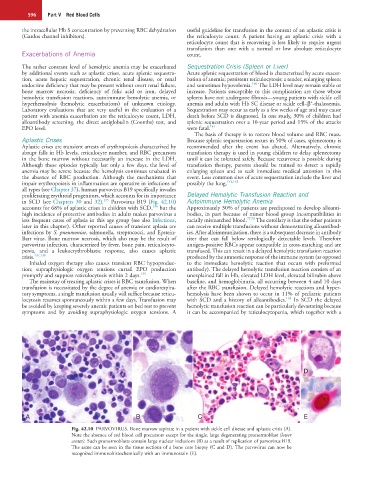
        Aplastic crises are transient arrests of erythropoiesis characterized by   recommended  after  the  event  has  abated.  Alternatively,  chronic
        abrupt falls in Hb levels, reticulocyte number, and RBC precursors   transfusion therapy is used in young children to delay splenectomy
        in  the  bone  marrow  without  necessarily  an  increase  in  the  LDH.   until it can be tolerated safely. Because recurrence is possible during
        Although these episodes typically last only a few days, the level of   transfusion  therapy,  parents  should  be  trained  to  detect  a  rapidly
        anemia may be severe because the hemolysis continues unabated in   enlarging  spleen  and  to  seek  immediate  medical  attention  in  this
        the  absence  of  RBC  production.  Although  the  mechanisms  that   event. Less common sites of acute sequestration include the liver and
        impair erythropoiesis in inflammation are operative in infections of   possibly the lung. 142,143
        all types (see Chapter 37), human parvovirus B19 specifically invades
        proliferating erythroid progenitors, which accounts for its importance   Delayed Hemolytic Transfusion Reaction and
                                   135
        in SCD (see Chapters 30 and 32).  Parvovirus B19 (Fig. 42.10)   Autoimmune Hemolytic Anemia
                                                   136
        accounts for 68% of aplastic crises in children with SCD,  but the   Approximately 30% of patients are predisposed to develop alloanti-
        high incidence of protective antibodies in adults makes parvovirus a   bodies,  in  part  because  of  minor  blood  group  incompatibilities  in
        less frequent cause of aplasia in this age group (see also Infections,   racially mismatched blood. 77,78  The corollary is that the other patients
        later in this chapter). Other reported causes of transient aplasia are   can receive multiple transfusions without demonstrating alloantibod-
        infections by S. pneumoniae, salmonella, streptococci, and Epstein-  ies. After alloimmunization, there is a subsequent decrease in antibody
        Barr virus. Bone marrow necrosis, which also may be the result of   titer  that  can  fall  below  serologically  detectable  levels.  Therefore
        parvovirus infection, characterized by fever, bone pain, reticulocyto-  antigen-positive RBCs appear compatible in cross-matching and are
        penia,  and  a  leukoerythroblastic  response,  also  causes  aplastic   transfused. This can result in a delayed hemolytic transfusion reaction
        crisis. 137,138                                       produced by the amnestic response of the immune system (as opposed
           Inhaled oxygen therapy also causes transient RBC hypoproduc-  to  the  immediate  hemolytic  reaction  that  occurs  with  preformed
        tion;  supraphysiologic  oxygen  tensions  curtail  EPO  production   antibody). The delayed hemolytic transfusion reaction consists of an
        promptly and suppress reticulocytosis within 2 days. 139  unexplained fall in Hb, elevated LDH level, elevated bilirubin above
           The mainstay of treating aplastic crises is RBC transfusion. When   baseline, and hemoglobinuria, all occurring between 4 and 10 days
        transfusion is necessitated by the degree of anemia or cardiorespira-  after the RBC transfusion. Delayed hemolytic reactions and hyper-
        tory symptoms, a single transfusion usually will suffice because reticu-  hemolysis have been shown to occur in 11% of pediatric patients
                                                                                               144
        locytosis resumes spontaneously within a few days. Transfusion may   with  SCD  and  a  history  of  alloantibodies.   In  SCD  the  delayed
        be avoided by keeping severely anemic patients on bed rest to prevent   hemolytic transfusion reaction can be particularly devastating because
        symptoms  and  by  avoiding  supraphysiologic  oxygen  tensions.  A   it can be accompanied by reticulocytopenia, which together with a


                                                                                                    D


         A                                    B                   C                                 E

                        Fig. 42.10  PARVOVIRUS. Bone marrow aspirate in a patient with sickle cell disease and aplastic crisis (A).
                        Note the absence of red blood cell precursors except for the single, large degenerating pronormoblast (lower
                        center). Such pronormoblasts contain large nuclear inclusions (B) as a result of replication of parvovirus B19.
                        The same can be seen in the tissue sections of a bone core biopsy (C and D). The parvovirus can now be
                        recognized immunohistochemically with an immunostain (E).

