


Page 705 - Hematology_ Basic Principles and Practice ( PDFDrive )
P. 705
Chapter 42  Sickle Cell Disease  597


            bystander  effect  of  destruction  of  recipient  blood  (not  just  donor   serum opsonizing activity. Even before the anatomic autoinfarction
            blood)  can  result  in  unanticipated  worsening  of  anemia  to  levels   of  the  spleen  in  patients  with  sickle  cell  anemia,  defective  splenic
                                      145
            below that seen before transfusion.  In addition to the manifesta-  function is demonstrable by Howell-Jolly bodies on the peripheral
            tions of a delayed hemolytic transfusion reaction as listed, patients   blood  smear,  visible  “pits”  on  the  surface  of  RBCs,  and  abnormal
                                                                                              150
            may  develop  acute  congestive  heart  failure,  acute  renal  failure,  or   results of radionuclide spleen scanning.  Specific syndromes exhibit-
            acute  chest  syndrome  (accompanied  by  vasoocclusive  pain  crisis).   ing greater rates of hemolysis cause loss of splenic function at earlier
            Subsequent transfusions may further exacerbate the anemia.  ages—sickle cell anemia earlier than Hb SC disease earlier than sickle
                                                                      +
              Resolution  of  severe  anemia  may  only  occur  after  withholding   cell–β -thalassemia.
            further  transfusions  with  subsequent  reticulocyte  count  recovery.   Infectious complications of SCD are a major cause of morbidity
                                                                            151
            Corticosteroids at high doses (e.g., intravenous methylprednisolone   and  mortality   even  with  current  vaccination  and  prophylactic
            500 mg/day for 2–3 days) should be considered if the anemia is life   antibiotic regimens. The infections caused by particular organisms
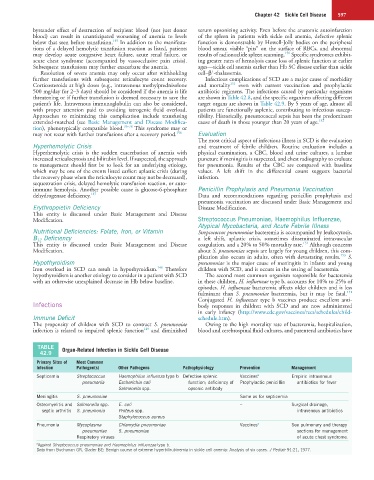
            threatening or if further transfusion is deemed necessary to save the   are shown in Table 42.8, and the specific organisms affecting different
            patient’s life. Intravenous immunoglobulin can also be considered,   target organs are shown in Table 42.9. By 5 years of age, almost all
            with  proper  attention  paid  to  avoiding  iatrogenic  fluid  overload.   patients are functionally asplenic, contributing to infectious suscep-
            Approaches  to  minimizing  this  complication  include  transfusing   tibility. Historically, pneumococcal sepsis has been the predominant
            extended-matched  (see  Basic  Management  and  Disease  Modifica-  cause of death in those younger than 20 years of age. 152
            tion), phenotypically compatible blood. 76–78  This syndrome may or
            may not recur with further transfusions after a recovery period. 146  Evaluation
                                                                  The most critical aspect of infectious illness in SCD is the evaluation
            Hyperhemolytic Crisis                                 and  treatment  of  febrile  children.  Routine  evaluation  includes  a
            Hyperhemolytic  crisis  is  the  sudden  exacerbation  of  anemia  with   physical  examination,  a  CBC,  blood  and  urine  cultures,  a  lumbar
            increased reticulocytosis and bilirubin level. If suspected, the approach   puncture if meningitis is suspected, and chest radiography to evaluate
            to management should first be to look for an underlying etiology,   for  pneumonia.  Results  of  the  CBC  are  compared  with  baseline
            which may be one of the events listed earlier: aplastic crisis (during   values.  A  left  shift  in  the  differential  count  suggests  bacterial
            the recovery phase when the reticulocyte count may not be decreased),   infection.
            sequestration crisis, delayed hemolytic transfusion reaction, or auto-
            immune  hemolysis.  Another  possible  cause  is  glucose-6-phosphate   Penicillin Prophylaxis and Pneumonia Vaccination
            dehydrogenase deficiency. 147                         Data  and  recommendations  regarding  penicillin  prophylaxis  and
                                                                  pneumonia vaccination are discussed under Basic Management and
            Erythropoietin Deficiency                             Disease Modification.
            This  entity  is  discussed  under  Basic  Management  and  Disease
            Modification.                                         Streptococcus Pneumoniae, Haemophilus Influenzae,
                                                                  Atypical Mycobacteria, and Acute Febrile Illness
            Nutritional Deficiencies: Folate, Iron, or Vitamin    Streptococcus pneumoniae bacteremia is accompanied by leukocytosis,
            B 12  Deficiency                                      a  left  shift,  aplastic  crisis,  sometimes  disseminated  intravascular
                                                                                                    151
            This  entity  is  discussed  under  Basic  Management  and  Disease   coagulation, and a 20% to 50% mortality rate.  Although concerns
            Modification.                                         about S. pneumoniae sepsis are largely for young children, this com-
                                                                                                                153
                                                                  plication also occurs in adults, often with devastating results.  S.
            Hypothyroidism                                        pneumoniae is the major cause of meningitis in infants and young
                                                     148
            Iron  overload  in  SCD  can  result  in  hypothyroidism.   Therefore   children with SCD, and it occurs in the setting of bacteremia.
            hypothyroidism is another etiology to consider in a patient with SCD   The second most common organism responsible for bacteremia
            with an otherwise unexplained decrease in Hb below baseline.  in these children, H. influenzae type b, accounts for 10% to 25% of
                                                                  episodes. H. influenzae bacteremia affects older children and is less
                                                                                                                  151
                                                                  fulminant  than  S.  pneumoniae  bacteremia,  but  it  may  be  fatal.
                                                                  Conjugated  H.  influenzae  type  b  vaccines  produce  excellent  anti-
            Infections                                            body  responses  in  children  with  SCD  and  are  now  administered
                                                                  in  early  infancy  (http://www.cdc.gov/vaccines/recs/schedules/child-
            Immune Deficit                                        schedule.htm).
            The  propensity  of  children  with  SCD  to  contract  S.  pneumoniae   Owing to the high mortality rate of bacteremia, hospitalization,
                                                149
            infection is related to impaired splenic function  and diminished   blood and cerebrospinal fluid cultures, and parenteral antibiotics have
             TABLE   Organ-Related Infection in Sickle Cell Disease
              42.9
             Primary Sites of   Most Common
             Infection    Pathogen(s)   Other Pathogens      Pathophysiology    Prevention      Management
             Septicemia   Streptococcus   Haemophilus influenza type b Defective splenic   Vaccines a  Empiric intravenous
                            pneumonia   Escherichia coli       function; deficiency of   Prophylactic penicillin  antibiotics for fever
                                        Salmonella spp.        opsonic antibody
             Meningitis   S. pneumoniae                                         Same as for septicemia
             Osteomyelitis and  Salmonella spp.  E. coli                        –               Surgical drainage,
               septic arthritis  S. pneumonia  Proteus spp.                                       intravenous antibiotics
                                        Staphylococcus aureus
             Pneumonia    Mycoplasma    Chlamydia pneumoniae                    Vaccines a      See pulmonary and therapy
                            pneumoniae  S. pneumoniae                                             sections for management
                          Respiratory viruses                                                     of acute chest syndrome.
             a Against Streptococcus pneumoniae and Haemophilus influenzae type b.
             Data from Buchanan GR, Glader BE: Benign course of extreme hyperbilirubinemia in sickle cell anemia: Analysis of six cases. J Pediatr 91:21, 1977.

