


Page 703 - Hematology_ Basic Principles and Practice ( PDFDrive )
P. 703
Chapter 42  Sickle Cell Disease  595


            or  oxygen  desaturation,  administer  naloxone.  Incentive  spirometry   Chronic Pain
            and mandatory time out of bed are helpful in patients with chest pain   Chronic  pain  in  SCD  usually  (but  not  always)  has  an  identifi-
            to  decrease  the  risk  for  hypoventilation.  Adjuvant  medications  to   able  basis  such  as  vertebral  fractures,  femoral  head  necrosis,  early
            consider include NSAIDs, acetaminophen, antiemetics, and antihis-  degenerative changes or osteoarthritis, or chronic skin ulcers. Most
            tamines. Laxatives or stool softeners should be prescribed in keeping   patients  without  such  identifiable  complications  do  not  require
            with close monitoring for constipation.               chronic pain medications similar to those used for terminal cancer
              After 2–3 days, consider decreasing the dose and switching from   because  the  pain  from  a  typical  vasoocclusive  crisis  is  episodic.
            parenteral to oral administration of opioids. For adult patients whose   Inappropriately maintaining patients without chronic musculoskel-
            pain  requires  several  or  many  days  to  resolve,  a  sustained-release   etal  degeneration  on  long-acting  opiates  can  impair  their  overall
            opioid  preparation  is  appropriate  and  provides  a  more  consistent   psychosocial  functioning.  On  the  other  hand,  adequate  analgesia
            analgesia.                                            with  long-acting  opiates  (e.g.,  long-acting  morphine  preparations
              Hydration  is  a  critical  part  of  management.  However,  cardiac   similar  to  those  used  in  cancer  patients)  is  important  to  maintain
            function may be significantly impaired, especially in adult patients,   the psychosocial functioning of patients who do have complications
            and  standard  discipline  must  be  followed  with  intravenous  fluid   that cause chronic pain. Also, consider agents such as amitriptyline or
                                                                                   130
            management to avoid iatrogenic fluid overload. Patients with SCD   antiseizure medications  that can address neuropathic components
            cannot concentrate their urine and are at risk for dehydration when   and help decrease the sleep impairment and depression that can occur
            not taking adequate fluids (60 mL/kg/24 h in adults). Intravenous   with chronic pain. If the patient is not taking a disease-modifying
            hydration  is  indicated  when  the  patient  is  not  taking  oral  fluids   agent such as HU, consideration should be given to initiating such
            adequately. Ideally, the urine specific gravity should be kept under   therapy.
            1.010  by  daily  testing  when  in  the  hospital.  Hb  may  decrease  by
            1–2 g/dL in an uncomplicated pain crisis; blood transfusion is not
            routinely indicated for an uncomplicated pain crisis.  Chronic Anemia
              Equianalgesic doses of oral opioids should be prescribed for home
            use when necessary to maintain the relief achieved in the emergency   Chronic hemolytic anemia is one of the hallmarks of SCD. Sickle
            department or hospital ward. Care should be taken to appropriately   erythrocytes  are  destroyed  randomly,  with  a  mean  life  span  of  17
                                                                                                               132
                                                                     131
            taper opioids in patients who have received daily opioids over many   days.  The overall hemolytic rate reflects the number of ISCs.  The
            days.  In  these  patients,  there  may  be  physical  opiate  dependence,   degree of anemia is most severe in sickle cell anemia, and Hb S–β°-
                                                                                         +
                                                                                                                  133
            which is characterized by the onset of acute withdrawal symptoms   thalassemia, milder in Hb S–β -thalassemia and Hb SC disease,
            upon  cessation  of  opioid  administration.  For  patients  at  risk  for   and, among patients with sickle cell anemia, less severe in those who
            physical dependence, opiates should be titrated downward by 15%   have coexistent α-thalassemia (Table 42.8 and see Table 42.1). 134
            to 20% per day to zero. Physical dependence is a physiologic problem,   As  already  noted,  EPO  deficiency  from  otherwise  subclinical
            but addiction is a psychologic problem characterized by craving—  chronic renal damage may also contribute to a decline in Hb levels
            behavior that is overwhelmingly directed at obtaining the drug; use   below baseline. The level of chronic anemia is a significant prognostic
            of the drug for purposes other than pain control; and use of the drug   marker. 19
            despite negative physical, social, legal, or psychologic consequences.  The  treatment  options  for  the  chronic  anemia  of  SCD  have
              If the patient is not taking a disease-modifying agent such as HU,   already been mentioned. These strategies attempt to decrease hemo-
            consideration should be given to initiating such therapy either as an   lysis by increasing Hb F (HU and the experimental approaches with
            inpatient or during follow up in the outpatient setting.  EPO,  decitabine,  and  histone  deacetylase  inhibitors)  or  decreasing

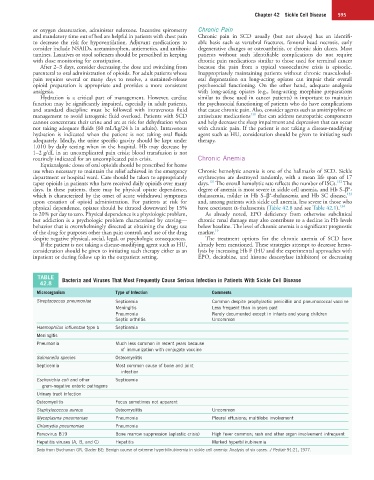
             TABLE   Bacteria and Viruses That Most Frequently Cause Serious Infection in Patients With Sickle Cell Disease
              42.8
             Microorganism             Type of Infection              Comments
             Streptococcus pneumoniae  Septicemia                     Common despite prophylactic penicillin and pneumococcal vaccine
                                       Meningitis                     Less frequent than in years past
                                       Pneumonia                      Rarely documented except in infants and young children
                                       Septic arthritis               Uncommon
             Haemophilus influenzae type b  Septicemia
             Meningitis
             Pneumonia                 Much less common in recent years because
                                         of immunization with conjugate vaccine
             Salmonella species        Osteomyelitis
             Septicemia                Most common cause of bone and joint
                                         infection
             Escherichia coli and other   Septicemia
               gram-negative enteric pathogens
             Urinary tract infection
             Osteomyelitis             Focus sometimes not apparent
             Staphylococcus aureus     Osteomyelitis                  Uncommon
             Mycoplasma pneumoniae     Pneumonia                      Pleural effusions; multilobe involvement
             Chlamydia pneumoniae      Pneumonia
             Parvovirus B19            Bone marrow suppression (aplastic crisis)  High fever common; rash and other organ involvement infrequent
             Hepatitis viruses (A, B, and C)  Hepatitis               Marked hyperbilirubinemia
             Data from Buchanan GR, Glader BE: Benign course of extreme hyperbilirubinemia in sickle cell anemia: Analysis of six cases. J Pediatr 91:21, 1977.

