


Page 722 - Hematology_ Basic Principles and Practice ( PDFDrive )
P. 722
Chapter 43  Hemoglobin Variants Associated With Hemolytic Anemia, Altered Oxygen Affinity, and Methemoglobinemias  609


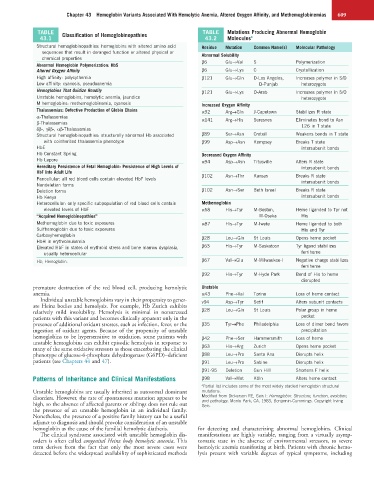
             TABLE   Classification of Hemoglobinopathies          TABLE   Mutations Producing Abnormal Hemoglobin
              43.1                                                  43.2   Molecules a
             Structural hemoglobinopathies: hemoglobins with altered amino acid   Residue  Mutation  Common Name(s)  Molecular Pathology
               sequences that result in deranged function or altered physical or   Abnormal Solubility
               chemical properties                                 β6      Glu→Val  S             Polymerization
             Abnormal Hemoglobin Polymerization: HbS
             Altered Oxygen Affinity                               β6      Glu→Lys  C             Crystallization
             High affinity: polycythemia                           β121    Glu→Gln  D-Los Angeles,   Increases polymer in S/D
             Low affinity: cyanosis, pseudoanemia                                     D-Punjab      heterozygote
             Hemoglobins That Oxidize Readily                      β121    Glu→Lys  O-Arab        Increases polymer in S/O
             Unstable hemoglobins, hemolytic anemia, jaundice                                       heterozygote
             M hemoglobins: methemoglobinemia, cyanosis            Increased Oxygen Affinity
             Thalassemias: Defective Production of Globin Chains   α92     Arg→Gln  J-Capetown    Stabilizes R state
             α-Thalassemias                                        α141    Arg→His  Suresnes      Eliminates bond to Asn
             β-Thalassemias                                                                         126 in T state
             δβ-, γδβ-, αβ-Thalassemias
             Structural hemoglobinopathies: structurally abnormal Hb associated   β89  Ser→Asn  Creteil  Weakens bonds in T state
               with coinherited thalassemia phenotype              β99     Asp→Asn  Kempsey       Breaks T state
             HbE                                                                                    intersubunit bonds
             Hb Constant Spring                                    Decreased Oxygen Affinity
             Hb Lepore                                             α94     Asp→Asn  Titusville    Alters R state
             Hereditary Persistence of Fetal Hemoglobin: Persistence of High Levels of              intersubunit bonds
             HbF Into Adult Life
             Pancellular: all red blood cells contain elevated HbF levels  β102  Asn→Thr  Kansas  Breaks R state
                                                                                                    intersubunit bonds
             Nondeletion forms
             Deletion forms                                        β102    Asn→Ser  Beth Israel   Breaks R state
             Hb Kenya                                                                               intersubunit bonds
             Heterocellular: only specific subpopulation of red blood cells contain   Methemoglobin
               elevated levels of HbF                              α58     His→Tyr  M-Boston,     Heme liganded to Tyr not
             “Acquired Hemoglobinopathies”                                            M-Osaka       His
             Methemoglobin due to toxic exposures                  α87     His→Tyr  M-Iwate       Heme liganded to both
             Sulfhemoglobin due to toxic exposures                                                  His and Tyr
             Carboxyhemoglobin                                     β28     Leu→Gln  St Louis      Opens heme pocket
             HbH in erythroleukemia
             Elevated HbF in states of erythroid stress and bone marrow dysplasia,   β63  His→Tyr  M-Saskatoon  Tyr ligand stabilizes
               usually heterocellular                                                               ferriheme
             Hb, Hemoglobin.                                       β67     Val→Glu  M-Milwaukee-I  Negative charge stabilizes
                                                                                                    ferriheme
                                                                   β92     His→Tyr  M-Hyde Park   Bond of His to heme
                                                                                                    disrupted
            premature  destruction  of  the  red  blood  cell,  producing  hemolytic   Unstable
            anemia.                                                α43     Phe→Val  Torino        Loss of heme contact
              Individual unstable hemoglobins vary in their propensity to gener-  v94  Asp→Tyr  Setif  Alters subunit contacts
            ate Heinz bodies and hemolysis. For example, Hb Zurich exhibits
            relatively  mild  insolubility.  Hemolysis  is  minimal  in  nonstressed   β28  Leu→Gln  St Louis  Polar group in heme
            patients with this variant and becomes clinically apparent only in the                  pocket
            presence of additional oxidant stresses, such as infection, fever, or the   β35  Tyr→Phe  Philadelphia  Loss of dimer bond favors
            ingestion of oxidant agents. Because of the propensity of unstable                      precipitation
            hemoglobins to be hypersensitive to oxidation, some patients with   β42  Phe→Ser  Hammersmith  Loss of heme
            unstable hemoglobins can exhibit episodic hemolysis in response to
            many of the same oxidative stressors as those exacerbating the clinical   β63  His→Arg  Zurich  Opens heme pocket
            phenotype of glucose-6-phosphate dehydrogenase (G6PD)–deficient   β88  Leu→Pro  Santa Ana  Disrupts helix
            patients (see Chapters 44 and 47).                     β91     Leu→Pro  Sabine        Disrupts helix
                                                                   β91-95  Deletion  Gun Hill     Shortens F helix
            Patterns of Inheritance and Clinical Manifestations    β98     Val→Met  Köln          Alters heme contact
                                                                   a Partial list includes some of the most widely studied hemoglobin structural
            Unstable hemoglobins are usually inherited as autosomal dominant   mutations.
            disorders. However, the rate of spontaneous mutation appears to be   Modified from Dickerson RE, Geis I: Hemoglobin: Structure, function, evolution,
                                                                   and pathology. Menlo Park, CA, 1983, Benjamin-Cummings. Copyright Irving
            high, so the absence of affected parents or siblings does not rule out   Geis.
            the  presence  of  an  unstable  hemoglobin  in  an  individual  family.
            Nonetheless, the presence of a positive family history can be a useful
            adjunct to diagnosis and should provoke consideration of an unstable
            hemoglobin as the cause of the familial hemolytic diathesis.  for  detecting  and  characterizing  abnormal  hemoglobins.  Clinical
              The clinical syndrome associated with unstable hemoglobin dis-  manifestations are highly variable, ranging from a virtually asymp-
            orders is often called congenital Heinz body hemolytic anemia. This   tomatic  state  in  the  absence  of  environmental  stressors,  to  severe
            term  derives  from  the  fact  that  only  the  most  severe  cases  were   hemolytic anemia manifesting at birth. Patients with chronic hemo-
            detected before the widespread availability of sophisticated methods   lysis  present  with  variable  degrees  of  typical  symptoms,  including

