


Page 724 - Hematology_ Basic Principles and Practice ( PDFDrive )
P. 724
Chapter 43  Hemoglobin Variants Associated With Hemolytic Anemia, Altered Oxygen Affinity, and Methemoglobinemias  611


            not  particularly  acute  or  brisk.  Thus  Heinz  bodies  may  not  be   strong evidence in support of the diagnosis. A normal electropho-
            demonstrable at all times. Two provocative laboratory maneuvers are   retogram,  however,  should  never  be  regarded  as  strong  evidence
            used to aid detection, both of which unmask the tendency of unstable   against the presence of a mutant hemoglobin, especially if the clini-
            hemoglobins  to  precipitate:  the  heat  instability  test  (heating  of  a   cal picture or family history otherwise supports the diagnosis. Mass
            hemoglobin  solution  to  50°C)  or  the  isopropanol  instability  test   spectrometry analysis of hemoglobin and direct globin gene sequenc-
            (insolubility in 17% isopropanol).                    ing  are  supplanting  electrophoresis  as  diagnostic  strategies.  They
              Hemoglobin electrophoresis should be performed but should not   usually provide unambiguous identification of a sequence abnormal-
            be relied on as the major diagnostic criterion for ruling in or ruling out   ity. However, electrophoresis is still in use in many clinical settings.
            a  hemoglobinopathy.  Many  amino  acid  substitutions  that  have  a   Thus  the  aforementioned  precautions  in  interpretation  are  still
            profound effect on solubility do not change the overall charge on the   worth noting.
            hemoglobin molecule. For example, Hb Köln, the most common of   Additional sophisticated analyses of hemoglobin can be obtained
            the unstable hemoglobin mutations, arises from a mutation chang-  from  reference  laboratories  if  detailed  characterization  seems  war-
            ing  the  valine  at  position  98  to  a  methionine.  This  mutation  is   ranted. For example, abnormal hemoglobin or globin bands migrat-
            electrically neutral; it does not alter electrophoretic mobility. There-  ing to novel positions on an isoelectric focusing gel can result from
            fore these variants do not form an abnormal band on an electropho-  hemoglobin or globin moieties lacking heme in groups. When heme
            resis  gel.  Demonstration  of  an  abnormal  band  would  clearly  add   is added to the sample and the proteins are reanalyzed, these bands
                                                                  disappear. This behavior is nearly diagnostic of an unstable variant.
                                                                    Detection of unstable hemoglobins is occasionally compromised
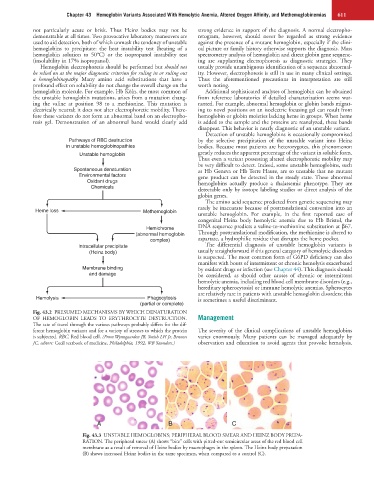
                        Pathways of RBC destruction               by  the  selective  precipitation  of  the  unstable  variant  into  Heinz
                       in unstable hemoglobinopathies             bodies. Because most patients are heterozygotes, this phenomenon
                           Unstable hemoglobin                    greatly reduces the apparent percentage of the variant in soluble form.
                                                                  Thus even a variant possessing altered electrophoretic mobility may
                                                                  be very difficult to detect. Indeed, some unstable hemoglobins, such
                         Spontaneous denaturation                 as Hb Geneva or Hb Terre Haute, are so unstable that no mutant
                           Environmental factors                  gene product can be detected in the steady state. These abnormal
                              Oxidant drugs                       hemoglobins  actually  produce  a  thalassemic  phenotype.  They  are
                               Chemicals                          detectable only by isotope labeling studies or direct analysis of the
                                                                  globin genes.
                                                                    The amino acid sequence predicted from genetic sequencing may
                                                                  rarely be inaccurate because of posttranslational conversion into an
             Heme loss                          Methemoglobin     unstable  hemoglobin.  For  example,  in  the  first  reported  case  of
                                                                  congenital  Heinz  body  hemolytic  anemia  due  to  Hb  Bristol,  the
                                                 Hemichrome       DNA sequence predicts a valine-to-methionine substitution at β67.
                                             (abnormal hemoglobin  Through posttranslational modification, the methionine is altered to
                                                  complex)        aspartate, a hydrophilic residue that disrupts the heme pocket.
                           Intracellular precipitate                The  differential  diagnosis  of  unstable  hemoglobin  variants  is
                              (Heinz body)                        usually straightforward if this general category of hemolytic disorders
                                                                  is suspected. The most common form of G6PD deficiency can also
                                                                  manifest with bouts of intermittent or chronic hemolysis exacerbated
                            Membrane binding                      by oxidant drugs or infection (see Chapter 44). This diagnosis should
                              and damage                          be  considered,  as  should  other  causes  of  chronic  or  intermittent
                                                                  hemolytic anemia, including red blood cell membrane disorders (e.g.,
                                                                  hereditary spherocytosis) or immune hemolytic anemias. Spherocytes
                                                                  are relatively rare in patients with unstable hemoglobin disorders; this
             Hemolysis                           Phagocytosis     is sometimes a useful discriminant.
                                               (partial or complete)
            Fig. 43.2  PRESUMED MECHANISMS BY WHICH DENATURATION
            OF  HEMOGLOBIN  LEADS  TO  ERYTHROCYTE  DESTRUCTION.   Management
            The rate of travel through the various pathways probably differs for the dif-
            ferent hemoglobin variants and for a variety of stresses to which the protein   The severity of the clinical complications of unstable hemoglobins
            is subjected. RBC, Red blood cell. (From Wynngaarden JB, Smith LH Jr, Bennett   varies  enormously.  Many  patients  can  be  managed  adequately  by
            JC, editors: Cecil textbook of medicine, Philadelphia, 1992, WB Saunders.)  observation and education to avoid agents that provoke hemolysis.


                                 A                      B                    C
                            Fig. 43.3  UNSTABLE HEMOGLOBINS; PERIPHERAL BLOOD SMEAR AND HEINZ BODY PREPA-
                            RATION. The peripheral smear (A) shows “bite” cells with pitted-out semicircular areas of the red blood cell
                            membrane as a result of removal of Heinz bodies by macrophages in the spleen. The Heinz body preparation
                            (B) shows increased Heinz bodies in the same specimen, when compared to a control (C).

