


Page 723 - Hematology_ Basic Principles and Practice ( PDFDrive )
P. 723
610    Part V  Red Blood Cells


                       HbS
          β 2                  Shepherds              Rahere                                                 β 1
                                   Bush
                                         Buenos           Agenogi
                                         Aires
                              Seattle       Boras    Crefeil  Syracuse
                                                                  Andrew-Minneapolis
                      Christchurch         Olmsted           Sabine  Rainier
                                  Wien     North Shore                     Hiroshima
            Olympia
                                     M-Milwaukee
             O-Arab
                      Riverdale-
                        Bronx      Zurich    Heathrow  Brigham
                                                              Malmo
                                                    Köln
                 Freiburg
                         Peterborough    Casper
                                     Yoshizuka  Kansas  Kempsey
                                                                         Torino
                                San Diego
                                             Bucaresti


                                             Philly            G-Georgia             M-Boston
                         Okaloosa             Hirose       Chesapeake
                                                                                   Tarrant
                                                                 M-Iwate

                                             Suresnes              Bibba


          α 2                                                                                                α 1


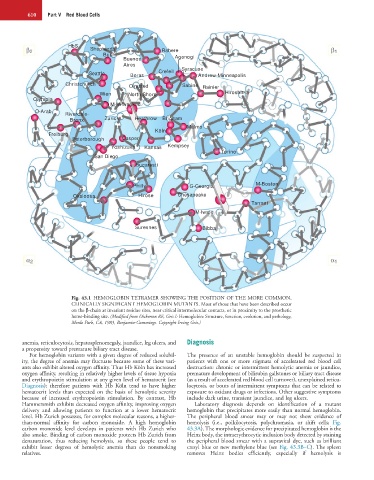
                        Fig. 43.1  HEMOGLOBIN TETRAMER SHOWING THE POSITION OF THE MORE COMMON,
                        CLINICALLY SIGNIFICANT HEMOGLOBIN MUTANTS. Most of those that have been described occur
                        on the β-chain at invariant residue sites, near critical intermolecular contacts, or in proximity to the prosthetic
                        heme-binding site. (Modified from Dickerson RE, Geis I: Hemoglobin: Structure, function, evolution, and pathology,
                        Menlo Park, CA, 1983, Benjamin-Cummings. Copyright Irving Geis.)


        anemia, reticulocytosis, hepatosplenomegaly, jaundice, leg ulcers, and   Diagnosis
        a propensity toward premature biliary tract disease.
           For hemoglobin variants with a given degree of reduced solubil-  The  presence  of  an  unstable  hemoglobin  should  be  suspected  in
        ity, the degree of anemia may fluctuate because some of these vari-  patients  with  one  or  more  stigmata  of  accelerated  red  blood  cell
        ants also exhibit altered oxygen affinity. Thus Hb Köln has increased   destruction: chronic or intermittent hemolytic anemia or jaundice,
        oxygen affinity, resulting in relatively higher levels of tissue hypoxia   premature development of bilirubin gallstones or biliary tract disease
        and erythropoietin stimulation at any given level of hematocrit (see   (as a result of accelerated red blood cell turnover), unexplained reticu-
        Diagnosis);  therefore  patients  with  Hb  Köln  tend  to  have  higher   locytosis, or bouts of intermittent symptoms that can be related to
        hematocrit  levels  than  expected  on  the  basis  of  hemolytic  severity   exposure to oxidant drugs or infections. Other suggestive symptoms
        because  of  increased  erythropoietin  stimulation.  By  contrast,  Hb   include dark urine, transient jaundice, and leg ulcers.
        Hammersmith exhibits decreased oxygen affinity, improving oxygen   Laboratory  diagnosis  depends  on  identification  of  a  mutant
        delivery  and  allowing  patients  to  function  at  a  lower  hematocrit   hemoglobin that precipitates more easily than normal hemoglobin.
        level. Hb Zurich possesses, for complex molecular reasons, a higher-  The  peripheral  blood  smear  may  or  may  not  show  evidence  of
        than-normal  affinity  for  carbon  monoxide.  A  high  hemoglobin   hemolysis  (i.e.,  poikilocytosis,  polychromasia,  or  shift  cells;  Fig.
        carbon  monoxide  level  develops  in  patients  with  Hb  Zurich  who   43.3A). The morphologic evidence for precipitated hemoglobin is the
        also smoke. Binding of carbon monoxide protects Hb Zurich from   Heinz body, the intraerythrocytic inclusion body detected by staining
        denaturation,  thus  reducing  hemolysis,  so  these  people  tend  to   the peripheral blood smear with a supravital dye, such as brilliant
        exhibit  lesser  degrees  of  hemolytic  anemia  than  do  nonsmoking   cresyl blue or new methylene blue (see Fig. 43.3B–C). The spleen
        relatives.                                            removes  Heinz  bodies  efficiently,  especially  if  hemolysis  is

