


Page 763 - Hematology_ Basic Principles and Practice ( PDFDrive )
P. 763
650    Part V  Red Blood Cells


        T-cell deficiencies) T-cell and humoral immune deficiency predispose   female  <12.0 g/dL),  reticulocytosis  (corrected  reticulocyte  count
        to  WAIHA,  but  no  correlation  between  the  type  and  severity  of   >2% or absolute reticulocyte count >100,000/µL to 120,000/µL),
        immune deficiency and the risk of AIHA has been established. One   low haptoglobin, elevated lactate dehydrogenase (LDH), and elevated
        phenomenon that is poorly understood is the lack of a clear relation-  unconjugated  (indirect)  bilirubin.  Haptoglobin  is  an  α2-globulin
        ship between the presence of RBC antibodies and anemia. In many   that  binds  Hb. This  Hb–haptoglobin  complex  is  degraded  in  the
        instances, there is no anemia despite a strongly positive DAT or high   liver. Hemopexin is another plasma protein with a very high binding
        titers  of  CAIHAs.  There  is  also  only  a  poor  correlation  between   affinity to Hb. It scavenges heme released from RBCs and protects
        antibody titers and severity of anemia. Another unexplained finding   the organisms from the adverse effects of circulating Hb. The deter-
        in secondary AIHA is the occurrence of both WAIHAs and CAIHAs   mination of hemopexin is not essential for the diagnosis of AIHA.
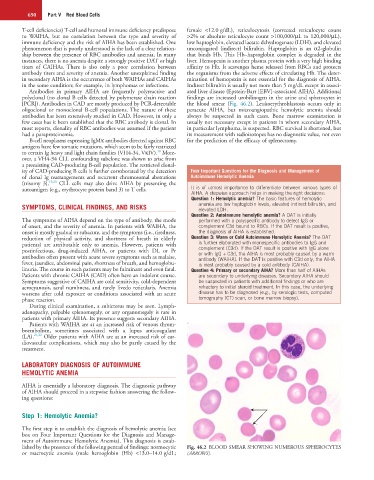
        in the some condition; for example, in lymphomas or infections.  Indirect bilirubin is usually not more than 5 mg/dL except in associ-
           Antibodies  in  primary  AIHA  are  frequently  polyreactive  and   ated liver disease (Epstein-Barr [EBV]-associated AIHA). Additional
        polyclonal (no clonal B cells detected by polymerase chain reaction   findings are increased urobilinogen in the urine and spherocytes in
        [PCR]). Antibodies in CAD are mostly produced by PCR-detectable   the  blood  smear  (Fig.  46.2).  Leukoerythroblastosis  occurs  only  in
        oligoclonal or monoclonal B-cell populations. The nature of these   peracute  AIHA,  but  microangiopathic  hemolytic  anemia  should
        antibodies has been extensively studied in CAD. However, in only a   always  be  suspected  in  such  cases.  Bone  marrow  examination  is
        few cases has it been established that the RBC antibody is clonal. In   usually not necessary except in patients in whom secondary AIHA,
        most reports, clonality of RBC antibodies was assumed if the patient   in particular lymphoma, is suspected. RBC survival is shortened, but
        had a paraproteinemia.                                its measurement with radioisotopes has no diagnostic value, not even
           B-cell neoplasms expressing IgMκ antibodies directed against RBC   for the prediction of the efficacy of splenectomy.
        antigens have few somatic mutations, which seem to be fairly restricted
                                                    18
        to certain Ig heavy and light chain families (VH4-34, VκIV).  More-
        over, a VH4-34 CLL confounding subclone was shown to arise from
        a preexisting CAD-producing B-cell population. The restricted clonal-
        ity of CAD-producing B cells is further corroborated by the detection   Four Important Questions for the Diagnosis and Management of
        of  clonal  Ig  rearrangements  and  recurrent  chromosomal  aberrations   Autoimmune Hemolytic Anemia
        (trisomy  3). 19,20   CLL  cells  may  also  drive  AIHA  by  presenting  the
        autoantigen (e.g., erythrocyte protein band 3) to T cells.  It  is  of  utmost  importance  to  differentiate  between  various  types  of
                                                                AIHA. A stepwise approach helps in making the right decisions:
                                                                Question 1: Hemolytic anemia? The basic features of hemolytic
        SYMPTOMS, CLINICAL FINDINGS, AND RISKS                    anemia are low haptoglobin levels, elevated indirect bilirubin, and
                                                                  elevated LDH.
                                                                Question 2: Autoimmune hemolytic anemia? A DAT is initially
        The symptoms of AIHA depend on the type of antibody, the mode   performed with a polyspecific antibody to detect IgG or
        of onset, and the severity of anemia. In patients with WAIHA, the   complement C3d bound to RBCs. If the DAT result is positive,
        onset is mostly gradual or subacute, and the symptoms (i.e., tiredness,   the diagnosis of AIHA is established.
        reduction  of  physical  activity,  and  shortness  of  breath  in  elderly   Question 3: Warm or Cold Autoimmune Hemolytic Anemia? The DAT
        patients)  are  attributable  only  to  anemia.  However,  patients  with   is further elaborated with monospecific antibodies to IgG and
        postinfectious,  drug-induced  AIHA,  or  patients  with  DL  or  Pr   complement (C3d). If the DAT result is positive with IgG alone
                                                                  or with IgG + C3d, the AIHA is most probably caused by a warm
        antibodies often present with acute severe symptoms such as malaise,   antibody (WAIHA). If the DAT is positive with C3d only, the AIHA
        fever, jaundice, abdominal pain, shortness of breath, and hemoglobu-  is most probably caused by a cold antibody (CAIHA).
        linuria. The course in such patients may be fulminant and even fatal.   Question 4: Primary or secondary AIHA? More than half of AIHAs
        Patients with chronic CAIHA (CAD) often have an indolent course.   are secondary to underlying diseases. Secondary AIHA should
        Symptoms suggestive of CAIHA are cold sensitivity, cold-dependent   be suspected in patients with additional findings or who are
        acrocyanosis, acral numbness, and rarely livedo reticularis. Anemia   refractory to initial steroid treatment. In this case, the underlying
        worsens after cold exposure or conditions associated with an acute   disease has to be diagnosed (e.g., by serologic tests, computed
        phase reaction.                                           tomography (CT) scan, or bone marrow biopsy).
           During clinical examination, a subicterus may be seen. Lymph-
        adenopathy, palpable splenomegaly, or any organomegaly is rare in
        patients with primary AIHA. Its presence suggests secondary AIHA.
           Patients with WAIHA are at an increased risk of venous throm-
        boembolism,  sometimes  associated  with  a  lupus  anticoagulant
        (LA). 21,22  Older patients with AIHA are at an increased risk of car-
        diovascular complications, which may also be partly caused by the
        treatment.


        LABORATORY DIAGNOSIS OF AUTOIMMUNE
        HEMOLYTIC ANEMIA

        AIHA is essentially a laboratory diagnosis. The diagnostic pathway
        of AIHA should proceed in a stepwise fashion answering the follow-
        ing questions:


        Step 1: Hemolytic Anemia?

        The first step is to establish the diagnosis of hemolytic anemia (see
        box on Four Important Questions for the Diagnosis and Manage-
        ment of Autoimmune Hemolytic Anemia). This diagnosis is estab-
        lished by the presence of the following pentad of findings: normocytic   Fig. 46.2  BLOOD SMEAR SHOWING NUMEROUS SPHEROCYTES
        or  macrocytic  anemia  (male  hemoglobin  (Hb)  <13.0–14.0 g/dL;   (ARROWS).

