


Page 764 - Hematology_ Basic Principles and Practice ( PDFDrive )
P. 764
Chapter 46  Autoimmune Hemolytic Anemia  651


              Among methodologic diagnostic problems, reticulocyte counting   reliable,  and  probably  more  sensitive  (Fig.  46.4).  In  the  indirect
            is the biggest, because in many laboratories low-precision microscopic   antiglobulin test (IAT), patient plasma or serum is incubated with
            counts are still performed. Automatic flow cytometric methods are   test  RBCs,  and  (after  washing)  RBC-bound  IgG  is  detected  with
            more  precise,  reliable,  and  convenient.  With  flow  cytometry,  the   the  DAT.  IAT  is  usually  not  required  for  the  diagnosis  of  AIHA
            number  of highly fluorescent  reticulocytes (which  are increased  in   except when a drug-dependent antibody is suspected. For the dif-
            AIHA but are low in hereditary spherocytosis) can also be measured.   ferentiation  of  drug-dependent  antibodies  and  autoantibodies,  an
            Falsely very high mean corpuscular volume (MCV) and mean cor-  acid eluate of the patient’s RBCs should be made and tested in the
            puscular Hb concentration occur in some cases of CAIHA because   IAT.  If  the  IAT  result  is  positive,  the  patient  has  autoantibodies.
            RBC counts are falsely low because of agglutination of RBC at room   The  severity  of  AIHA  does  not  correlate  with  the  strength  of  the
            temperature. If a CAIHA is suspected, blood samples should be sent   DAT but rather with the immunoglobulin subclass of the antibody
            to the laboratory in warmed containers.               (IgG 1  or  IgG 3).  The  result  of  the  DAT  is  not  a  reliable  marker
              All of the findings of the pentad are not always present. Reticu-  of treatment success because patients with a complete hematologic
            locytosis  is  often  (in  ≈25%)  not  present  at  the  onset  of  AIHA.   remission may remain DAT positive, and DAT positivity or negativ-
            This is mostly because of a delayed initial bone marrow response of   ity  has  only  limited  value  to  predict  the  duration  of  hematologic
            erythropoiesis. After 1 week, most of these patients have reticulocy-  remission.
            tosis. In other patients (particularly in secondary cases), absence of
            reticulocytosis may be attributable to impairment of erythropoiesis
            caused by bone marrow infiltration or blunted erythropoiesis caused   Falsely Negative and Positive Direct Antiglobulin
            by  an  acute-phase  reaction.  If  the  reticulocyte  count  is  very  low,   Test Results Without Hemolysis or Anemia
            pure RBC aplasia (PRCA), either immune mediated or induced by a
            parvovirus (or HHV6) infection, should be suspected. Haptoglobin   If  the  conventional  DAT  test  result  is  negative,  hemolytic  anemia
            may  be  falsely  normal  or  even  increased,  particularly  in  patients   is  defined  as  DAT  negative.  However,  AIHA  cannot  be  definitely
            with  malignant  or  immune  diseases,  because  haptoglobin  is  an   excluded  because  about  5%  (2%  to  11%)  of  AIHA  patients  are
            acute-phase  protein.  Haptoglobin  may  be  falsely  low  in  patients   DAT negative. If AIHA is suspected for clinical grounds despite a
            with  a  haplotype  H 0 H 0   and  in  patients  with  severe  liver  disease.   negative DAT result, more sensitive quantitative tests are required to
            Both increased bilirubin and elevated LDH have a limited specificity    determine the amount of IgG on the RBCs. The threshold of positiv-
            for AIHA.                                             ity of the conventional DAT is 100–200 IgG molecules per RBC,
                                                                  but in some AIHA patients, the RBC IgG is less than this amount.
                                                                  In about one-third of DAT-negative cases, one of the more sensitive
            Step 2: Autoimmune Hemolytic Anemia?                  test results (e.g., immunoradiometric tests) will be positive. However,
                                                                  the relationship between the amount of RBC IgG and hemolysis is
                                                                                                         23
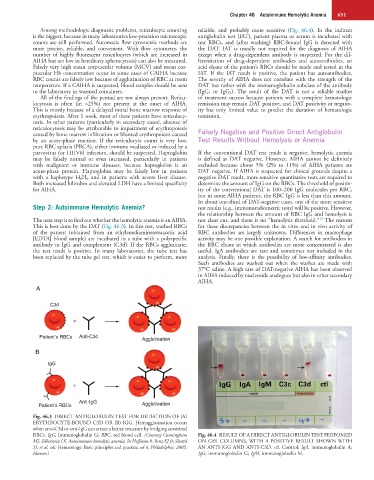
            The next step is to find out whether the hemolytic anemia is an AIHA.   not clear cut, and there is no “hemolysis threshold.”  The reasons
            This is best done by the DAT (Fig. 46.3). In this test, washed RBCs   for these discrepancies between the in vitro and in vivo activity of
            of  the  patient  (obtained  from  an  ethylenediaminetetraacetic  acid   RBC  antibodies  are  largely  unknown.  Differences  in  macrophage
            [EDTA] blood sample) are incubated in a tube with a polyspecific   activity may be one possible explanation. A search for antibodies in
            antibody to IgG and complement (C3d). If the RBCs agglutinate,   the RBC eluate in which antibodies are more concentrated is also
            the  test  result  is  positive.  In  many  laboratories,  the  tube  test  has   useful. IgA antibodies are rare and sometimes not included in the
            been replaced by the tube gel test, which is easier to perform, more   analysis.  Finally,  there  is  the  possibility  of  low-affinity  antibodies.
                                                                  Such  antibodies  are  washed  out  when  the  washes  are  made  with
                                                                  37°C saline. A high rate of DAT-negative AIHA has been observed
                                                                  in AIHA induced by nucleoside analogues but also in other secondary
                                                                  AIHA.
             A


                 C3d

                         +

              Patient’s RBCs  Anti-C3d         Agglutination

             B

                 IgG


                         +

                           Anti-IgG
              Patient’s RBCs                   Agglutination
            Fig. 46.3  DIRECT ANTIGLOBULIN TEST FOR DETECTION OF (A)
            ERYTHROCYTE-BOUND C3D OR (B) IGG. Hemagglutination occurs
            when anti-C3d or anti-IgG can create a lattice structure by bridging sensitized
            RBCs. IgG, Immunoglobulin G; RBC, red blood cell. (Courtesy Cunningham   Fig. 46.4  RESULT OF A DIRECT ANTIGLOBULIN TEST PERFOMED
            MJ, Silberstein LE: Autoimmune hemolytic anemia. In Hoffman R, Benz EJ Jr, Shattil   ON GEL COLUMNS, WITH A POSITIVE RESULT SHOWN WITH
            SJ, et al, eds: Hematology: Basic principles and practice, ed 4, Philadelphia, 2005,   AN ANTI-IGG AND ANTI-C3D. ctl, Control; IgA, immunoglobulin A;
            Elsevier.)                                            IgG, immunoglobulin G; IgM, immunoglobulin M.

