


Page 766 - Hematology_ Basic Principles and Practice ( PDFDrive )
P. 766
Chapter 46  Autoimmune Hemolytic Anemia  653


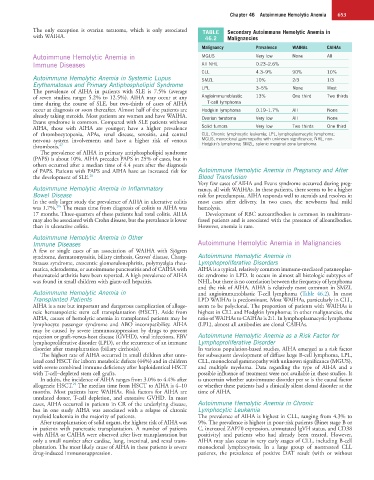
            The  only  exception  is  ovarian  teratoma,  which  is  only  associated    TABLE   Secondary Autoimmune Hemolytic Anemia in
            with WAIHA.                                             46.2   Malignancies
                                                                   Malignancy        Prevalence  WAIHAs     CAIHAs
            Autoimmune Hemolytic Anemia in                         MGUS              Very low    None       All
            Immune Diseases                                        All NHL           0.23–2.6%
                                                                   CLL               4.3–9%      90%        10%
            Autoimmune Hemolytic Anemia in Systemic Lupus          SMZL              10%         2/3        1/3
            Erythematosus and Primary Antiphospholipid Syndrome
            The  prevalence  of  AIHA  in  patients  with  SLE  is  7.5%  (average   LPL  3–5%   None       Most
            of seven studies; range: 5.2% to 12.5%). AIHA may occur at any   Angioimmunoblastic   13%  One third  Two thirds
            time  during  the  course  of  SLE,  but  two-thirds  of  cases  of  AIHA   T-cell lymphoma
            occur at diagnosis or soon thereafter. Almost half of the patients are   Hodgkin lymphoma  0.19–1.7%  All  None
            already taking steroids. Most patients are women and have WAIHA.   Ovarian teratoma  Very low  All  None
            Evans syndrome is common. Compared with SLE patients without
            AIHA,  those  with  AIHA  are  younger;  have  a  higher  prevalence   Solid tumors  Very low  Two thirds  One third
            of  thrombocytopenia,  APAs,  renal  disease,  serositis,  and  central   CLL, Chronic lymphocytic leukemia; LPL, lymphoplasmacytic lymphoma;
            nervous  system  involvement;  and  have  a  higher  risk  of  venous    MGUS, monoclonal gammopathy with unknown significance; NHL, non-
            thrombosis. 27                                         Hodgkin’s lymphoma; SMZL, splenic marginal zone lymphoma.
              The prevalence of AIHA in primary antiphospholipid syndrome
            (PAPS) is about 10%. AIHA precedes PAPS in 25% of cases, but in
            others occurred after a median time of 4.4 years after the diagnosis
            of PAPS. Patients with PAPS and AIHA have an increased risk for   Autoimmune Hemolytic Anemia in Pregnancy and After
            the development of SLE. 28                            Blood Transfusion
                                                                  Very few cases of AIHA and Evans syndrome occurred during preg-
            Autoimmune Hemolytic Anemia in Inflammatory           nancy, all with WAIHAs. In these patients, there seems to be a higher
            Bowel Disease                                         risk for preeclampsia. AIHA responds well to steroids and resolves in
            In the only larger study the prevalence of AIHA in ulcerative colitis   most  cases  after  delivery.  In  two  cases,  the  newborns  had  mild
                   28a
            was 1.7%.  The mean time from diagnosis of colitis to AIHA was   hemolysis.
            17 months. Three-quarters of these patients had total colitis. AIHA   Development of RBC autoantibodies is common in multitrans-
            may also be associated with Crohn disease, but the prevalence is lower   fused patients and is associated with the presence of alloantibodies.
            than in ulcerative colitis.                           However, anemia is rare.
            Autoimmune Hemolytic Anemia in Other
            Immune Diseases                                       Autoimmune Hemolytic Anemia in Malignancies
            A  few  or  single  cases  of  an  association  of  WAIHA  with  Sjögren
            syndrome, dermatomyositis, biliary cirrhosis, Graves’ disease, Churg-  Autoimmune Hemolytic Anemia in
            Strauss syndrome, crescentic glomerulonephritis, polymyalgia rheu-  Lymphoproliferative Disorders
            matica, scleroderma, or autoimmune pancreatitis and of CAIHA with   AIHA is a typical, relatively common immune-mediated paraneoplas-
            rheumatoid arthritis have been reported. A high prevalence of AIHA   tic syndrome in LPD. It occurs in almost all histologic subtypes of
            was found in small children with giant-cell hepatitis.  NHL, but there is no correlation between the frequency of lymphoma
                                                                  and the risk of AIHA. AIHA is relatively most common in SMZL
            Autoimmune Hemolytic Anemia in                        and  angioimmunoblastic  T-cell  lymphoma  (Table  46.2).  In  most
            Transplanted Patients                                 LPD WAIHAs is predominant. Most WAIHAs, particularly in CLL,
            AIHA is a rare but important and dangerous complication of alloge-  seem to be polyclonal. The proportion of patients with WAIHAs is
            neic  hematopoietic  stem  cell  transplantation  (HSCT).  Aside  from   highest in CLL and Hodgkin lymphoma; in other malignancies, the
            AIHA, causes of hemolytic anemia in transplanted patients may be   ratio of WAIHAs to CAIHAs is 2:1. In lymphoplasmacytic lymphoma
            lymphocyte  passenger  syndrome  and  ABO  incompatibility.  AIHA   (LPL), almost all antibodies are clonal CAIHAs.
            may  be  caused  by  severe  immunosuppression  by  drugs  to  prevent
            rejection or graft-versus-host disease (GVHD), viral infections, EBV   Autoimmune Hemolytic Anemia as a Risk Factor for
            lymphoproliferative disorder (LPD), or the recurrence of an immune   Lymphoproliferative Disorder
            disorder after transplantation (biliary cirrhosis).   In various population-based studies, AIHA emerged as a risk factor
              The highest rate of AIHA occurred in small children after unre-  for subsequent development of diffuse large B-cell lymphoma, LPL,
            lated cord HSCT for inborn metabolic defects (44%) and in children   CLL, monoclonal gammopathy with unknown significance (MGUS),
            with severe combined immune deficiency after haploidentical HSCT   and  multiple  myeloma.  Data  regarding  the  type  of  AIHA  and  a
            with T-cell–depleted stem cell grafts.                possible influence of treatment were not available in these studies. It
              In adults, the incidence of AIHA ranges from 3.0% to 4.4% after   is uncertain whether autoimmune disorder per se is the causal factor
                         29
            allogeneic HSCT.  The median time from HSCT to AIHA is 4–10   or whether these patients had a clinically silent clonal disorder at the
            months.  Most  patients  have  WAIHAs.  Risk  factors  for  AIHA  are   time of AIHA.
            unrelated  donor, T-cell  depletion,  and  extensive  GVHD.  In  most
            cases, AIHA occurred in patients in CR of the underlying disease,   Autoimmune Hemolytic Anemia in Chronic
            but  in  one  study  AIHA  was  associated  with  a  relapse  of  chronic   Lymphocytic Leukemia
            myeloid leukemia in the majority of patients.         The prevalence of AIHA is highest in CLL, ranging from 4.3% to
              After transplantation of solid organs, the highest risk of AIHA was   9%. The prevalence is highest in poor-risk patients (Binet stage B or
            in  patients  with  pancreatic  transplantation.  A  number  of  patients   C, increased ZAP70 expression, unmutated IgVH status, and CD38
            with AIHA or CAIHA were observed after liver transplantation but   positivity)  and  patients  who  had  already  been  treated.  However,
            only a small number after cardiac, lung, intestinal, and renal trans-  AIHA may also occur in very early stages of CLL, including B-cell
            plantation. The most likely cause of AIHA in these patients is severe   monoclonal  lymphocytosis.  In  a  large  group  of  nontreated  CLL
            drug-induced immunosuppression.                       patients,  the  prevalence  of  positive  DAT  result  (with  or  without

