


Page 817 - Hematology_ Basic Principles and Practice ( PDFDrive )
P. 817
Chapter 50  Disorders of Phagocyte Function  703


            has been identified have point mutations in a stretch of 250 amino     C3b                CD11b
            acids  in  the  extracellular  domain  of  CD18. This  region  is  highly
            conserved  among  all  β  subunits  and  appears  to  be  important  for
                                                                      Normal                                100%
            interaction with the α subunit.

            Clinical Features

            The key features of LAD I are summarized in Table 50.7. The clinical
            presentation of LAD is heterogeneous and is related to the severity                             0.1%
            of the deficiency of the β2 integrins. The severe clinical phenotype   Severe
            is  associated  with  less  than  0.3%  of  the  normal  amount  of  these
            glycoproteins on the leukocyte surface; the moderate phenotype has
            2.5– 6% of normal levels. In both the severe and moderate forms of   Cell number
            the disease, persistent granulocytosis (neutrophil count of 12,000–                             4.0%
                      3
            100,000/mm )  is  a  constant  finding,  as  are  recurrent  cutaneous
            abscesses and aggressive periodontitis and gingivitis. Additional clini-  Moderate
            cal features seen more often in the severe clinical phenotype include
            delayed  umbilical  cord  separation,  omphalitis,  perirectal  cellulitis,
            severe ulcerative stomatitis, and bacterial sepsis. A striking finding in
            LAD I is that abscesses and other sites of infections are devoid of pus                         60%
            despite the marked neutrophilia because neutrophils are unable to   Hetero
            emigrate to tissues. S. aureus and gram-negative enteric bacteria cause
            the majority of infections in LAD I. Fungal infections can also occur,
            particularly from C. albicans and Aspergillus spp.
              Note that infants with delayed separation of the umbilical cord        Log fluorescence intensity
            who are healthy and have normal blood counts are very unlikely to
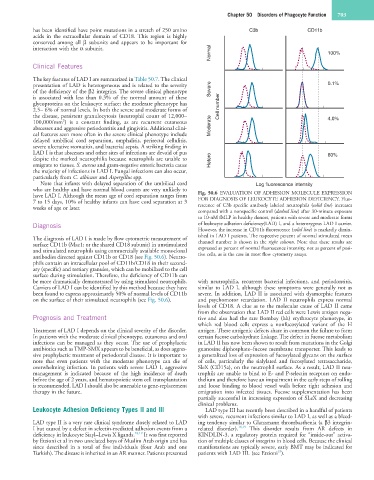
            have LAD I. Although the mean age of cord separation ranges from   Fig. 50.6  EVALUATION OF ADHESION MOLECULE EXPRESSION
            7 to 15 days, 10% of healthy infants can have cord separation at 3   FOR DIAGNOSIS OF LEUKOCYTE ADHESION DEFICIENCY. Fluo-
            weeks of age or later.                                rescence  of  C3b  specific  antibody  labeled  neutrophils  (solid  line)  increases
                                                                  compared with a nonspecific control (dashed line) after 30-minute exposure
                                                                  to 10-nM fMLP in healthy donors, patients with severe and moderate forms
            Diagnosis                                             of leukocyte adhesion deficiency(LAD) I, and a heterozygous LAD I carrier.
                                                                  However, the increase in CD11b fluorescence (solid line) is markedly dimin-
                                                                  ished in LAD I patients. The respective percent of normal stimulated mean
            The diagnosis of LAD I is made by flow cytometric measurement of
            surface CD11b (Mac1; or the shared CD18 subunit) in unstimulated   channel  number  is  shown  in  the  right  column.  Note  that  these  results  are
            and stimulated neutrophils using commercially available monoclonal   expressed as percent of normal fluorescence intensity, not as percent of posi-
            antibodies directed against CD11b or CD18 (see Fig. 50.6). Neutro-  tive cells, as is the case in most flow cytometry assays.
            phils contain an intracellular pool of CD11b/CD18 in their second-
            ary (specific) and tertiary granules, which can be mobilized to the cell
            surface during stimulation. Therefore, the deficiency of CD11b can
            be more dramatically demonstrated by using stimulated neutrophils.   with neutrophilia, recurrent bacterial infections, and periodontitis,
            Carriers of LAD I can be identified by this method because they have   similar  to LAD  I,  although these  symptoms  were generally not  as
            been found to express approximately 50% of normal levels of CD11b   severe. In addition, LAD II is associated with dysmorphic features
            on the surface of their stimulated neutrophils (see Fig. 50.6).  and  psychomotor  retardation.  LAD  II  neutrophils  express  normal
                                                                  levels of CD18. A clue as to the molecular cause of LAD II came
                                                                  from the observation that LAD II red cells were Lewis antigen nega-
            Prognosis and Treatment                               tive and also had the rare Bombay (hh) erythrocyte phenotype, in
                                                                  which  red  blood  cells  express  a  nonfucosylated  variant  of  the  H
            Treatment of LAD I depends on the clinical severity of the disorder.   antigen. These antigenic defects share in common the failure to form
            In patients with the moderate clinical phenotype, cutaneous and oral   certain fucose carbohydrate linkage. The defect in fucose metabolism
            infections  can  be  managed  as  they  occur. The  use  of  prophylactic   in LAD II has now been shown to result from mutations in the Golgi
            antibiotics such as TMP-SMX appears to be beneficial, as does aggres-  guanosine diphosphate–fucose membrane transporter. This leads to
            sive prophylactic treatment of periodontal disease. It is important to   a generalized loss of expression of fucosylated glycans on the surface
            note  that  even  patients  with  the  moderate  phenotype  can  die  of   of  cells,  particularly  the  sialylated  and  fucosylated  tetrasaccharide,
            overwhelming infection. In patients with severe LAD I, aggressive   SleX (CD15a), on the neutrophil surface. As a result, LAD II neu-
            management  is  indicated  because  of  the  high  incidence  of  death   trophils are unable to bind to E- and P-selectin receptors on endo-
            before the age of 2 years, and hematopoietic stem cell transplantation   thelium and therefore have an impairment in the early steps of rolling
            is recommended. LAD I should also be amenable to gene-replacement   and  loose  binding  to  blood  vessel  walls  before  tight  adhesion  and
            therapy in the future.                                emigration  into  infected  tissues.  Fucose  supplementation  has  been
                                                                  partially successful in increasing expression of SLeX and decreasing
                                                                  clinical problems.
            Leukocyte Adhesion Deficiency Types II and III          LAD type III has recently been described in a handful of patients
                                                                  with severe, recurrent infections similar to LAD I, as well as a bleed-
            LAD type II is a very rare clinical syndrome closely related to LAD   ing tendency similar to Glanzmann thrombasthenia (a β3 integrin-
            I but caused by a defect in selectin-mediated adhesion events from a   related  disorder). 18,19   This  disorder  results  from  AR  defects  in
            deficiency in leukocyte Siayl–Lewis X ligands. 18,19  It was first reported   KINDLIN-3, a regulatory protein required for “inside-out” activa-
            by Etzioni et al in two unrelated boys of Muslim Arab origin and has   tion of multiple classes of integrins in blood cells. Because the clinical
            since  described  in  a  total  of  five  individuals  (four  Arab  and  one   manifestations are typically severe, early BMT may be indicated for
                                                                                            19
            Turkish). The disease is inherited in an AR manner. Patients presented   patients with LAD III. (see Etzioni ).

