


Page 816 - Hematology_ Basic Principles and Practice ( PDFDrive )
P. 816
702    Part VI  Non-Malignant Leukocytes

                                                                                   3
        chemotactic assay systems faithfully reflect prevailing in vivo condi-  Newburger, and Borregaard ). The patient’s neutrophils could not be
        tions is not known. Our understanding of chemotactic disorders has   made to adhere to plastic surfaces or to respond to serum-opsonized
        been hampered by the limitations of these assays, just as the elucida-  particles in terms of ingestion and respiratory burst activity.
        tion of respiratory burst defects was obscured when the major avail-  The  molecular  basis  of  LAD  I  is  now  known  to  result  from
        able  assay  was  in  vitro  bacterial  killing.  In  this  section,  the  most   mutations in the gene for the common CD18 β2 subunit for these
        important and best characterized of the chemotactic disorders, LAD,   three leukocyte glycoproteins, now termed β2 integrins, that belong
        is  discussed  in  detail.  A  brief  discussion  of  several  other  clinically   to  the  integrin  superfamily  of  adhesion  molecules.  Integrins  are
        significant chemotactic disorders is also provided.   noncovalently linked heterodimeric glycoproteins consisting of an α
                                                              and a β subunit. Within each of the eight known integrin subfamilies
                                                              the  β  subunit  is  identical  (and  defines  the  subfamily),  but  the  α
        Leukocyte Adhesion Deficiency Type I                  subunit varies and confers the functional specificity on the integrin.
                                                              The molecular defect in LAD involves all members of the β2 integrin
        LAD type I (LAD I) is a rare AR disorder of leukocyte adhesion,   subfamily: αL β 2 (CD11a/CD18), αm β 2 (CD11b/CD18), and
        chemotaxis, and ingestion of C3bi-opsonized microbes as a result of   αx β 2 (CD11c/CD18). CD11a/CD18 is often referred to as LFA-1
        decreased or absent expression of the leukocyte β 2 integrins (Table   while  CD11b/CD18  is  also  called  Mac-1,  Mo1,  or  CR3.  LAD  I
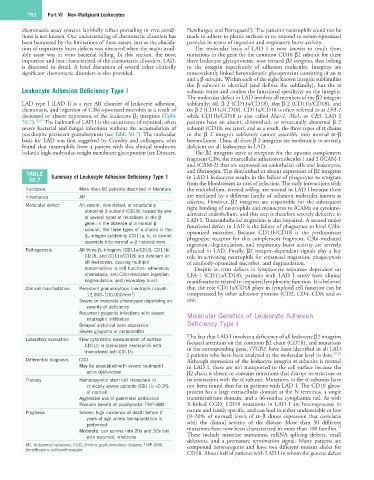
        50.7). 18,19  The hallmark of LAD I is the occurrence of repeated, often   patients  have  an  absent,  diminished,  or  structurally  abnormal  β  2
        severe bacterial and fungal infections without the accumulation of   subunit (CD18; see later), and as a result, the three types of α chains
        pus despite persistent granulocytosis (see Table 50.7). The molecular   in  the  β  2  integrin  subfamily  cannot  assemble  into  normal  α–β
        basis for LAD was first suggested by Crowley and colleagues, who   heterodimers. Thus, all three β 2 integrins are moderately to severely
        found  that  neutrophils  from  a  patient  with  this  clinical  syndrome   deficient on all leukocytes in LAD.
        lacked a high-molecular-weight membrane glycoprotein (see Dinauer,   The β2 integrins serve as receptors for the opsonic complement
                                                              fragment C3bi, the intercellular adhesion molecules 1 and 2 (ICAM-1
                                                              and ICAM-2) that are expressed on endothelial cells and leukocytes,
          TABLE   Summary of Leukocyte Adhesion Deficiency Type 1  and fibrinogen. The diminished or absent expression of β2 integrins
          50.7                                                in LAD I leukocytes results in the failure of phagocytes to emigrate
                                                              from the bloodstream to sites of infection. The early interactions with
         Incidence         More than 60 patients described in literature  the endothelium, termed rolling, are normal in LAD I because these
         Inheritance       AR                                 are mediated by a different family of adhesion molecules known as
                                                              selectins.  However,  β2  integrins  are  responsible  for  the  subsequent
         Molecular defect  An absent, diminished, or structurally   tight binding of neutrophils and monocytes to ICAMs on cytokine-
                             abnormal β subunit (CD18) caused by one   activated endothelium, and this step is therefore severely defective in
                             of several types of mutations in the β   LAD I. Transendothelial migration is also impaired. A second major
                             gene; in the absence of a normal β   functional defect in LAD is the failure of phagocytes to bind C3bi-
                             subunit, the three types of α chains in the   opsonized  microbes.  Because  CD11b/CD18  is  the  predominant
                             β 2  integrin subfamily (CD11a, b, c) cannot   phagocyte  receptor  for  this  complement  fragment,  C3bi-mediated
                             assemble into normal α–β heterodimers
                                                              ingestion, degranulation, and respiratory burst activity are severely
         Pathogenesis      All three β 2  integrins (CD11a/CD18, CD11b/  affected in LAD. Finally, β2 integrin-dependent signals play a key
                             CD18, and CD11c/CD18) are deficient on   role in activating neutrophils for enhanced migration, phagocytosis
                             all leukocytes, causing multiple   of antibody-opsonized microbes, and degranulation.
                             abnormalities in cell function: adherence;   Despite in vitro defects in lymphocyte responses dependent on
                             chemotaxis; and C3bi-mediated ingestion,   LFA-1  (CD11a/CD18),  patients  with  LAD  I  rarely  have  clinical
                             degranulation, and respiratory burst  manifestations related to impaired lymphocyte function. It is believed
         Clinical manifestation  Persistent granulocytosis (neutrophil count:   that the role CD11a/CD18 plays in lymphoid cell function can be
                                            3
                             12,000–100,000/mm )              compensated by other adhesion proteins (CD2, CD4, CD8, and so
                           Severe or moderate phenotypes depending on   on).
                             severity of deficiency
                           Recurrent pyogenic infections with absent   Molecular Genetics of Leukocyte Adhesion
                             neutrophil infiltration
                           Delayed umbilical cord separation  Deficiency Type I
                           Severe gingivitis or periodontitis
                                                              The fact that LAD I involves a deficiency of all leukocyte β2 integrins
         Laboratory evaluation  Flow cytometric measurement of surface   focused attention on the common β2 chain (CD18), and mutations
                             CD11b in stimulated neutrophils with   in the corresponding gene, ITGB2, have been identified in all LAD
                             monoclonal anti-CD11b                                                            18,19
                                                              I patients who have been analyzed at the molecular level to date.
         Differential diagnosis  CGD                          Although expression of the leukocyte integrin α subunits is normal
                           May be associated with severe neutrophil   in LAD I, these are not transported to the cell surface because the
                             actin dysfunction                β2 chain is absent or contains mutations that disrupt its structure or
         Therapy           Hematopoietic stem cell transplant in   its interaction with the α subunit. Mutations in the α subunits have
                             clinically severe patients (CD11b <0.3%   not been found thus far in patients with LAD I. The CD18 glyco-
                             of normal)                       protein has a large extracellular domain at the N terminus, a single
                           Aggressive use of parenteral antibiotics  transmembrane domain, and a 46-residue cytoplasmic tail. As with
                           Possible benefit of prophylactic TMP-SMX  X-linked  CGD,  CD18  mutations  in  LAD  I  are  heterogeneous  in
         Prognosis         Severe: high incidence of death before 2   nature and family specific, and can lead to either undetectable or low
                             years of age unless transplantation is   (9–20%  of normal) levels  of  α–β  dimer  expression that correlates
                             performed                        with  the  clinical  severity  of  the  disease.  More  than  50  different
                                                                                                               18
                           Moderate: can survive into 20s and 30s but   mutations have now been characterized in more than 100 families.
                             with recurrent infections        These  include  missense  mutations,  mRNA  splicing  defects,  small
                                                              deletions,  and  a  premature  termination  signal.  Many  patients  are
         AR, Autosomal recessive; CGD, chronic granulomatous disease; TMP-SMX,   compound heterozygotes and have two different mutant alleles for
         trimethoprim–sulfamethoxazole.
                                                              CD18. About half of patients with LAD I in whom the genetic defect

