


Page 815 - Hematology_ Basic Principles and Practice ( PDFDrive )
P. 815
Chapter 50  Disorders of Phagocyte Function  701


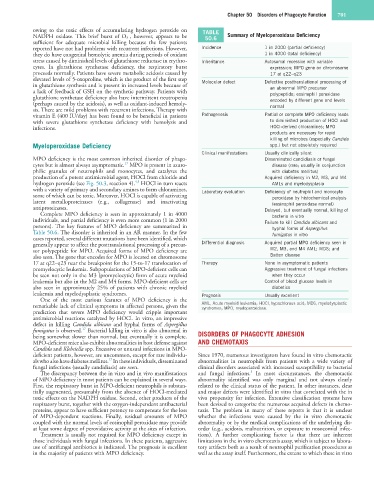
            owing  to  the  toxic  effects  of  accumulating  hydrogen  peroxide  on   TABLE
                                           −
            NADPH  oxidase. This  brief  burst  of  O 2 ,  however,  appears  to  be   50.6  Summary of Myeloperoxidase Deficiency
            sufficient  for  adequate  microbial  killing  because  the  few  patients
            reported have not had problems with recurrent infections. However,   Incidence  1 in 2000 (partial deficiency)
            they do have congenital hemolytic anemia during periods of oxidant          1 in 4000 (total deficiency)
            stress caused by diminished levels of glutathione reductase in erythro-  Inheritance  Autosomal recessive with variable
            cytes.  In  glutathione  synthetase  deficiency,  the  respiratory  burst    expression; MPO gene on chromosome
            proceeds normally. Patients have severe metabolic acidosis caused by         17 at q22−q23
            elevated levels of 5-oxoproline, which is the product of the first step   Molecular defect  Defective posttranslational processing of
            in glutathione synthesis and is present in increased levels because of       an abnormal MPO precursor
            a lack of feedback of GSH on the synthetic pathway. Patients with            polypeptide; eosinophil peroxidase
            glutathione synthetase deficiency also have intermittent neutropenia         encoded by different gene and levels
            (perhaps caused by the acidosis), as well as oxidant-induced hemoly-         normal
            sis. There are mild problems with recurrent infections. Therapy with
            vitamin E (400 IU/day) has been found to be beneficial in patients   Pathogenesis  Partial or complete MPO deficiency leads
            with  severe  glutathione  synthetase  deficiency  with  hemolysis  and      to diminished production of HOCl and
            infections.                                                                  HOCl-derived chloramines; MPO
                                                                                         products are necessary for rapid
                                                                                         killing of microbes (especially Candida
            Myeloperoxidase Deficiency                                                   spp.) but not absolutely required
                                                                   Clinical manifestations  Usually clinically silent
            MPO deficiency is the most common inherited disorder of phago-              Disseminated candidiasis or fungal
                                          17
            cytes but is almost always asymptomatic.  MPO is present in azuro-            disease (rare; usually in conjunction
            philic  granules  of  neutrophils  and  monocytes,  and  catalyzes  the       with diabetes mellitus)
            production of a potent antimicrobial agent, HOCl from chloride and          Acquired deficiency in M2, M3, and M4
                                             4,5
            hydrogen peroxide (see Fig. 50.3, reaction 4).  HOCl in turn reacts           AMLs and myelodysplasia
            with a variety of primary and secondary amines to form chloramines,   Laboratory evaluation  Deficiency of neutrophil and monocyte
            some of which can be toxic. Moreover, HOCl is capable of activating           peroxidase by histochemical analysis
            latent  metalloproteinases  (e.g.,  collagenase)  and  inactivating           (eosinophil peroxidase normal)
            antiproteinases.                                                            Delayed, but eventually normal, killing of
              Complete MPO deficiency is seen in approximately 1 in 4000                  bacteria in vitro
            individuals, and partial deficiency is even more common (1 in 2000          Failure to kill Candida albicans and
            persons). The  key  features  of  MPO  deficiency  are  summarized  in        hyphal forms of Aspergillus
            Table 50.6. The disorder is inherited in an AR manner. In the few             fumigatus in vitro
            cases reported, several different mutations have been identified, which
            generally appear to affect the posttranslational processing of a precur-  Differential diagnosis  Acquired partial MPO deficiency seen in
            sor polypeptide for MPO. Acquired forms of MPO deficiency are                M2, M3, and M4 AML; MDS; and
            also seen. The gene that encodes for MPO is located on chromosome            Batten disease
            17 at q22–q23 near the breakpoint for the 15-to-17 translocation of   Therapy  None in asymptomatic patients
            promyelocytic leukemia. Subpopulations of MPO-deficient cells can           Aggressive treatment of fungal infections
            be seen not only in the M3 (promyelocytic) form of acute myeloid              when they occur
            leukemia but also in the M2 and M4 forms. MPO-deficient cells are           Control of blood glucose levels in
            also  seen  in  approximately  25%  of  patients  with  chronic  myeloid      diabetics
            leukemia and myelodysplastic syndromes.                Prognosis            Usually excellent
              One  of  the  most  curious  features  of  MPO  deficiency  is  the
            remarkable lack of clinical symptoms in affected persons, given the   AML, Acute myeloid leukemia; HOCl, hypochlorous acid; MDS, myelodysplastic
                                                                   syndromes; MPO, myeloperoxidase.
            prediction  that  severe  MPO  deficiency  would  cripple  important
            antimicrobial reactions catalyzed by HOCl. In vitro, an impressive
            defect  in  killing  Candida  albicans  and  hyphal  forms  of  Aspergillus
                            17
            fumigatus is observed.  Bacterial killing in vitro is also abnormal in
            being somewhat slower than normal, but eventually it is complete.   DISORDERS OF PHAGOCYTE ADHESION
            MPO-deficient mice also exhibit abnormalities in host defense against   AND CHEMOTAXIS
            Candida and Klebsiella spp. Excessive or unusual infections in MPO-
            deficient patients, however, are uncommon, except for rare individu-  Since 1970, numerous investigators have found in vitro chemotactic
                                     17
            als who also have diabetes mellitus.  In these individuals, disseminated   abnormalities  in  neutrophils  from  patients  with  a  wide  variety  of
            fungal infections (usually candidiasis) are seen.     clinical disorders associated with increased susceptibility to bacterial
                                                                                   3
              The discrepancy between the in vitro and in vivo manifestations   and  fungal  infections.   In  most  circumstances,  the  chemotactic
            of MPO deficiency in most patients can be explained in several ways.   abnormality  identified  was  only  marginal  and  not  always  clearly
            First, the respiratory burst in MPO-deficient neutrophils is substan-  related to the clinical status of the patient. In other instances, clear
            tially augmented, presumably from the absence of HOCl-mediated   and major defects were identified in vitro that correlated with the in
            toxic effects on the NADPH oxidase. Second, other products of the   vivo  propensity  for  infection.  Extensive  classification  systems  have
            respiratory burst, together with the oxygen-independent antibacterial   been devised to categorize the numerous acquired defects in chemo-
            proteins, appear to have sufficient potency to compensate for the loss   taxis.  The  problem  in  many  of  these  reports  is  that  it  is  unclear
            of  MPO-dependent  reactions.  Finally,  residual  amounts  of  MPO   whether  the  infections  were  caused  by  the  in  vitro  chemotactic
            coupled with the normal levels of eosinophil peroxidase may provide   abnormality or by the medical complications of the underlying dis-
            at least some degree of peroxidative activity at the sites of infection.  order (e.g., acidosis, malnutrition, or exposure to nosocomial infec-
              Treatment is usually not required for MPO deficiency except in   tions).  A  further  complicating  factor  is  that  there  are  inherent
            those individuals with fungal infections. In these patients, aggressive   limitations in the in vitro chemotaxis assay, which is subject to labora-
            use of antifungal antibiotics is indicated. The prognosis is excellent   tory artifacts both as a result of neutrophil purification procedures as
            in the majority of patients with MPO deficiency.      well as the assay itself. Furthermore, the extent to which these in vitro

