


Page 818 - Hematology_ Basic Principles and Practice ( PDFDrive )
P. 818
704    Part VI  Non-Malignant Leukocytes

        Hyperimmunoglobulin E Syndrome                           Most cases of HIES result from inherited or sporadic autosomal
                                                              dominant  (AD)  mutations  in  signal  transducer  and  activator  of
        Hyperimmunoglobulin  E  syndrome  (HIES)  is  a  complex  disorder   transcription 3 (STAT3), a Janus kinase (JAK)-activated transcription
        characterized by markedly elevated serum IgE levels, serious recurrent   factor activated in response to many cytokines and growth factors.
        staphylococcal infections, mucocutaneous candidiasis, chronic derma-  These mutations, which are located primarily in regions of the protein
        titis, and skeletal and dental abnormalities. 20,21  Although not a primary   that interact with other proteins or with DNA, inhibit the activity
        phagocyte defect, neutrophils from patients with this syndrome exhibit   of  the  wild-type  STAT3  allele  and  result  in  a  complex  pattern  of
        a variable and at times profound chemotactic defect. HIES was first   altered cytokine signaling and impaired T helper type 17 (Th17) cell
        described  in  1966  and  was  called  Job  syndrome,  in  reference  to  the   differentiation. Mutations in DOCK8, a guanine nucleotide exchange
        biblical description of Job as being affected by “sore boils from the soles   factor, or TYK2, a JAK family member, result in the more rare AR
        of his feet unto his crown.” The skin abscesses in patients with HIES   forms of HIES that have more profound impairments in lymphocyte
        lack the erythema that is typical of such lesions and are referred to as   function, leading to a broader risk of infection and other immune
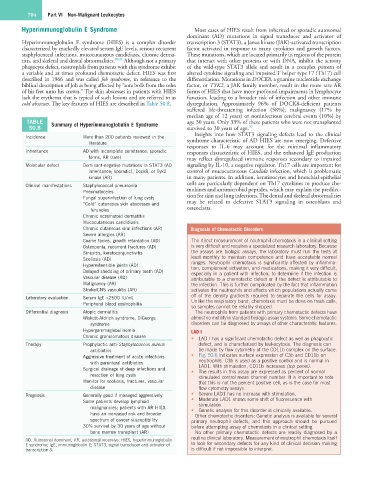
        cold abscesses. The key features of HIES are described in Table 50.8.  dysregulation.  Approximately  96%  of  DOCK8-deficient  patients
                                                              suffered  life-threatening  infection  (58%),  malignancy  (17%  by
                                                              median age of 12 years) or noninfectious cerebral events (10%) by
          TABLE   Summary of Hyperimmunoglobulin E Syndrome   age 30 years. Only 33% of these patients who were not transplanted
          50.8                                                survived to 30 years of age. 20
                                                                 Insights  into  how  STAT3  signaling  defects  lead  to  the  clinical
         Incidence          More than 200 patients reviewed in the   syndrome characteristic of AD HIES are now emerging. Defective
                              literature
                                                              responses  to  IL-6  may  account  for  the  minimal  inflammatory
         Inheritance        AD with incomplete penetrance; sporadic   responses characteristic of HIES, and the enhanced IgE production
                              forms, AR (rare)                may  reflect  dysregulated  immune  responses  secondary  to  impaired
         Molecular defect   Dominant-negative mutations in STAT3 (AD   signaling by IL-10, a negative regulator. Th17 cells are important for
                              inheritance; sporadic), Dock8, or Tyk2   control of mucocutaneous Candida infection, which is problematic
                              kinase (AR)                     in many patients. In addition, keratinocytes and bronchial epithelial
         Clinical manifestations  Staphylococcal pneumonia    cells are particularly dependent on Th17 cytokines to produce che-
                            Pneumatoceles                     mokines and antimicrobial peptides, which may explain the predilec-
                            Fungal superinfection of lung cysts  tion for skin and lung infections. The dental and skeletal abnormalities
                            “Cold” cutaneous skin abscesses and   may  be  related  to  defective  STAT3  signaling  in  osteoblasts  and
                               furuncles                      osteoclasts.
                            Chronic eczematoid dermatitis
                            Mucocutaneous candidiasis
                            Chronic cutaneous viral infections (AR)  Diagnosis of Chemotactic Disorders
                            Severe allergies (AR)
                            Coarse facies, growth retardation (AD)  The direct measurement of neutrophil chemotaxis in a clinical setting
                            Osteopenia, recurrent fractures (AD)  is very difficult and requires a specialized research laboratory. Because
                            Sinusitis, keratoconjunctivitis     the  assays  are  biologic  assays,  the  laboratory  must  run  the  tests  at
                            Scoliosis (AD)                      least  monthly  to  maintain  competence  and  have  acceptable  normal
                                                                ranges.  Neutrophil  chemotaxis  is  significantly  affected  by  inflamma-
                            Hyperextensible joints (AD)         tion, complement activation, and medications, making it very difficult,
                            Delayed shedding of primary teeth (AD)  especially in a patient with infection, to determine if the infection is
                            Vascular disease (AD)               attributable to a chemotactic defect or if the defect is attributable to
                            Malignancy (AR)                     the infection. This is further complicated by the fact that inflammation
                            Stroke/CNS vasculitis (AR)          activates the neutrophils and affects which populations actually come
         Laboratory evaluation  Serum IgE >2500 IU/mL           off  of  the  density  gradients  required  to  separate  the  cells  for  assay.
                                                                Unlike the respiratory burst, chemotaxis must be done on fresh cells,
                            Peripheral blood eosinophilia
                                                                so samples cannot be reliably shipped.
         Differential diagnosis  Atopic dermatitis               The neutrophils from patients with primary chemotactic defects have
                            Wiskott-Aldrich syndrome, DiGeorge   almost no motility in standard biologic assay systems. Some chemotactic
                               syndrome                         disorders can be diagnosed by assays of other characteristic features.
                            Hypergammaglobulinemia              LAD I
                            Chronic granulomatous disease       •  LAD I has a significant chemotactic defect as well as phagocytic
         Therapy            Prophylactic anti-Staphylococcus aureus   defect, and is characterized by leukocytosis. The diagnosis can
                               antibiotics                        be made by flow cytometry of the CD11b complex on the surface.
                            Aggressive treatment of acute infections   •  Fig. 50.6 indicates surface expression of C3b and CD11b on
                               with parenteral antibiotics        neutrophils. C3b is used as a positive control and is normal in
                                                                  LAD1. With stimulation, CD11b increases (top panel).
                            Surgical drainage of deep infections and   •  The results in this assay are expressed as percent of normal
                               resection of lung cysts            stimulated control mean channel number. It is important to note
                            Monitor for scoliosis, fractures, vascular   that this is not the percent positive cell, as is the case for most
                               disease                            flow cytometry assays.
         Prognosis          Generally good if managed aggressively  •  Severe LAD1 has no increase with stimulation.
                            Some patients develop lymphoid      •  Moderate LAD1 shows some shift of fluorescence with
                                                                  stimulation.
                               malignancies; patients with AR HIES   •  Genetic analysis for this disorder is clinically available.
                               have an increased risk and broader   Other chemotactic disorders: Genetic analysis is available for several
                               spectrum of cancer susceptibility  primary  neutrophil  defects,  and  this  approach  should  be  pursued
                            30% survival by 30 years of age without   before attempting assay of chemotaxis in a clinical setting.
                               bone marrow transplant (AR)       No  other  primary  chemotactic  defects  are  readily  diagnosed  by  a
         AD, Autosomal dominant; AR, autosomal recessive; HIES, hyperimmunoglobulin   routine clinical laboratory. Measurement of neutrophil chemotaxis itself
         E syndrome; IgE, immunoglobulin E; STAT3, signal transducer and activator of   to look for secondary defects for any kind of clinical decision making
         transcription 3.                                       is difficult if not impossible to interpret.

