


Page 813 - Hematology_ Basic Principles and Practice ( PDFDrive )
P. 813
Chapter 50  Disorders of Phagocyte Function  699


            these tests performed on appropriately handled blood samples and   likely  because  of  the  effects  of  modifier  genes;  these  patients  may
            by  experienced  laboratories  to  avoid  inconclusive  or  false-normal   warrant more aggressive treatment such as bone marrow transplanta-
            results.                                              tion (BMT; see later).
              Genetic classification is useful primarily for purposes of genetic   Several approaches can be used to prevent infections. Patients with
            counseling  and  prenatal  diagnosis.  With  the  exception  of  classic   CGD  should  receive  all  their  routine  immunizations  on  schedule
            X-linked disease in a male whose mother is a carrier, determining the   (including live virus vaccines), with influenza vaccine administered
            specific oxidase gene affected in a given CGD patient (see Table 50.1)   each year as well. Cuts and skin abrasions should be cleansed promptly
            requires  additional  laboratory  studies.  Genetic  testing  for  the  four   with soap and water and a topical antiseptic applied (2% hydrogen
            most common genetic subgroups is commercially available. Labora-  peroxide, Betadine ointment, or both). Frequent brushing, flossing,
            tories  specializing  in  neutrophil  biochemistry  can  also  perform   use of antibacterial mouthwash, and professional cleaning of teeth
            immunoblot  analysis  of  neutrophil  extracts,  flavocytochrome  b   can help prevent gingivitis. Constipation should be avoided because
            spectroscopy, or functional analysis of membrane and cytosol frac-  it can lead to rectal or anal fissures and abscesses. Early anal infections
            tions in the cell-free oxidase assay. In a male with absent flavocyto-  can be treated with soaking in soapy water (with or without Betadine).
            chrome b without clear evidence for a maternal carrier, it is necessary   The frequency of pulmonary infections can be reduced by not using
            to search for the mutation in both the gp91 phox  and p22 phox  genes by   commercially available bedside humidifiers; avoiding smoking (ciga-
            DNA sequencing or another method of analysis.         rettes and marijuana); and refraining from handling decaying plant
              Testing for the McLeod red cell phenotype should be done in all   materials  (e.g.,  hay,  mulch,  rotting  sawdust),  which  often  contain
            patients diagnosed with X-linked CGD. This causes a mild hemo-  numerous Aspergillus spp. Avoidance of construction sites, especially
            lytic anemia. More importantly, there can be serious problems with   demolition of old buildings that may harbor fungi, is recommended.
            development of hemolytic antibodies if these patients are transfused.  There have been clear outbreaks of Aspergillus pneumonias in immu-
                                                                  nosuppressed children visiting hospitals undergoing renovation.
                                                                    There is clear evidence that chronic prophylactic TMP-SMX can
            Prognosis and Treatment                               decrease the number of bacterial infections in CGD patients by more
                                                                  than half without a concomitant increased risk of fungal infection.
            The cornerstones of therapy in CGD are currently (1) prevention   In  addition,  itraconazole  is  an  effective  agent  for  prophylaxis  for
            and  early  treatment  of  infections,  (2)  aggressive  use  of  parenteral   fungal infections in CGD. Liver function tests should be monitored
            antibiotics for most infections, (3) use of prophylactic TMP-SMX   in patients receiving itraconazole.
            (5 mg/kg/day of trimethoprim) or dicloxacillin (25–50 mg/kg/day)   Prophylactic rIFN-γ has been another mainstay of current man-
                                                                               3,8
            for sulfa-allergic patients, (4) prophylactic itraconazole (200 mg/day   agement of CGD.  The clinical benefit of rIFN-γ is probably related
            if 13 years of age or older or if weighing at least 50 kg, or 100 mg   to generally enhanced phagocyte function and killing by nonoxida-
            daily if younger than 13 years of age or weighing less than 50 kg),   tive mechanisms because its use is not accompanied by any measur-
            and (5) use of prophylactic recombinant human interferon-γ (rIFN-γ;   able improvement in NADPH oxidase activity in the vast majority
                                                 2
                    2
            0.05 mg/m   or  0.0015 mg/kg  if  less  than  0.5 m   three  times  per   of  CGD  patients.  In  the  original  multicenter  trial,  patients  were
                 3,8
            week).  Using these guidelines, the prognosis for patients with CGD   randomized  in  a  double-blind  fashion  to  receive  either  placebo  or
                                                                                2
            has improved dramatically since the disorder was first described in   rIFN-γ (0.05 mg/m  three times per week). As summarized in Table
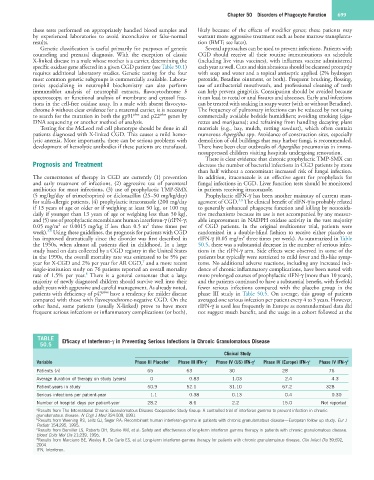
            the  1950s,  when  almost  all  patients  died  in  childhood.  In  a  large   50.5, there was a substantial decrease in the number of serious infec-
            study based on data collected by a CGD registry in the United States   tions in the rIFN-γ arm. Side effects were observed in some of the
            in the 1990s, the overall mortality rate was estimated to be 5% per   patients but typically were restricted to mild fever and flu-like symp-
                                                7
            year for X-CGD and 2% per year for AR CGD,  and a more recent   toms. No additional adverse reactions, including any increased inci-
            single-institution study on 76 patients reported an overall mortality   dence of chronic inflammatory complications, have been noted with
                             8
            rate  of  1.5%  per  year.   There  is  a  general  consensus  that  a  large   more prolonged courses of prophylactic rIFN-γ (more than 10 years),
            majority of newly diagnosed children should survive well into their   and the patients continued to have a substantial benefit, with fivefold
            adult years with aggressive and careful management. As already noted,   fewer  serious  infections  compared  with  the  placebo  group  in  the
            patients with deficiency of p47 phox  have a tendency for milder disease   phase  III  study  in Table  50.5.  On  average,  this  group  of  patients
            compared with those with flavocytochrome-negative CGD. On the   averaged one serious infection per patient every 4 to 5 years. However,
            other  hand,  some  patients  (usually  X-linked)  prove  to  have  more   rIFN-γ is used less frequently in Europe as nonrandomized data did
            frequent serious infections or inflammatory complications (or both),   not suggest much benefit, and the usage in a cohort followed at the

             TABLE   Efficacy of Interferon-γ in Preventing Serious Infections in Chronic Granulomatous Disease
              50.5
                                                                          Clinical Study
             Variable                        Phase III Placebo a  Phase III IFN-γ a  Phase IV (US) IFN-γ b  Phase IV (Europe) IFN-γ c  Phase IV IFN-γ d
             Patients (n)                        65           63            30               28              76
             Average duration of therapy on study (years)  0   0.83          1.03             2.4             4.3
             Patient-years in study              50.9         52.1          31.10            67.2           328
             Serious infections per patient-year  1.1          0.38          0.13             0.4             0.30
             Number of hospital days per patient-year  28.2    8.6           2.2             15.0         Not reported
             a Results from The International Chronic Granulomatous Disease Cooperative Study Group: A controlled trial of interferon gamma to prevent infection in chronic
             granulomatous disease. N Engl J Med 324:509, 1991.
             b Results from Weening RS, Leitz GJ, Seger RA: Recombinant human interferon-gamma in patients with chronic granulomatous disease—European follow up study. Eur J
             Pediatr 154:295, 1995.
             c Results from Bemiller LS, Roberts DH, Starko KM, et al: Safety and effectiveness of long-term interferon gamma therapy in patients with chronic granulomatous disease.
             Blood Cells Mol Dis 21:239, 1995.
             d Results from Marciano BE, Wesley R, De Carlo ES, et al: Long-term interferon-gamma therapy for patients with chronic granulomatous disease. Clin Infect Dis 39:692,
             2004.
             IFN, Interferon.

