


Page 869 - Hematology_ Basic Principles and Practice ( PDFDrive )
P. 869
752    Part VI  Non-Malignant Leukocytes


        the majority of patients recover within 1 to 2 months. Patients usually   Other Organ Involvement
        have a positive direct Coombs test. Most common anti-I antibodies
        are present; however, anti-I, anti-N, and Donath-Landsteiner anti-  Although symptomatic heart disease with IM is uncommon, in one
        bodies have also been reported. In addition to hemolysis, IM-associated   cohort  of  patients,  unspecific  ST-  and  T-wave  abnormalities  were
        anemia can be caused by erythroblastopenia.           found in 6% of patients. Renal involvement manifested as micro-
                                                              scopic hematuria, and proteinuria is seen in 10% to 15% of patients;
        Neutropenia                                           however,  significant  renal  dysfunction  is  rare.  Airway  compromise
        Mild, self-limiting neutropenia is a common finding during the first   due to hypertrophy of the adenoids and tonsils or mucosal inflam-
        4 weeks of the disease. However, severe neutropenia associated with   mation and edema is uncommon but potentially fatal.
        fatal bacterial infections has been reported.
        Thrombocytopenia                                      Diagnosis
                                              3
        Mild  thrombocytopenia  (50,000  to  150,000/mm )  is  a  common
        finding  in  patients  with  IM.  It  usually  occurs  within  the  first  2   Atypical  lymphocytosis  is  the  cardinal  hematologic  finding  in  IM
        weeks  of  presentation  and  resolves  within  2  months.  Severe   (Fig. 54.4). It develops during the first week of the illness and peaks
        thrombocytopenia with overt bleeding is rare; however, death from   between the second and third week. Atypical lymphocytes represent
        intracranial  hemorrhage  has  been  described.  The  etiology  of  the   60%  to  70%  of  the  total  white  cell  count,  which  ranges  between
                                                                       3
                                                                                    3
        thrombocytopenia  is  not  completely  understood,  and  a  variety  of   12,000/mm  and 18,000/mm . In general, the atypical lymphocytes
        explanations have been suggested. Because bone marrow examination   are large and vary in size. Nuclei are large and eccentrically placed;
        shows normal or increased numbers of megakaryocytes, peripheral   the  cytoplasm  is  basophilic,  and  vacuoles  are  often  present.  The
        platelet destruction is most likely due to the presence of antiplatelet   variable morphologic pattern of atypical lymphocytes in IM distin-
        antibodies  or  platelet  pooling  and  destruction  within  an  enlarged    guishes them from the monotonous appearance of immature leukemic
        spleen.                                               blasts. Atypical lymphocytosis is not pathognomonic for IM and is
                                                              associated  with  other  diseases  such  as  acute  viral  hepatitis,  CMV
                                                              infections,  mumps,  toxoplasmosis,  rubella,  roseola,  and  drug
        Splenic Rupture                                       reactions.
                                                                 The diagnosis of EBV infection depends on serologic testing. Tests
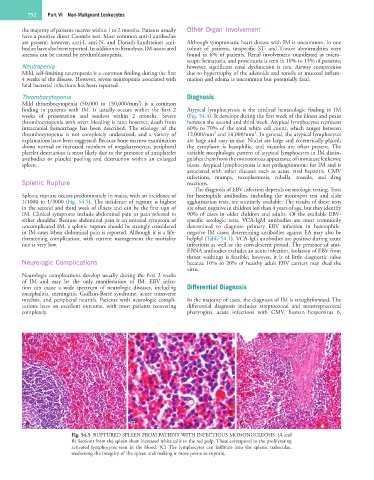
        Splenic rupture occurs predominately in males, with an incidence of   for  heterophile  antibodies,  including  the  monospot  test  and  slide
        1/1000 to 1/3000 (Fig. 54.5). The incidence of rupture is highest   agglutination tests, are routinely available. The results of these tests
        in the second and third week of illness and can be the first sign of   are often negative in children less than 4 years of age, but they identify
        IM. Clinical symptoms include abdominal pain or pain referred to   90%  of  cases  in  older  children  and  adults.  Of  the  available  EBV-
        either shoulder. Because abdominal pain is an unusual symptom of   specific  serologic  tests,  VCA-IgM  antibodies  are  most  commonly
        uncomplicated IM, a splenic rupture should be strongly considered   determined  to  diagnose  primary  EBV  infection  in  heterophile-
        in IM cases when abdominal pain is reported. Although it is a life-  negative IM cases; determining antibodies against EA may also be
        threatening  complication,  with  current  management  the  mortality   helpful (Table 54.1). VCA-IgG antibodies are positive during acute
        rate is very low.                                     infections as well as the convalescent period. The presence of anti-
                                                              EBNA antibodies excludes an acute infection. Isolation of EBV from
                                                              throat  washings  is  feasible;  however,  it  is  of  little  diagnostic  value
        Neurologic Complications                              because 10% to 20% of healthy adult EBV carriers may shed the
                                                              virus.
        Neurologic complications develop usually during the first 2 weeks
        of  IM  and  may  be  the  only  manifestation  of  IM.  EBV  infec-
        tion  can  cause  a  wide  spectrum  of  neurologic  diseases,  including   Differential Diagnosis
        encephalitis,  meningitis,  Guillain-Barré  syndrome,  acute  transverse
        myelitis,  and  peripheral  neuritis.  Patients  with  neurologic  compli-  In the majority of cases, the diagnosis of IM is straightforward. The
        cations  have  an  excellent  outcome,  with  most  patients  recovering     differential  diagnosis  includes  streptococcal  and  nonstreptococcal
        completely.                                           pharyngitis,  acute  infections  with  CMV,  human  herpesvirus  6,


         A                                  B                                  C
                        Fig. 54.5  RUPTURED SPLEEN FROM PATIENT WITH INFECTIOUS MONONUCLEOSIS. (A and
                        B) Sections from the spleen show increased white cells in the red pulp. These correspond to the proliferating
                        activated  lymphocytes  seen  in  the  blood.  (C) The  lymphocytes  can  infiltrate  into  the  splenic  trabeculae,
                        weakening the integrity of the spleen and making it more prone to rupture.

