


Page 868 - Hematology_ Basic Principles and Practice ( PDFDrive )
P. 868
Chapter 54  Infectious Mononucleosis and Other Epstein-Barr Virus–Associated Diseases  751


            administration was safe, no data are available if the vaccine boosted   Complications of Primary Epstein-Barr Virus Infections
            LMP2-specific T-cell responses.
                                                                  The incidence of complications associated with primary EBV infec-
                                                                  tion is low, although any organ system can be affected.
            INFECTIOUS MONONUCLEOSIS

            Epidemiology                                          Hematologic Complications

            EBV infections occur worldwide and in most populations 90% to   Patients  with  IM  may  present  with  a  wide  range  of  hematologic
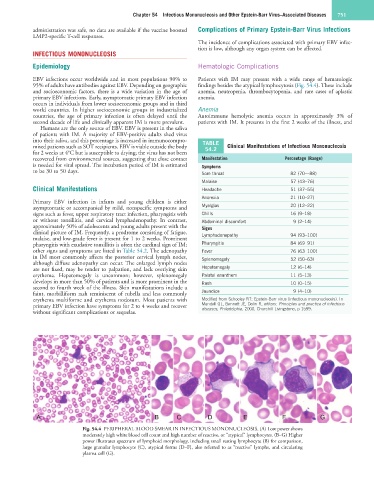
            95% of adults have antibodies against EBV. Depending on geographic   findings besides the atypical lymphocytosis (Fig. 54.4). These include
            and  socioeconomic  factors,  there  is  a  wide  variation  in  the  age  of   anemia,  neutropenia,  thrombocytopenia,  and  rare  cases  of  aplastic
            primary EBV infections. Early, asymptomatic primary EBV infection   anemia.
            occurs in individuals from lower socioeconomic groups and in third
            world  countries.  In  higher  socioeconomic  groups  in  industrialized   Anemia
            countries,  the  age  of  primary  infection  is  often  delayed  until  the   Autoimmune  hemolytic  anemia  occurs  in  approximately  3%  of
            second decade of life and clinically apparent IM is more prevalent.  patients with IM. It presents in the first 2 weeks of the illness, and
              Humans are the only source of EBV. EBV is present in the saliva
            of patients with IM. A majority of EBV-positive adults shed virus
            into their saliva, and this percentage is increased in immunocompro-  TABLE
            mised patients such as SOT recipients. EBV is viable outside the body   54.2  Clinical Manifestations of Infectious Mononucleosis
            for 2 weeks at 4°C but is susceptible to drying; the virus has not been
            recovered from environmental sources, suggesting that close contact   Manifestation  Percentage (Range)
            is needed for viral spread. The incubation period of IM is estimated   Symptoms
            to be 30 to 50 days.                                   Sore throat                  82 (70––88)
                                                                   Malaise                      57 (43–76)
            Clinical Manifestations                                Headache                     51 (37–55)
                                                                   Anorexia                     21 (10–27)
            Primary  EBV  infection  in  infants  and  young  children  is  either
            asymptomatic or accompanied by mild, nonspecific symptoms and   Myalgias            20 (12–22)
            signs such as fever, upper respiratory tract infection, pharyngitis with   Chills   16 (9–18)
            or  without  tonsillitis,  and  cervical  lymphadenopathy.  In  contrast,   Abdominal discomfort  9 (2–14)
            approximately 50% of adolescents and young adults present with the   Signs
            clinical picture of IM. Frequently, a prodrome consisting of fatigue,   Lymphadenopathy  94 (93–100)
            malaise, and low-grade fever is present for 1 to 2 weeks. Prominent
            pharyngitis with exudative tonsillitis is often the cardinal sign of IM;   Pharyngitis  84 (69–91)
            other signs and symptoms are listed in Table 54.2. The adenopathy   Fever           76 (63–100)
            in IM most commonly affects the posterior cervical lymph nodes,   Splenomegaly      52 (50–63)
            although diffuse adenopathy can occur. The enlarged lymph nodes
            are not fixed, may be tender to palpation, and lack overlying skin   Hepatomegaly   12 (6–14)
            erythema.  Hepatomegaly  is  uncommon;  however,  splenomegaly   Palatal enanthem   11 (5–13)
            develops in more than 50% of patients and is more prominent in the   Rash           10 (0–15)
            second to fourth week of the illness. Skin manifestations include a
            faint, morbilliform rash reminiscent of rubella and less commonly   Jaundice         9 (4–10)
            erythema  multiforme  and  erythema  nodosum.  Most  patients  with   Modified from Schooley RT: Epstein-Barr virus (infectious mononucleosis). In
            primary EBV infection have symptoms for 2 to 4 weeks and recover   Mandell GL, Bennett JE, Dolin R, editors: Principles and practice of infectious
                                                                   diseases, Philadelphia, 2000, Churchill Livingstone, p 1599.
            without significant complications or sequelae.


             A                                      B      C         D           E           F            G

                            Fig. 54.4  PERIPHERAL BLOOD SMEAR IN INFECTIOUS MONONUCLEOSIS. (A) Low power shows
                            moderately high white blood cell count and high number of reactive, or “atypical” lymphocytes. (B–G) Higher
                            power illustrates spectrum of lymphoid morphology, including small resting lymphocyte (B) for comparison,
                            large granular lymphocyte (C), atypical forms (D–F), also referred to as “reactive” lymphs, and circulating
                            plasma cell (G).

