


Page 872 - Hematology_ Basic Principles and Practice ( PDFDrive )
P. 872
Chapter 54  Infectious Mononucleosis and Other Epstein-Barr Virus–Associated Diseases  755


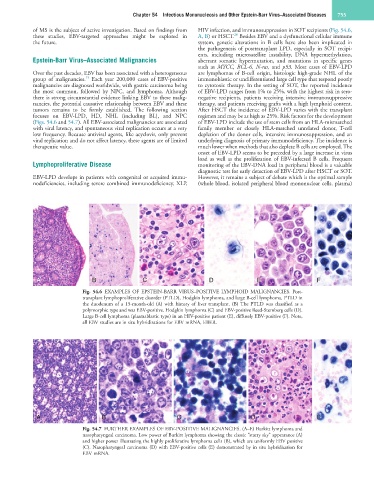
            of MS is the subject of active investigation. Based on findings from   HIV infection, and immunosuppression in SOT recipients (Fig. 54.6,
                                                                              20
            these  studies,  EBV-targeted  approaches  might  be  explored  in    A, B) or HSCT.  Besides EBV and a dysfunctional cellular immune
            the future.                                           system,  genetic  alterations  in  B  cells  have  also  been  implicated  in
                                                                  the  pathogenesis  of  posttransplant  LPD,  especially  in  SOT  recipi-
                                                                  ents,  including  microsatellite  instability,  DNA  hypermethylation,
            Epstein-Barr Virus–Associated Malignancies            aberrant  somatic  hypermutation,  and  mutations  in  specific  genes
                                                                  such  as  MYCC,  BCL-6,  N-ras,  and  p53.  Most  cases  of  EBV-LPD
            Over the past decades, EBV has been associated with a heterogeneous   are lymphomas of B-cell origin, histologic high-grade NHL of the
                             15
            group  of  malignancies.   Each  year  200,000  cases  of  EBV-positive   immunoblastic or undifferentiated large cell type that respond poorly
            malignancies are diagnosed worldwide, with gastric carcinoma being   to cytotoxic therapy. In the setting of SOT, the reported incidence
            the  most  common,  followed  by  NPC,  and  lymphoma.  Although   of EBV-LPD ranges from 1% to 25%, with the highest risk in sero-
            there is strong circumstantial evidence linking EBV to these malig-  negative recipients, patients receiving intensive immunosuppressive
            nancies, the potential causative relationship between EBV and these   therapy, and patients receiving grafts with a high lymphoid content.
            tumors  remains  to  be  firmly  established.  The  following  section   After HSCT the incidence of EBV-LPD varies with the transplant
            focuses  on  EBV-LPD,  HD,  NHL  (including  BL),  and  NPC    regimen and may be as high as 25%. Risk factors for the development
            (Figs. 54.6 and 54.7). All EBV-associated malignancies are associated   of EBV-LPD include the use of stem cells from an HLA-mismatched
            with viral latency, and spontaneous viral replication occurs at a very   family  member  or  closely  HLA-matched  unrelated  donor,  T-cell
            low frequency. Because antiviral agents, like acyclovir, only prevent   depletion of the donor cells, intensive immunosuppression, and an
            viral replication and do not affect latency, these agents are of limited   underlying diagnosis of primary immunodeficiency. The incidence is
            therapeutic value.                                    much lower when methods that also deplete B cells are employed. The
                                                                  onset of EBV-LPD seems to be preceded by a large increase in virus
                                                                  load as well as the proliferation of EBV-infected B cells. Frequent
            Lymphoproliferative Disease                           monitoring of the EBV-DNA load in peripheral blood is a valuable
                                                                  diagnostic test for early detection of EBV-LPD after HSCT or SOT.
            EBV-LPD develops in patients with congenital or acquired immu-  However, it remains a subject of debate which is the optimal sample
            nodeficiencies, including severe combined immunodeficiency, XLP,   (whole blood, isolated peripheral blood mononuclear cells, plasma)


             A                 B                C                    D               E                   F

                            Fig. 54.6  EXAMPLES OF EPSTEIN-BARR VIRUS–POSITIVE LYMPHOID MALIGNANCIES. Post-
                            transplant lymphoproliferative disorder (PTLD), Hodgkin lymphoma, and large B-cell lymphoma. PTLD in
                            the duodenum of a 15-month-old (A) with history of liver transplant. (B) The PTLD was classified as a
                            polymorphic type and was EBV-positive. Hodgkin lymphoma (C) and EBV-positive Reed-Sternberg cells (D).
                            Large B-cell lymphoma (plasmablastic type) in an HIV-positive patient (E), diffusely EBV-positive (F). Note,
                            all EBV studies are in situ hybridizations for EBV mRNA, EBER.


                                                              G


             A                    B                        C                       D                     E

                            Fig. 54.7  FURTHER EXAMPLES OF EBV-POSITIVE MALIGNANCIES. (A–E) Burkitt lymphoma and
                            nasopharyngeal carcinoma. Low power of Burkitt lymphoma showing the classic “starry sky” appearance (A)
                            and higher power illustrating the highly proliferative lymphoma cells (B), which are uniformly EBV positive
                            (C). Nasopharyngeal carcinoma (D) with EBV-positive cells (E) demonstrated by in situ hybridization for
                            EBV mRNA.

