


Page 871 - Hematology_ Basic Principles and Practice ( PDFDrive )
P. 871
754    Part VI  Non-Malignant Leukocytes


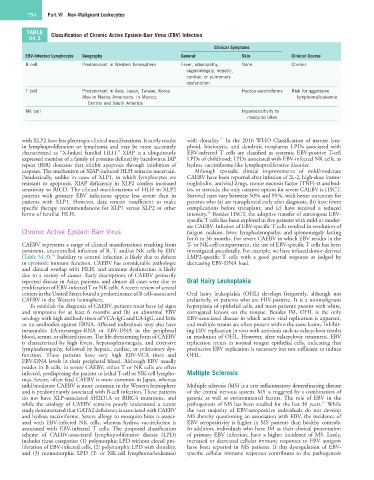
          TABLE   Classification of Chronic Active Epstein-Barr Virus (EBV) Infection
          54.3
                                                                       Clinical Symptoms
         EBV-Infected Lymphocyte  Geography                 General             Skin            Clinical Course
         B cell             Predominant in Western hemisphere  Fever, adenopathy,   None        Chronic
                                                              organomegaly, hepatic,
                                                              cardiac, or pulmonary
                                                              dysfunction
         T cell             Predominant in Asia: Japan, Taiwan, Korea           Hydroa vacciniforme  Risk for aggressive
                            Also in Native Americans: in Mexico,                                  lymphoma/leukemia
                              Central and South America
         NK cell                                                                Hypersensitivity to
                                                                                  mosquito bites


                                                                         17
        with XLP2 have less pleotropic clinical manifestations. It rarely results   with  clonality.   In  the  2016 WHO  Classification  of  mature  lym-
        in lymphoproliferation or lymphoma and may be more accurately   phoid,  histiocytic,  and  dendritic  neoplasms  LPDs  associated  with
        characterized  as  “X-linked  familial  HLH.”  XIAP  is  a  ubiquitously   EBV-infected T  cells  are  classified  as  systemic  EBV-positive T-cell
        expressed member of a family of proteins defined by baculovirus IAP   LPDs of childhood; LPDs associated with EBV-infected NK cells, as
        repeat (BIR) domains that inhibit apoptosis through inhibition of   hydroa vacciniforme-like lymphoproliferative disorder.
        caspases. The mechanism of XIAP-induced HLH remains uncertain.   Although  sporadic  clinical  improvements  of  mild/moderate
        Paradoxically,  unlike  in  cases  of  XLP1,  in  which  lymphocytes  are   CAEBV have been reported after infusion of IL-2, high-dose immu-
        resistant  to  apoptosis,  XIAP  deficiency  in  XLP2  confers  increased   noglobulin, antiviral drugs, tumor necrosis factor (TNF)-α antibod-
        sensitivity to RICD. The clinical manifestations of HLH in XLP2   ies, or steroids, the only curative option for severe CAEBV is HSCT.
        patients  with  primary  EBV  infections  appear  less  severe  than  in   Survival rates vary between 50% and 95%, with better outcomes for
        patients  with  XLP1.  However,  data  remain  insufficient  to  make   patients who (a) are transplanted early after diagnosis, (b) have fewer
        specific therapy recommendations for XLP1 versus XLP2 or other   complications  before  transplant,  and  (c)  have  received  a  reduced
                                                                     18
        forms of familial HLH.                                intensity.  Besides HSCT, the adoptive transfer of autologous EBV-
                                                              specific T cells has been explored in five patients with mild or moder-
                                                              ate CAEBV. Infusion of EBV-specific T cells resulted in resolution of
        Chronic Active Epstein-Barr Virus                     fatigue, malaise, fever, lymphadenopathy, and splenomegaly lasting
                                                              for 6 to 36 months. For severe CAEBV in which EBV resides in the
        CAEBV represents a range of clinical manifestations resulting from   T- or NK-cell compartment, the use of EBV-specific T cells has been
        persistent, uncontrolled infection of B, T, and/or NK cells by EBV   investigated anecdotally. For example, we have infused donor-derived
                  16
        (Table 54.3).  Inability to control infection is likely due to defects   LMP2-specific  T  cells  with  a  good  partial  response  as  judged  by
        in cytotoxic immune function. CAEBV has considerable pathologic   decreasing EBV-DNA load.
        and clinical overlap with HLH, and immune dysfunction is likely
        due to a variety of causes. Early descriptions of CAEBV primarily
        reported disease in Asian patients, and almost all cases were due to   Oral Hairy Leukoplakia
        proliferation of EBV-infected T or NK cells. A recent review of several
        centers in the United States found a predominance of B cell–associated   Oral  hairy  leukoplakia  (OHL)  develops  frequently,  although  not
        CAEBV in the Western hemisphere.                      exclusively, in patients who are HIV-positive. It is a nonmalignant
           To establish the diagnosis of CAEBV, patients must have (a) signs   hyperplasia of epithelial cells, and most patients present with white,
        and  symptoms  for  at  least  6  months  and  (b)  an  abnormal  EBV   corrugated  lesions  on  the  tongue.  Besides  IM,  OHL  is  the  only
        serology with high antibody titers of VCA-IgG and EA-IgG, and little   EBV-associated disease in which active viral replication is apparent,
        or no antibodies against EBNA. Affected individuals may also have   and multiple strains are often present within the same lesion. Inhibit-
        measurable  EA-messenger-RNA  or  EBV-DNA  in  the  peripheral   ing EBV replication in vivo with antivirals such as valacyclovir results
        blood, serum, or affected tissues. The life-threatening form of CAEBV   in resolution of OHL. However, after valacyclovir treatment, EBV
        is  characterized  by  high  fevers,  hepatosplenomegaly,  and  extensive   replication recurs in normal tongue epithelial cells, indicating that
        lymphadenopathy, followed by hepatic, cardiac, or pulmonary dys-  productive EBV replication is necessary but not sufficient to induce
        function.  These  patients  have  very  high  EBV-VCA  titers  and   OHL.
        EBV-DNA levels in their peripheral blood. Although EBV usually
        resides in B cells, in severe CAEBV, either T or NK cells are often
        infected, predisposing the patient to lethal T-cell or NK-cell lympho-  Multiple Sclerosis
        mas. Severe, often fatal CAEBV is more common in Japan, whereas
        mild/moderate CAEBV is more common in the Western hemisphere   Multiple sclerosis (MS) is a rare inflammatory demyelinating disease
        and is predominantly associated with B-cell infection. These patients   of the central nervous system. MS is triggered by a combination of
        do  not  have  XLP-associated  SH2D1A  or  BIRC4  mutations,  and   genetic  as  well  as  environmental  factors. The  role  of  EBV  in  the
                                                                                                          19
        while the etiology of CAEBV remains poorly understood a recent   pathogenesis of MS has been studied for the last 30 years.  While
        study demonstrated that GATA2 deficiency is associated with CAEBV   the  vast  majority  of  EBV-seropositive  individuals  do  not  develop
        and hydroa vacciniforme. Severe allergy to mosquito bites is associ-  MS thereby questioning an association with EBV, the incidence of
        ated  with  EBV-infected  NK  cells,  whereas  hydroa  vacciniforme  is   EBV seropositivity is higher in MS patients than healthy controls.
        associated  with  EBV-infected  T  cells.  The  proposed  classification   In addition, individuals who have IM as their clinical presentation
        scheme  of  CAEBV-associated  lymphoproliferative  disease  (LPD)   of  primary  EBV  infection, have  a  higher  incidence  of  MS. Lastly,
        includes three categories: (1) polymorphic LPD without clonal pro-  increased or decreased cellular immune responses to EBV antigens
        liferation of EBV-infected cells, (2) polymorphic LPD with clonality,   have  been  reported  in  MS  patients.  If  this  dysregulation  of  EBV-
        and  (3)  monomorphic  LPD  (T-  or  NK-cell  lymphoma/leukemia)   specific  cellular  immune  responses  contributes  to  the  pathogenesis

