


Page 888 - Hematology_ Basic Principles and Practice ( PDFDrive )
P. 888
Chapter 55  Progress in the Classification of Hematopoietic and Lymphoid Neoplasms  771


            overexpression. Patients with dual overexpression of MYC and BCL2   Peripheral T-Cell Lymphoma
            have  a  significantly  poorer  outcome  compared  with  patients  who
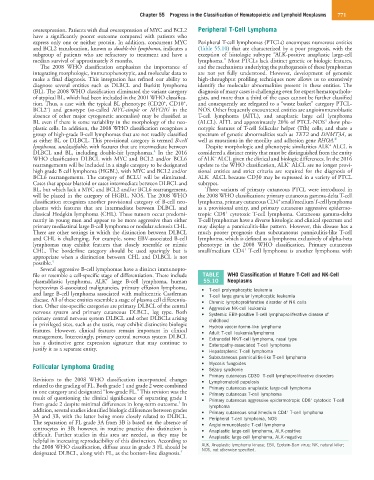
            express only one or neither protein. In addition, concurrent MYC   Peripheral T-cell lymphomas (PTCLs) encompass numerous entities
            and BCL2 translocation, known as double-hit lymphoma, indicates a   (Table 55.10) that are characterized by a poor prognosis, with the
            subgroup  of  patients  who  are  refractory  to  treatment  and  have  a   exception  of  histologic  subtype  “ALK-positive  anaplastic  large-cell
            median survival of approximately 8 months.            lymphoma.” Most PTCLs lack distinct genetic or biologic features,
              The  2008  WHO  classification  emphasizes  the  importance  of   and the mechanisms underlying the pathogenesis of these lymphomas
            integrating morphologic, immunophenotypic, and molecular data to   are  not  yet  fully  understood.  However,  development  of  genomic
            make  a  final  diagnosis. This  integration  has  refined  our  ability  to   high-throughput  profiling  techniques  now  allows  us  to  extensively
            diagnose  several  entities  such  as  DLBCL  and  Burkitt  lymphoma   identify  the  molecular  abnormalities  present  in  these  entities. The
            (BL). The 2008 WHO classification eliminated the variant category   diagnosis of many cases is challenging even for expert hematopatholo-
            of atypical BL, which had been included in the 2001 WHO classifica-  gists, and more than a third of the cases cannot be further classified
                                                       +
                                                             +
            tion. Thus, a case with the typical BL phenotype (CD20 , CD10 ,   and consequently are relegated to a “waste basket” category PTCL-
                −
            BCL2 )  and  genotype  (so-called  MYC-simple  or  MYC/IG  in  the   NOS. Other frequently encountered entities are angioimmunoblastic
            absence of other major cytogenetic anomalies) may be classified as   T-cell  lymphoma  (AITL),  and  anaplastic  large  cell  lymphoma
                                                                                                           4
            BL even if there is some variability in the morphology of the neo-  (ALCL). AITL and approximately 20% of PTCL-NOS  show phe-
            plastic cells. In addition, the 2008 WHO classification recognizes a   notypic  features  of T-cell  follicular  helper  (Tfh)  cells;  and  share  a
            group of high-grade B-cell lymphomas that are not readily classified   spectrum of genetic abnormalities such as TET2 and DNMT3A, as
            as either BL or DLBCL. This provisional category is termed B-cell   well as mutations in the motility and adhesion gene RHOA. 41
                                                                                                             +
            lymphoma, unclassifiable, with features that are intermediate between   Despite morphologic and phenotypic similarities ALK  ALCL is
                                                   4
            DLBCL  and  BL,  including  double-hit  lymphomas.   In  the  2016   considered a distinct entity that must be distinguished from the entity
                                                                       −
            WHO  classification  DLBCL  with  MYC  and  BCL2  and/or  BCL6   of ALK  ALCL given the clinical and biologic differences. In the 2016
                                                                                               −
            rearrangements will be included in a single category to be designated   update to the WHO classification, ALK  ALCL are no longer provi-
            high grade B cell lymphoma (HGBL), with MYC and BCL2 and/or   sional  entities  and  strict  criteria  are  required  for  the  diagnosis  of
                                                                     −
            BCL6  rearrangements. The  category  of  BCLU  will  be  eliminated.   ALK  ALCL because CD30 may be expressed in a variety of PTCL
            Cases that appear blastoid or cases intermediate between DLBCL and   subtypes.
            BL, but which lack a MYC and BCL2 and/or BCL6 rearrangement,   Three variants of primary cutaneous PTCL were introduced in
            will be placed  in  the  category of HGBL,  NOS. The  2008 WHO   the 2008 WHO classification; primary cutaneous gamma-delta T-cell
                                                                                            +
            classification recognizes another provisional category of B-cell neo-  lymphoma, primary cutaneous CD4  small/medium T-cell lymphoma
            plasms  with  features  that  are  intermediate  between  DLBCL  and   as a provisional entity, and primary cutaneous aggressive epidermo-
                                                                           +
            classical Hodgkin lymphoma (CHL). These tumors occur predomi-  tropic  CD8   cytotoxic  T-cell  lymphoma.  Cutaneous  gamma-delta
            nantly in young men and appear to be more aggressive than either   T-cell lymphomas have a diverse histologic and clinical spectrum and
            primary mediastinal large B-cell lymphoma or nodular sclerosis CHL.   may display a panniculitis-like pattern. However, this disease has a
            There are other settings in which the distinction between DLBCL   much  poorer  prognosis  than  subcutaneous  panniculitis-like  T-cell
            and CHL is challenging. For example, some EBV-associated B-cell   lymphoma, which is defined as a lymphoma exclusively of alpha-beta
            lymphomas  may  exhibit  features  that  closely  resemble  or  mimic   phenotype  in  the  2008  WHO  classification.  Primary  cutaneous
                                                                                 +
            CHL.  The  borderline  category  should  be  used  sparingly  but  is   small/medium  CD4  T-cell  lymphoma  is  another  lymphoma  with
            appropriate  when  a  distinction  between  CHL  and  DLBCL  is  not
            possible. 4
              Several aggressive B-cell lymphomas have a distinct immunopro-
            file or resemble a cell-specific stage of differentiation. These include   TABLE   WHO Classification of Mature T-Cell and NK-Cell
                                    +
            plasmablastic  lymphoma,  ALK   large  B-cell  lymphoma,  human   55.10  Neoplasms
            herpesvirus 8-associated malignancies, primary effusion lymphoma,   •  T-cell prolymphocytic leukemia
            and large B-cell lymphoma associated with multicentric Castleman   •  T-cell large granular lymphocytic leukemia
            disease. All of these entities resemble a stage of plasma cell differentia-  •  Chronic lymphoproliferative disorder of NK cells
            tion. Other site-specific categories are primary DLBCL of the central   •  Aggressive NK-cell leukemia
            nervous  system  and  primary  cutaneous  DLBCL,  leg  type.  Both   •  Systemic EBV-positive T-cell lymphoproliferative disease of
            primary central nervous system DLBCL and other DLBCLs arising   childhood
            in privileged sites, such as the testis, may exhibit distinctive biologic   •  Hydroa vacciniforme-like lymphoma
            features.  However,  clinical  features  remain  important  in  clinical   •  Adult T-cell leukemia/lymphoma
            management. Interestingly, primary central nervous system DLBCL   •  Extranodal NK/T-cell lymphoma, nasal type
            has  a  distinctive  gene  expression  signature  that  may  continue  to   •  Enteropathy-associated T-cell lymphoma
            justify it as a separate entity.                       •  Hepatosplenic T-cell lymphoma
                                                                   •  Subcutaneous panniculitis-like T-cell lymphoma
            Follicular Lymphoma Grading                            •  Mycosis fungoides
                                                                   •  Sézary syndrome
                                                                   •  Primary cutaneous CD30  T-cell lymphoproliferative disorders
                                                                                      −
            Revisions  to  the  2008  WHO  classification  incorporated  changes   •  Lymphomatoid papulosis
            related to the grading of FL. Both grade 1 and grade 2 were combined   •  Primary cutaneous anaplastic large-cell lymphoma
            in one category and designated “low-grade FL.” This revision was the   •  Primary cutaneous T-cell lymphoma
            result of questioning the clinical significance of separating grade 1   •  Primary cutaneous aggressive epidermotropic CD8  cytotoxic T-cell
                                                                                                       +
                                                           4
            from grade 2 despite minimal differences in long-term outcome.  In   lymphoma
            addition, several studies identified biologic differences between grades   •  Primary cutaneous small/medium CD4  T-cell lymphoma
                                                                                               +
            3A and 3B, with the latter being more closely related to DLBCL.   •  Peripheral T-cell lymphoma, NOS
            The separation of FL grade 3A from 3B is based on the absence of   •  Angioimmunoblastic T-cell lymphoma
            centrocytes  in  3B;  however,  in  routine  practice  this  distinction  is   •  Anaplastic large-cell lymphoma, ALK-positive
            difficult.  Further  studies  in  this  area  are  needed,  as  they  may  be   •  Anaplastic large-cell lymphoma, ALK-negative
            helpful in increasing reproducibility of this distinction. According to
            the 2008 WHO classification, diffuse areas in grade 3 FL should be   ALK, Anaplastic lymphoma kinase; EBV, Epstein-Barr virus; NK, natural killer;
                                                                   NOS, not otherwise specified.
            designated DLBCL, along with FL, as the bottom-line diagnosis. 4

