


Page 889 - Hematology_ Basic Principles and Practice ( PDFDrive )
P. 889
772    Part VII  Hematologic Malignancies


        Tfh cell origin that presents commonly as an isolated lesion in the   TABLE   WHO Classification of Histiocytic and Dendritic Cell
                        42
        head and neck region.  In the 2016 WHO classification a change in   55.11  Neoplasms
        the  terminology  of  this  entity  is  proposed—to  primary  cutaneous
                       +
        small/medium  CD4   T-cell  lymphoproliferative  disease  instead  of   •  Histiocytic sarcoma
        lymphoma.                                              •  Langerhans cell histiocytosis
           The  2008  WHO  classification  acknowledged  that  a  variety  of   •  Langerhans cell sarcoma
        PTCLs can present with intestinal disease and that not all of these   •  Interdigitating dendritic cell sarcoma
        cases are associated with celiac disease. Intestinal involvement can be   •  Follicular dendritic cell sarcoma
        seen at presentation, and/or with progression, in extranodal NK/T-  •  Fibroblastic reticular cell tumor
        cell lymphoma as well as in some gamma-delta T-cell lymphomas.   •  Intermediate dendritic cell tumor
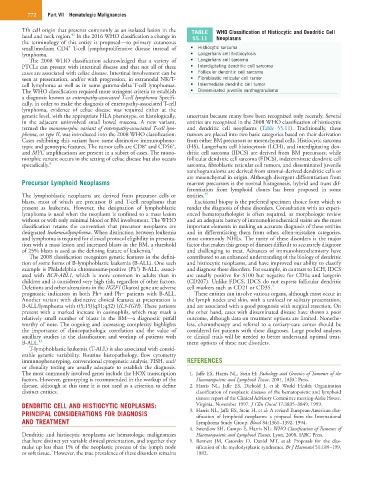
        The WHO classification required more stringent criteria to establish   •  Disseminated juvenile xanthogranuloma
        a diagnosis known as enteropathy-associated T-cell lymphoma Specifi-
        cally, in order to make the diagnosis of enteropathy-associated T-cell
        lymphoma,  evidence  of  celiac  disease  was  required  either  at  the
        genetic level, with the appropriate HLA phenotype, or histologically,   uncertain because many have been recognized only recently. Several
        in  the  adjacent  uninvolved  small  bowel  mucosa.  A  new  variant,   entities are recognized in the 2008 WHO classification of histiocytic
        termed the monomorphic variant of enteropathy-associated T-cell lym-  and  dendritic  cell  neoplasms  (Table  55.11).  Traditionally,  these
        phoma, or type II, was introduced into the 2008 WHO classification.   tumors are placed into two basic categories based on their derivation
        Cases exhibiting this variant have some distinctive immunopheno-  from either BM precursors or mesenchymal cells. Histiocytic sarcoma
                                                +
                                                         +
        typic and genotypic features. The tumor cells are CD8  and CD56 ,   (HS), Langerhans cell histiocytosis (LCH), and interdigitating den-
        and MYC amplifications are present in a subset of cases. The mono-  dritic cell sarcoma (IDCS) are derived from BM precursors; while
        morphic variant occurs in the setting of celiac disease but also occurs   follicular dendritic cell sarcoma (FDCS), indeterminate dendritic cell
        sporadically. 4                                       sarcoma, fibroblastic reticular cell tumors, and disseminated juvenile
                                                              xanthogranuloma are derived from stromal-derived dendritic cells or
                                                              are mesenchymal in origin. Although divergent differentiation from
        Precursor Lymphoid Neoplasms                          marrow precursors is the normal histogenesis, hybrid and trans dif-
                                                              ferentiation  from  lymphoid  clones  has  been  proposed  in  some
        The  lymphoblastic  neoplasms  are  derived  from  precursor  cells  or   entities. 39
        blasts,  most  of  which  are  precursor  B  and  T-cell  neoplasms  that   Excisional biopsy is the preferred specimen choice from which to
        present  as  leukemia.  However,  the  designation  of  lymphoblastic   render the diagnosis of these disorders. Consultation with an experi-
        lymphoma is used when the neoplasm is confined to a mass lesion   enced  hematopathologist  is  often  required,  as  morphologic  review
        without or with only minimal blood or BM involvement. The WHO   and an adequate battery of immunohistochemical stains are the most
        classification  retains  the  convention  that  precursor  neoplasms  are   important elements in making an accurate diagnosis of these entities
        designated leukemia/lymphoma. When distinction between leukemia   and  in  differentiating  them  from  other,  often-mistaken  categories,
        and lymphoma is required for clinical protocol eligibility in presenta-  most commonly NHLs. The rarity of these disorders is the major
        tion with a mass lesion and increased blasts in the BM, a threshold   factor that makes this group of diseases difficult to accurately diagnose
        of 25% blasts is used as the defining feature of leukemia. 4  and challenging to treat. Advances of immunohistochemistry have
           The 2008 classification recognizes genetic features in the defini-  contributed to an enhanced understanding of the biology of dendritic
        tion of some forms of B-lymphoblastic leukemia (B-ALL). One such   and histiocytic neoplasms, and have improved our ability to classify
                                              +
        example is Philadelphia chromosome-positive (Ph ) B-ALL, associ-  and diagnose these disorders. For example, in contrast to LCH, IDCS
        ated  with  BCR-ABL1,  which  is  more  common  in  adults  than  in   are  usually  positive  for  S100  but  negative  for  CD1a  and  langerin
        children and is considered very high risk, regardless of other factors.   (CD207). Unlike FDCS, IDCS do not express follicular dendritic
        Deletions and other alterations in the IKZF1 (Ikaros) gene are adverse   cell markers such as CD21 or CD35. 4
        prognostic  indicators  in  both  Ph+  and  Ph−  patients  with  B-ALL.   These entities can involve various organs, although most occur in
        Another  variant  with  distinctive  clinical  features  at  presentation  is   the lymph nodes and skin, with a unifocal or solitary presentation,
        B-ALL/lymphoma with t(5;15)(q31;q32) (IL3-IGH). These patients   and are associated with a good prognosis with surgical resection. On
        present with a marked increase in eosinophils, which may mask a   the other hand, cases with disseminated disease have shown a poor
        relatively  small  number  of  blasts  in  the  BM—a  diagnostic  pitfall   outcome, although data on treatment options are limited. Nonethe-
        worthy of note. The ongoing and increasing complexity highlights   less,  chemotherapy  and  referral  to  a  tertiary-care  center  should  be
        the  importance  of  clinicopathologic  correlation  and  the  value  of   considered for patients with these diagnoses. Large pooled analyses
        ancillary  studies  in  the  classification  and  workup  of  patients  with   or clinical trials will be needed to better understand optimal treat-
        B-ALL. 43                                             ment options of these rare disorders.
           T-lymphoblastic leukemia (T-ALL) is also associated with consid-
        erable  genetic  variability.  Routine  histopathology,  flow  cytometry
        immunophenotyping, conventional cytogenetic analysis, FISH, and/  REFERENCES
        or clonality testing are usually adequate to establish the diagnosis.
        The most commonly involved genes include the HOX transcription   1.  Jaffe ES, Harris NL, Stein H: Pathology and Genetics of Tumours of the
        factors. However, genotyping is recommended in the workup of the   Haematopoietic and Lymphoid Tissue, 2001, IARC Press.
        disease, although at this time it is not used as a criterion to define   2.  Harris  NL,  Jaffe  ES,  Diebold  J,  et al:  World  Health  Organization
        distinct entities.                                       classification of neoplastic diseases of the hematopoietic and lymphoid
                                                                 tissues: report of the Clinical Advisory Committee meeting-Airlie House,
        DENDRITIC CELL AND HISTIOCYTIC NEOPLASMS:                Virginia, November 1997. J Clin Oncol 17:3835–3849, 1999.
        PRINCIPAL CONSIDERATIONS FOR DIAGNOSIS                 3.  Harris NL, Jaffe ES, Stein H, et al: A revised European-American clas-
                                                                 sification  of  lymphoid  neoplasms:  a  proposal  from  the  International
        AND TREATMENT                                            Lymphoma Study Group. Blood 84:1361–1392, 1994.
                                                               4.  Swerdlow SH, Campo E, Harris NL: WHO Classification of Tumours of
        Dendritic  and  histiocytic  neoplasms  are  hematologic  malignancies   Haematopoietic and Lymphoid Tissues, Lyon, 2008, IARC Press.
        that have distinct yet variable clinical presentation, and together they   5.  Bennett  JM,  Catovsky  D,  Daniel  MT,  et al:  Proposals  for  the  clas-
        make up less than 1% of the neoplastic process of the lymph node   sification of the myelodysplastic syndromes. Br J Haematol 51:189–199,
                  4
        or soft tissue.  However, the true prevalence of these disorders remains   1982.

