


Page 89 - Hematology_ Basic Principles and Practice ( PDFDrive )
P. 89
60    Part I  Molecular and Cellular Basis of Hematology


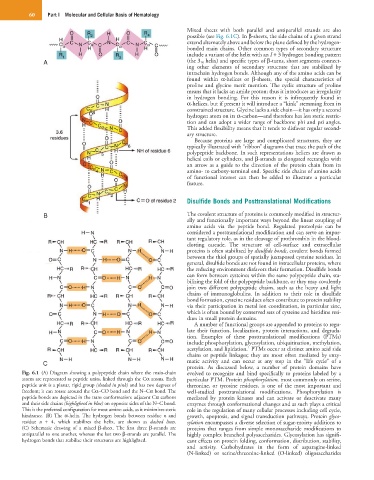
                                                              Mixed  sheets  with  both  parallel  and  antiparallel  strands  are  also
                                                              possible (see Fig. 6.1C). In β-sheets, the side chains of a given strand
                                                              extend alternately above and below the plane defined by the hydrogen-
                                                              bonded main chains. Other common types of secondary structure
                                                              include a variant of the helix with an I + 3 hydrogen bonding pattern
               A                                              (the 3 10 helix) and specific types of β-turns, short segments connect-
                                                              ing  other  elements  of  secondary  structure  that  are  stabilized  by
                                                              intrachain hydrogen bonds. Although any of the amino acids can be
                                                              found  within  α-helices  or  β-sheets,  the  special  characteristics  of
                                                              proline and glycine merit mention. The cyclic structure of proline
                                                              means that it lacks an amide proton; thus it introduces an irregularity
                                                              in  hydrogen  bonding.  For  this  reason  it  is  infrequently  found  in
                                                              α-helices, but if present it will introduce a “kink” stemming from its
                                                              constrained structure. Glycine lacks a side chain—it has only a second
                                                              hydrogen atom on its α-carbon—and therefore has less steric restric-
                                                              tion and can adopt a wider range of backbone phi and psi angles.
                                                              This added flexibility means that it tends to disfavor regular second-
                                                              ary structure.
                                                                 Because  proteins  are  large  and  complicated  structures,  they  are
                                                              typically illustrated with “ribbon” diagrams that trace the path of the
                                                              polypeptide backbone. In such representations helices are drawn as
                                                              helical coils or cylinders, and β-strands as elongated rectangles with
                                                              an arrow as a guide to the direction of the protein chain from its
                                                              amino- to carboxy-terminal end. Specific side chains of amino acids
                                                              of  functional  interest  can  then  be  added  to  illustrate  a  particular
                                                              feature.

                                                              Disulfide Bonds and Posttranslational Modifications

               B                                              The covalent structure of proteins is commonly modified in structur-
                                                              ally and functionally important ways beyond the linear coupling of
                                                              amino  acids  via  the  peptide  bond.  Regulated  proteolysis  can  be
                                                              considered a posttranslational modification and can serve an impor-
                                                              tant regulatory role, as in the cleavage of prothrombin in the blood-
                                                              clotting  cascade.  The  structure  of  cell-surface  and  extracellular
                                                              proteins is often stabilized by disulfide bonds, covalent bonds formed
                                                              between the thiol groups of spatially juxtaposed cysteine residues. In
                                                              general, disulfide bonds are not found in intracellular proteins, where
                                                              the reducing environment disfavors their formation. Disulfide bonds
                                                              can form between cysteines within the same polypeptide chain, sta-
                                                              bilizing the fold of the polypeptide backbone, or they may covalently
                                                              join two different polypeptide chains, such as the heavy and light
                                                              chains  of  immunoglobulins.  In  addition  to  their  role  in  disulfide
                                                              bond formation, cysteine residues often contribute to protein stability
                                                              via their participation in metal ion coordination, in particular zinc,
                                                              which is often bound by conserved sets of cysteine and histidine resi-
                                                              dues in small protein domains.
                                                                 A number of functional groups are appended to proteins to regu-
                                                              late  their  function,  localization,  protein  interactions,  and  degrada-
                                                              tion.  Examples  of  these  posttranslational  modifications  (PTMs)
                                                              include phosphorylation, glycosylation, ubiquitination, methylation,
                                                                                  1
                                                              acetylation, and lipidation.  PTMs occur at distinct amino acid side
                                                              chains or peptide linkages; they are most often mediated by enzy-
               C                                              matic  activity  and  can  occur  at  any  step  in  the  “life  cycle”  of  a
                                                              protein.  As  discussed  below,  a  number  of  protein  domains  have
        Fig. 6.1  (A) Diagram showing a polypeptide chain where the main-chain   evolved to recognize and bind specifically to proteins labeled by a
        atoms are represented as peptide units, linked through the Cα atoms. Each   particular PTM. Protein phosphorylation, most commonly on serine,
        peptide unit is a planar, rigid group (shaded in pink) and has two degrees of   threonine,  or  tyrosine  residues,  is  one  of  the  most  important  and
        freedom; it can rotate around the Cα–CO bond and the N–Cα bond. The   well-studied  posttranslational  modifications.  Phosphorylation  is
        peptide bonds are depicted in the trans conformation: adjacent Cα carbons   mediated  by  protein  kinases  and  can  activate  or  deactivate  many
        and their side chains (highlighted in blue) on opposite sides of the N–C bond.   enzymes through conformational changes and as such plays a critical
        This is the preferred configuration for most amino acids, as it minimizes steric   role in the regulation of many cellular processes including cell cycle,
        hindrance.  (B) The  α-helix. The  hydrogen  bonds  between  residue  n  and   growth, apoptosis, and signal transduction pathways. Protein glyco-
        residue  n  +  4,  which  stabilizes  the  helix,  are  shown  as  dashed  lines.   sylation encompasses a diverse selection of sugar-moiety additions to
        (C)  Schematic  drawing  of  a  mixed  β-sheet.  The  first  three  β-strands  are   proteins that ranges from simple monosaccharide modifications to
        antiparallel to one another, whereas the last two β-strands are parallel. The   highly complex branched polysaccharides. Glycosylation has signifi-
        hydrogen bonds that stabilize their structures are highlighted.   cant effects on protein folding, conformation, distribution, stability,
                                                              and  activity.  Carbohydrates  in  the  form  of  asparagine-linked
                                                              (N-linked)  or  serine/threonine-linked  (O-linked)  oligosaccharides

